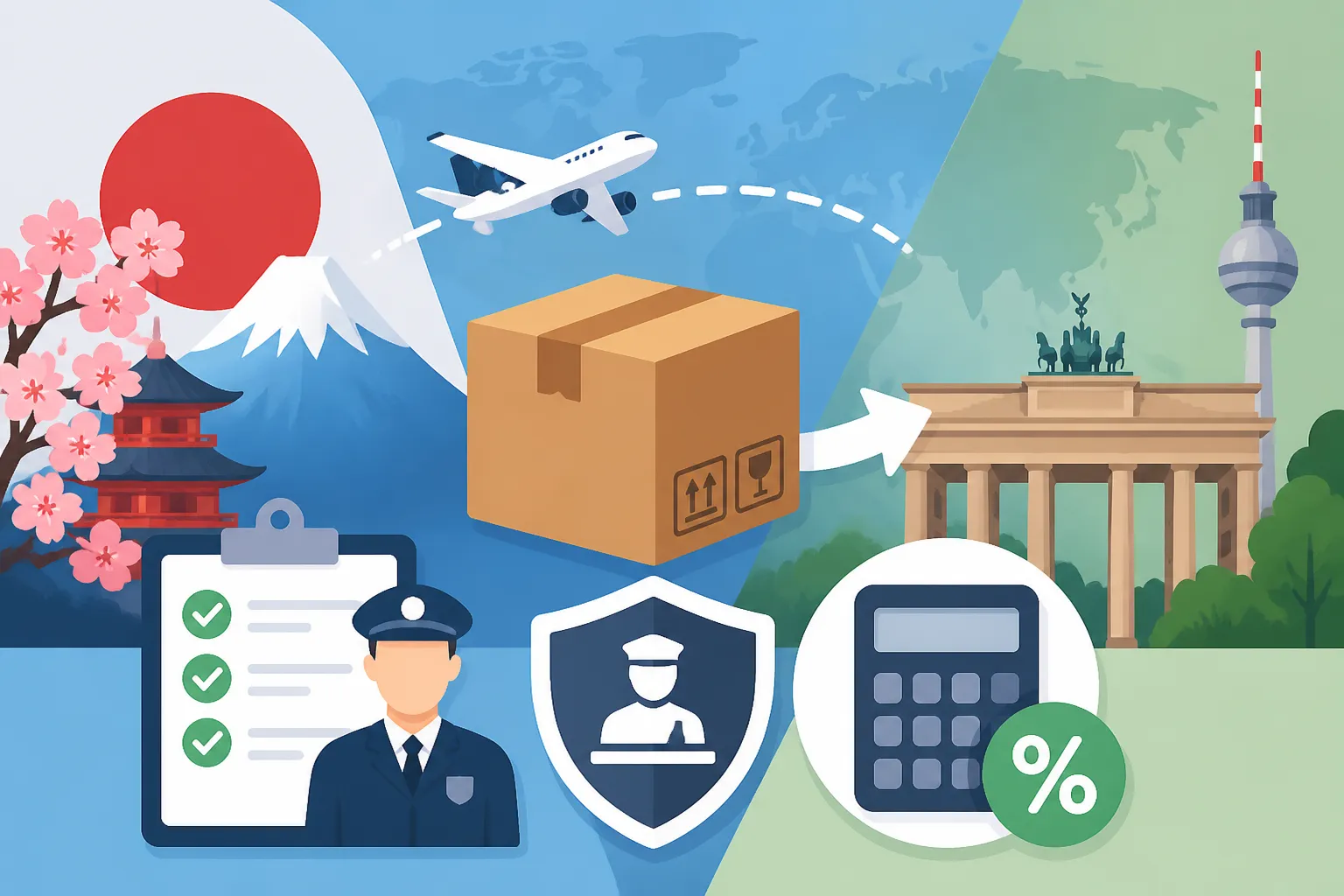
Buying from Japan to Germany: Customs and VAT
You have spotted a rare record, a secondhand designer bag or a box of figures on a Japanese site, and you live in Germany. Then the doubts start: will the parcel get stuck at the Zollamt, how much import VAT will you owe, and is there really a new customs duty on cheap parcels? This guide explains exactly which charges apply when you buy from Japan and how to plan for them.
Disclosure: This post may contain affiliate links. We may earn a commission at no extra cost to you if you make a purchase through these links. Read full disclosure.
How Buying From Japan Works for Shoppers in Germany
Most Japanese online shops, auction sites and flea-market apps are built for domestic customers. Many do not ship abroad, some refuse foreign credit cards, and almost all communicate only in Japanese. That is why most people in Germany who buy regularly from Japan use a proxy or forwarding service as a middleman.
Proxy and Forwarding Services in Plain Terms
A proxy service buys the item for you. You send a link or search through its interface, the service pays the seller, receives the goods at its warehouse in Japan and then ships them to your address in Germany. Buyee and ZenMarket are the services most European buyers come across first, because they connect directly to the big Japanese auction and flea-market platforms where secondhand and collector items are listed.
A forwarding service only provides a Japanese delivery address. You buy from the shop yourself, the shop ships to the forwarder, and the forwarder sends the parcel on to you. That model suits shops that accept foreign payment cards but will not ship outside Japan. The differences are covered in depth in Proxy Service vs Forwarding Service: What’s the Difference?.
| Feature | Proxy service | Forwarding service |
|---|---|---|
| Places the order with the Japanese seller | Yes, on your behalf | No, you order yourself |
| Works with auctions and flea-market apps | Yes, this is the main use | Rarely |
| Handles Japanese communication | Yes | No |
| Fills in the customs declaration | Yes, based on your order data | Yes, based on the shop invoice and your input |
| Best suited to | Auction, flea-market and collector purchases | A single shop that refuses overseas delivery |
The Route of a Parcel From Japan to Germany
It helps to know every stage, because each one adds time and sometimes cost.
- You buy the item through your proxy account and pay the item price plus any service charges.
- The seller ships the item within Japan to the proxy’s warehouse.
- The item is checked in and stored, and you can wait for other purchases to arrive so they can travel together.
- You request international shipping, pick a carrier and pay for postage.
- The proxy packs the parcel and completes the customs declaration listing contents and values.
- The parcel is exported from Japan and transported to the EU.
- On arrival, German customs processes the parcel. Import VAT and, where it applies, customs duty are assessed.
- The carrier delivers the parcel and collects any charges owed, or you are asked to deal with customs directly if paperwork is missing.
Stage 3 is where you can save the most. A single consolidated box usually costs less to ship per item than several small ones, and it means one customs process rather than many. See How Package Consolidation Saves You Money for the details.
Picking a Carrier
Your proxy will usually offer a choice between Japan Post services, such as EMS, airmail or surface mail, and private express couriers. Postal parcels are handed to the German postal network for the final leg. Couriers clear the parcel through customs themselves and charge you for anything owed, often with a handling charge of their own.
| Option | Speed | Tracking | How German charges usually reach you |
|---|---|---|---|
| EMS (Japan Post) | Fast for postal mail | Good | Collected by the postal carrier on delivery |
| Airmail or small packet | Moderate | Basic to good | Collected by the postal carrier on delivery |
| Surface or sea mail | Slow | Limited | Collected by the postal carrier on delivery |
| Private express courier | Fastest | Excellent | Invoiced by the courier, which acts as your customs agent |
For a comparison of speed and reliability, read Japan Shipping Methods Explained: EMS, DHL, FedEx, and Surface.
Japanese Tax Versus German Import Charges
The single most important thing to understand is that two countries are involved and only one of them taxes your purchase. Japan does not tax goods it exports, and Germany taxes goods it imports. Once that clicks, most of the confusion disappears.
No Japanese Consumption Tax on Exported Goods
Japan charges a consumption tax of 10% on most domestic sales. When a Japanese seller exports goods abroad, it does not charge Japanese consumption tax, because the goods are leaving the country. For goods mailed abroad worth 200,000 yen or less, the acceptance record from Japan Post is the proof that the goods were exported.
How that appears on your invoice depends on who is selling to whom. Marketplace prices are normally shown including tax, because they are aimed at Japanese buyers, and a private seller on a flea-market app is technically selling to your proxy in Japan. So you should not assume every price on your invoice is tax-free. The different cases are explained in Do You Pay Japanese Consumption Tax When Buying via Proxy?.
There is no Japanese import duty and no Japanese customs charge on your parcel. Japanese customs is concerned with goods entering Japan. Anything you read about Japanese import duty as part of your cost of buying from Japan is describing the wrong direction of travel.
Germany Charges the Duties and Taxes
Duties and taxes are charged by the buyer’s own country. For you, that is Germany, applying EU customs rules. The proxy, the seller and Japan Post simply pass on information through the customs declaration; German customs decides what is owed.
That is why the declaration matters so much. It should describe each item clearly, give the quantity and state the value actually paid. A vague label such as “gift” or “goods” on a purchase invites questions and delays. Customs Declarations for Japan Proxy Orders Explained shows what a clean declaration looks like.
Import VAT: No More Small-Parcel Exemption
Since 1 July 2021, VAT applies to every good imported into the EU. The old exemption that let parcels worth up to 22 euros arrive without VAT is gone. Even a single trading card or a paperback manga from Japan is subject to import VAT.
Germany’s standard import VAT rate is 19%. It is applied to the taxable value of the import, which generally includes the price of the goods and the cost of getting them to the EU, plus any customs duty. Some product categories are taxed differently, so if you buy books or similar items regularly, check the treatment for that category on the German customs website.
There are two main ways the VAT gets paid:
- Collected at checkout. Some sellers and services selling into the EU collect the import VAT when you pay, through the EU’s import one-stop-shop arrangement. The parcel should then clear without a further VAT demand at your door.
- Collected on arrival. If VAT was not collected at checkout, the carrier pays it on your behalf at import and collects it from you on delivery, usually with its own handling charge.
Ask your proxy which method applies to your shipment before you pay for postage, so you know whether to expect a bill at the door.
Customs Duty: The New 3-Euro Charge on Small Consignments
This is the part that older guides get wrong. For a long time, consignments with a value below 150 euros were exempt from customs duty in the EU. Many articles still describe that exemption as if it were the current rule. It is not.
From 1 July 2026, a temporary customs duty of 3 euros per item applies to consignments worth up to 150 euros. It replaces the former duty exemption below 150 euros and is set to run until 1 July 2028. So your small parcel from Japan now carries both import VAT and this flat customs duty.
| Consignment | Import VAT | Customs duty |
|---|---|---|
| Up to 150 euros | Yes, every import since 1 July 2021, at the standard 19% for most goods | Temporary flat duty of 3 euros per item, from 1 July 2026 until 1 July 2028 |
| Above 150 euros | Yes, at the standard 19% for most goods | Normal customs duty according to the type of goods |
| Former rules, for comparison | No VAT below 22 euros, before 1 July 2021 | No duty below 150 euros, before 1 July 2026 |
Because the flat duty is charged per item, a consignment containing several items can owe it more than once. That changes how you should think about consolidation, which I come back to below.
For consignments above 150 euros, normal customs duty applies, and the rate depends on how the goods are classified. I am not going to quote rates here, because they vary widely by product, and guessing would do you more harm than good. The German customs authority publishes the tariff, and your carrier will show you the exact amount assessed.
Planning the Real Cost of a Japan Order
The rules above mean that almost every parcel from Japan now arrives with something to pay. The trick is to know every layer in advance so nothing comes as a shock at the door.
All the Layers on One Page
| Cost layer | Paid to | When | Notes |
|---|---|---|---|
| Item price | Seller, via your proxy | At purchase | Japanese prices are usually shown tax-included |
| Domestic shipping in Japan | Seller or proxy | At purchase | Not always included in the listing |
| Proxy service charges | Proxy | At purchase and at shipping | Check the provider’s current fee page |
| International shipping | Proxy, passed to the carrier | When you request shipping | Weight, size and carrier decide it |
| Optional extras | Proxy | At shipping | Insurance, extra packing, photos, consolidation |
| Import VAT | German customs, via the carrier or at checkout | At checkout or on delivery | Standard 19% for most goods |
| Customs duty | German customs, via the carrier | On delivery | 3 euros per item up to 150 euros; normal duty above |
| Carrier handling charge | Carrier | On delivery | Common when the carrier advances VAT and duty |
| Currency conversion | Card issuer or payment provider | At each payment | Depends on how you pay |
For help with the proxy’s own fee structure, see Understanding Japan Proxy Shopping Fees and How to Calculate the Total Cost of a Japan Proxy Order.
A Worked Example With the Current Rules
Let me walk through a typical order the way I plan my own now. Say I have bought three different secondhand items: a vintage camera strap, a CD and a small figure. Together, with shipping, their value stays under 150 euros.
- Item prices and proxy charges. I add up what I paid through the proxy, including any domestic shipping in Japan.
- International shipping. I wait until all three items reach the warehouse and ask for a consolidated quote.
- Customs duty. The consignment is worth up to 150 euros, so the temporary flat duty of 3 euros applies to each item in it. With three separate items on the declaration, I budget for that duty three times rather than once.
- Import VAT. I expect 19% VAT on the value of the goods including the transport cost and the duty, unless it was collected at checkout.
- Handling. If the carrier advances the VAT and duty, I expect a handling charge from the carrier on top and check its current terms.
- Delivery. I pay what is due on delivery or online, and the parcel is released.
Under the old rules, the same box would have had VAT but no customs duty at all. That is the exact difference that catches people out today.
Now imagine I had bought one expensive item instead, such as a vintage watch worth more than 150 euros. The flat 3-euro duty no longer applies to that consignment. Instead, normal customs duty for watches applies, and import VAT at 19% is calculated on top. For goods like this, I check the tariff classification on the German customs site before I bid, so the final price does not surprise me.
Questions to Ask Your Proxy Before Shipping to Germany
Proxy services differ in how they handle EU shipments, and the answers decide what you will pay at the door. Before I request shipping from Buyee, ZenMarket or any other service, I look for answers to these questions in its help pages or ask its support team:
- Is import VAT collected at checkout for consignments up to 150 euros, or will the carrier collect it on delivery?
- How are the items in my box listed on the customs declaration, and can I check the descriptions before the parcel leaves?
- Which carriers are currently available for German addresses, and which of them charge a handling fee for advancing VAT and duty?
- If a parcel is refused or returned, what happens to it, and who pays the return postage?
Getting these answers once saves a lot of frustration later, and it also tells you a great deal about how seriously a service takes EU customs.
Practical Ways to Keep Costs Reasonable
There is no legal way to avoid VAT or duty, but there are plenty of ways to stop them from spiralling.
- Think about what goes in each box. Consolidation still saves on shipping, but because the small-consignment duty is charged per item, piling lots of cheap items into one box under 150 euros adds a flat charge for each. Weigh shipping savings against that.
- Ask about VAT collection at checkout. If your proxy or seller can collect VAT up front, clearance is usually faster and you avoid some handling at the door.
- Declare accurately. A precise description and the true value help the parcel clear quickly. Undervaluing or labelling a purchase as a gift is a false declaration and can lead to fines and seized goods.
- Watch for restricted goods. Food, cosmetics, batteries, knives and plant or animal products can need extra checks. Prohibited and Restricted Items When Importing from Japan covers the common problem categories.
- Mind the exchange rate. Paying with a provider that offers a fair rate makes a real difference across several orders.
How to Avoid High Customs Fees on Japan Orders has more legitimate tips, but none of them involves pretending a purchase is something it is not.
When Your Parcel Is Held by German Customs
Most parcels clear without drama, especially when the declaration is clean. But every buyer in Germany seems to have a story about a box that ended up at the customs office instead of on the doorstep.
Why the Zollamt Might Keep Your Parcel
From what I and friends have experienced, these are the usual reasons:
- Missing or unclear documents. If the declaration or invoice does not make the contents and value clear, customs may ask you to prove what you paid.
- Value doubts. If an obviously valuable item is declared at a very low value, customs will want evidence.
- Restricted items. Certain goods require checks or permits, or cannot be imported at all.
- Carrier could not clear it. Sometimes the carrier passes the parcel to the customs office and sends you a notice to collect it in person.
What to Do Step by Step
- Read the notice carefully. It will say whether you need to pay online, provide documents, or collect the parcel from a customs office.
- Gather proof of what you paid: your proxy order history, the item invoice, and the shipping invoice.
- If you must collect in person, bring your ID, the notice and your payment proof. Open the parcel there if asked, so officers can see the contents.
- Pay the import VAT and duty assessed. The notice tells you which payment methods are accepted.
- If you think the assessment is wrong, ask how to challenge it on the spot or in writing.
- If your parcel was returned to Japan, contact your proxy’s support team right away about reshipping options.
For a complete troubleshooting path, read What to Do If Your Japan Package Is Stuck in Customs.
Watch Out for Fake Customs Messages
As more parcels from outside the EU now carry charges, fake text messages and emails asking for “customs fees” have multiplied. A real notice refers to an actual tracking number from your shipment and can be checked by logging in to the carrier’s own website, not through a link in an unexpected SMS. If something looks off, it probably is.
Is It Still Worth Buying From Japan?
For many items, absolutely. Secondhand fashion, retro games, records, art books, hobby supplies and collectibles that never get a European release are still easier and often cheaper to find in Japan. The difference is that you now need to budget honestly: every import carries VAT, and every small consignment now carries a customs duty too.
If you are new to all of this, start with How to Buy Anything from Japan: The Complete Proxy Shopping Guide, and if you shop elsewhere in Europe too, Buying from Japan to Europe: Customs and VAT gives the wider EU picture. Plan each box, keep your paperwork, and you will rarely be surprised at the door.
Disclaimer
This article is for general informational purposes only and does not constitute professional advice. Laws, prices and regulations vary by location and change over time. Consult a qualified professional for guidance on your specific situation.