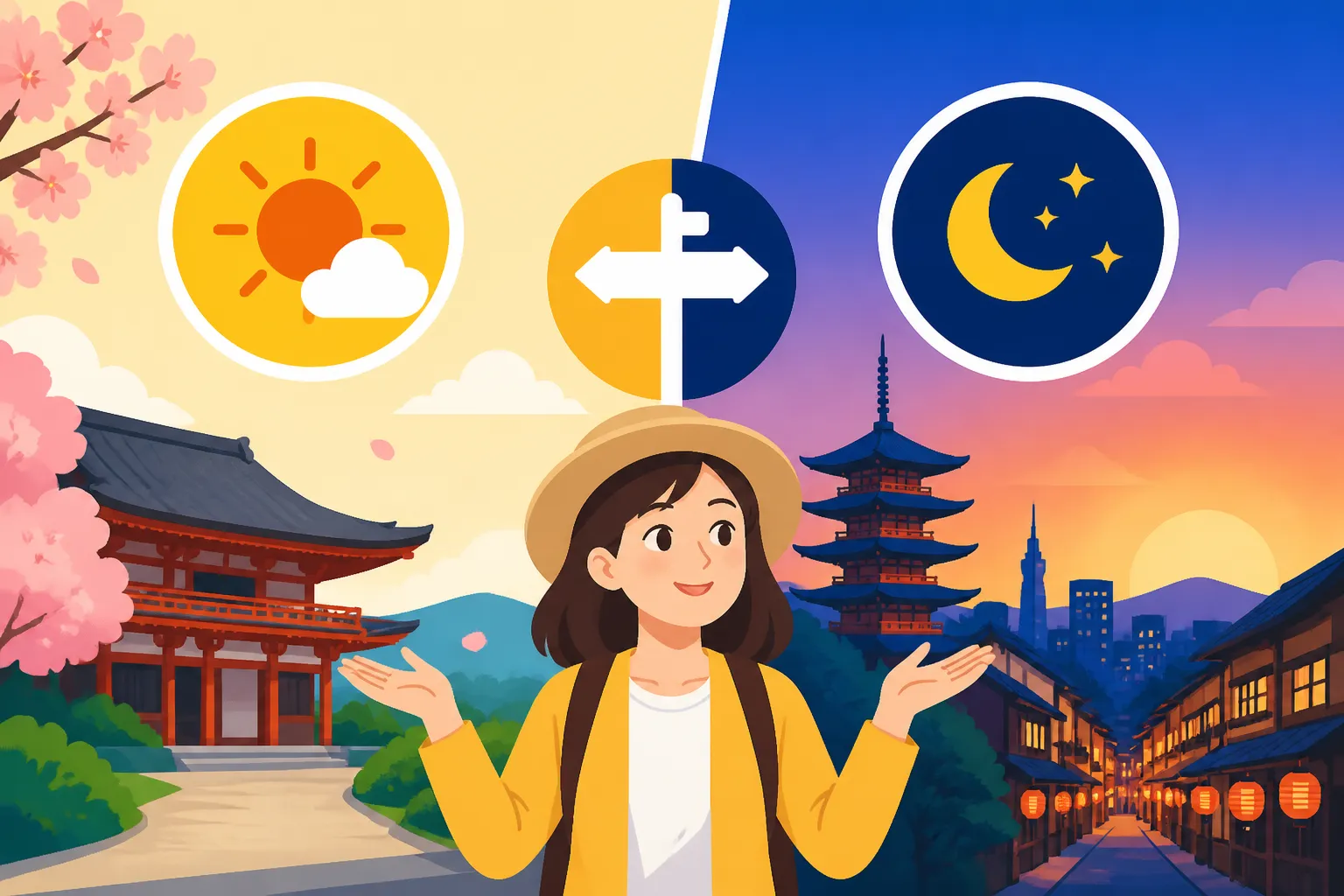
Half-Day vs Full-Day Tours in Japan: Which Format Fits Which City
Here is the problem. You have one free day in Kyoto, or a single Saturday between work weeks in Tokyo. The tour listings all look appealing, and you can’t tell whether a four-hour walk or a ten-hour coach trip will make the day memorable or leave you exhausted. This guide matches each tour format to the cities and travelers it suits, so you can book with confidence.
Disclosure: This post may contain affiliate links. We may earn a commission at no extra cost to you if you make a purchase through these links. Read full disclosure.
Half-Day vs Full-Day Tours in Japan: What Actually Changes
Over my years in Japan I have booked many guided tours: for myself, for visiting parents, and for friends who arrived jet-lagged and wanted their week planned for them. I have also made bad choices. The worst was putting my mother on a full-day coach tour to Mt. Fuji the morning after a long-haul flight. She slept through the scenery and still talks about the “very nice bus seat.” The second worst was booking a rushed half-day temple walk in Kyoto for a friend who wanted to linger. She spent the whole morning looking back at things the group had already passed.
So choosing between half-day and full-day tours in Japan isn’t really about value. It’s about fit. The city, the season, the travel time to the main sights and your energy levels all change the answer. Here is what each format involves before we go city by city.
How Each Format Is Built
A half-day tour usually takes up a morning or an afternoon. In big cities it is often a walking tour, sometimes combined with public transport or a short private vehicle ride. It typically covers one neighborhood, one theme or a tight cluster of sights. Examples include an early-morning Fushimi Inari walk before the crowds arrive, an Asakusa and Ueno heritage stroll, or an evening food crawl through Osaka’s Shinsekai and Dotonbori. Groups tend to be small, and the guide can adjust the pace as you go.
A full-day tour runs from early morning into the evening. It nearly always relies on a coach, minivan or a carefully timed set of train connections, because its main purpose is to get you somewhere that is awkward to reach alone. That might be the Fuji Five Lakes, Hakone’s ropeway and lake cruise, Nikko’s shrines, Shirakawa-go in winter, or the flower fields of Biei and Furano. You’ll often visit three to five stops, eat lunch at a set location, and spend a good part of the day on the road.
Neither format is the leisurely one. A good half-day tour is short and focused, and you have the rest of the day free. A full-day tour gives you more total sightseeing, but its pace is often relentless. You get fixed time slots at every stop, strict coach departure times, and a lot of walking on uneven paths and stone steps. It can be physically demanding, especially in summer humidity or winter snow.
The Real Trade-Off: Depth, Energy, and Flexibility
Over the years I’ve come to judge every tour on three things.
The first is depth. A half-day tour covers fewer places but often more thoroughly. A guide spending three hours in Gion can explain the machiya architecture, point out the details of the teahouses, and talk about geiko etiquette without rushing. A full-day tour covers more ground with less detail at each stop, and that is fine when the scenery is the attraction.
The second is energy. Japan wears visitors out more than they expect. Station transfers, staircases, crowds and the heat of July and August all take their toll. A half-day tour leaves you with energy for the afternoon. A full-day tour uses up most of it, and many people are ready for a convenience store dinner and bed by the time the coach gets back.
The third is flexibility. With a half-day tour, you plan the rest of the day yourself. You can wander, nap, shop or add a second half-day experience. A full-day tour decides your whole day for you. If the weather turns, you may spend hours at a viewpoint where the clouds never clear.
| Factor | Half-Day Tour | Full-Day Tour |
|---|---|---|
| Typical span | A morning or an afternoon | Early morning to evening |
| Usual transport | Walking, local trains, short vehicle legs | Coach, minivan or timed train connections |
| Number of stops | One area or theme | Several spread-out destinations |
| Pace | Short and focused, easier to recover from | Long and demanding, fixed stop times |
| Physical load | Light to moderate | Moderate to heavy, plenty of walking plus long rides |
| Best for | City neighborhoods, food, temples, first days after arrival | Remote scenery, places hard to reach without a car |
| Flexibility afterward | Rest of the day is yours | Little to none |
| Weather risk | Easier to rebook or reschedule around | One bad-weather day can ruin the main view |
Which Tour Format Fits Which City
This is the core of the decision. Japan’s cities differ a lot in layout and in how far their main attractions are from the center, and that should guide your choice more than anything else.
Tokyo: Half-Days in the City, Full-Days Outside It
Tokyo is a group of neighborhoods connected by an excellent rail network. Asakusa, Yanaka, Shibuya, Harajuku, Shinjuku’s Golden Gai and the Tsukiji outer market each suit a separate half-day tour. Combining them into one long guided day mostly means following a guide through train transfers that you could easily manage yourself.
Half-day formats that work well in Tokyo include morning market and food walks, heritage strolls through the old Shitamachi districts, and evening izakaya tours in places like Yurakucho or Shimbashi, where the alleys under the train tracks are hard to explore without a local. If an evening food tour interests you, Food and Izakaya Tours in Japan: Are Guided Night Tours Worth the Price? looks at whether those tours are worth paying for.
Full-day tours make sense in Tokyo when you are going out of the city. Mt. Fuji and the Fuji Five Lakes, Hakone, Nikko and Kamakura are the classic options, and a coach tour saves you from planning several transfers. If you’re deciding which of those to book, Tokyo Day Trips: Best Klook Tours for Mt. Fuji, Hakone, Nikko, and Kamakura (Ranked by Value) compares them, and Mt. Fuji Day Tours vs Independent Travel: Cost and Time Comparison covers whether to join a coach or go independently.
Kamakura is the odd one out. It is close enough for a half-day trip, and I prefer it that way: a morning at the Great Buddha and Hasedera, then a slow afternoon on the coast. Nara, Kamakura, and Nikko: Guided Tour vs DIY Breakdown explains why Kamakura and Nikko call for such different approaches.
Kyoto: The Strongest Case for Half-Day Tours
If you remember one thing from this guide, make it this: Kyoto suits half-day tours best. The city’s sights are spread out and crowded, and many are at their best early in the morning or late in the afternoon. A full-day Kyoto tour that tries to fit in Kinkakuji, Fushimi Inari, Kiyomizu-dera and Arashiyama spends much of the day in traffic and much of the rest in crowds.
Two half-day tours on different days, or one in the morning and one in the afternoon with a long lunch in between, give you a far better experience. Book an early Fushimi Inari tour while the torii gates are still quiet, then a late-afternoon Gion walk as the lanterns come on. Arashiyama deserves its own half-day, ideally at dawn. Kyoto Guided Tours: Which Temples Actually Benefit From a Guide helps you decide which Kyoto sights benefit from a guide and which are better explored on your own.
Full-day tours from Kyoto make sense when they leave Kyoto, for example to Amanohashidate, Miho Museum or Ise. Inside the city, I would choose half-days almost every time.
Osaka and Nara: Evenings in Osaka, a Half-Day or Full Day for Nara
Osaka is at its best after dark. The neon of Dotonbori, the old-fashioned stalls of Shinsekai, and the takoyaki and kushikatsu counters around Ura-Namba all suit a short evening food tour. A full day of guided sightseeing in Osaka itself is rarely worth it. Osaka Castle and Umeda Sky Building are easy to visit alone.
Nara is the exception. It’s close enough to Osaka and Kyoto for a half-day trip covering the deer park, Todaiji and Kasuga Taisha. If you want to add Horyuji, or Fushimi Inari on the way back, a full-day tour that links Nara and Kyoto starts to make sense. Choose based on your energy. Nara involves a lot of walking on gravel paths, and the deer are less gentle than the photos suggest.
Hiroshima and Miyajima: Full-Day Territory
Hiroshima is where full-day tours come into their own. Most visitors start from Osaka or Kyoto, and the trip involves a Shinkansen ride, a city tour, a tram or bus transfer, a ferry to Miyajima, and the return journey. Arranging all of that yourself is possible, but a well-planned full-day tour takes care of the timing and puts the Peace Memorial Park and Itsukushima Shrine in the right order.
Be realistic about how demanding it is. The Peace Memorial Museum is emotionally heavy, and Miyajima adds stairs and crowds. I’ve seen travelers arrive back in Osaka completely drained, and that is normal. Hiroshima and Miyajima Day Tours From Osaka or Kyoto compares the routes and departure points in detail.
Hokkaido, Takayama and the Alps: Full-Days Because of Distance
In rural and mountain regions, the deciding factor is distance. The flower fields of Furano and Biei, Shiretoko’s coastline, Shirakawa-go’s thatched villages and the alpine scenery around Kamikochi are far apart and poorly served by public transport, especially in winter. A full-day tour is often the practical choice if you aren’t driving.
Hokkaido Tours: Furano, Biei, and Shiretoko Access Without Driving and Shirakawa-go and Takayama Tours: Winter Access Without a Car both cover these regions. In short: in snow country, let someone else handle the roads.
Takayama’s old town is the exception. It’s compact and works well as a half-day walking tour, especially on market mornings.
| City or Region | Best Format | Why |
|---|---|---|
| Tokyo, central neighborhoods | Half-day | Compact districts, easy rail links, strong food and heritage walks |
| Tokyo, Fuji, Hakone, Nikko | Full-day | Long distances and multiple transfers outside the city |
| Kamakura | Half-day | Close to Tokyo, best done slowly |
| Kyoto | Half-day | Crowds, spread-out sights, early and late light |
| Osaka | Half-day, evening | Food and nightlife suit short evening tours |
| Nara | Half-day or full-day | Half-day for the park, full-day if combined with Kyoto |
| Hiroshima and Miyajima | Full-day | Shinkansen, ferry and several sites in one trip |
| Hokkaido countryside | Full-day | Long drives, limited public transport |
| Shirakawa-go and the Alps | Full-day | Mountain roads, winter access |
| Takayama old town | Half-day | Compact and walkable |
How to Book the Right Tour on Klook Step by Step
Once you know which format suits the city, the next step is finding a tour that matches. Klook is my default for this in Japan. Its biggest advantage for foreign visitors is the English-language interface with half-day and full-day options listed side by side for the same destination, so you can compare them without switching between several local booking sites in Japanese. Klook also covers the experiences you might add around a half-day tour, such as attraction tickets, airport transfers and rail passes, so a whole trip can be organized in one app.
Reading a Listing Before You Commit
Every tour listing has details that tell you whether it suits you. Here’s how I check one before booking.
- Find the actual time on the ground. A “full-day” Fuji tour may involve many hours of driving, so count how much time you get at each stop compared with time on the coach.
- Check the meeting point and its distance from your hotel. An early start from Shinjuku is far easier if you’re staying in Shinjuku rather than across Tokyo.
- Look for language and group-size details. A small English-speaking group feels very different from a large bilingual coach.
- Read what’s included. Lunch, entry tickets, ropeway fares and ferry crossings may or may not be covered, and that changes the true cost.
- Check the walking load. Look for mentions of stairs, hiking or uneven ground, especially if you’re traveling with children or older relatives.
- Read the cancellation terms on the listing itself. They vary by operator, so check them before you pay. Cancellation Policies on Japan Tours: What You Get Back and When explains how refunds usually work.
- Read recent reviews that mention pace. Reviewers are usually frank about whether a day felt rushed or relaxed.
- Look at the weather options. For Fuji and alpine tours, check how the operator handles bad visibility or typhoon disruption.
If you’re comparing Klook with other platforms, Klook vs KKday for Japan: Coverage, Price, and Cancellation Compared goes through the differences.
Building a Multi-Day Itinerary Around Both Formats
The trips I’ve planned that worked best used both formats. A sample week follows this pattern.
- On arrival day, book nothing guided. Rest, get an IC card and find dinner.
- On the first full day, take a half-day Tokyo walk in the morning and leave the afternoon free.
- On the second day, take a full-day Fuji or Hakone coach tour, then have an easy evening.
- On the third day, travel to Kyoto by Shinkansen and take a half-day Gion walk in the late afternoon.
- On the fourth day, do an early half-day at Fushimi Inari and spend the afternoon exploring on your own.
- On the fifth day, take a full-day Hiroshima and Miyajima tour from Kyoto.
- On the sixth day, do a half-day in Nara, then an evening food tour in Osaka.
Alternating like this stops you from running out of energy. Never schedule two full-day tours back to back unless your group is young and very fit. To keep travel days lighter, send your suitcases ahead with Luggage Forwarding (Takkyubin): How to Travel Hands-Free so you’re not dragging bags through stations on a tour morning.
When it comes to paying, Klook’s seasonal promotions and app credits can lower the cost of a multi-tour trip. Klook Credits, Coupons, and Seasonal Sales: Timing Your Japan Bookings covers when to look for them. Current prices change by season, so check the Klook listing for each tour rather than relying on what you remember from a previous trip.
Real Scenarios: Matching Format to Traveler
Here are the situations I see most often, both from my own trips and from the friends and family I’ve helped plan.
First-Timers on a Short Trip
My friend Daniel came for six days and wanted to see everything. His first plan was four full-day tours in a row. I persuaded him to change two of them to half-days, one in Asakusa and one in Gion. On his last night he said those two were his favorite parts of the trip. They were the times he wasn’t watching the clock, and he had afternoons free to discover a tiny coffee shop in Yanaka and a back street off Hanamikoji.
For first-timers, my advice is to use full-day tours only for places you couldn’t otherwise reach in the time you have, and to see cities through half-day tours. Your first visit to Japan is overwhelming enough without making every day an endurance test.
Families, Seniors, and Mixed Groups
Traveling with children or older parents changes things a lot. A full-day coach tour may look easy because “you’re just sitting on a bus,” but the stops in between involve steep paths, temple steps and crowds that are tiring for small legs and stiff knees. Coach restrooms and fixed meal times also make it harder to deal with a toddler or someone with health needs.
For these groups, I recommend half-day tours as the default, plus one carefully chosen full-day tour with a light walking load. Private or small-group options on Klook can help here, because a private guide will stop when your child needs a break or your father needs a bench. For practical advice on planning for several generations or a larger party, Booking Japan Experiences for a Group: Family, Friends, and Company Trips goes into more detail.
Expats Using Weekends and Long Weekends
For those of us who live here, the calculation is different. We already know our neighborhoods, so a half-day tour of our own city appeals mainly for food, history or a hidden side we haven’t found. Where tours really help residents is getting out of the city on a Saturday without renting a car. That makes full-day tours especially useful: Shirakawa-go in the snow, Nikko in autumn colors, or Hokkaido’s flower fields in summer.
I treat a full-day Saturday tour as my sightseeing for the weekend and keep Sunday free to recover. On Golden Week or other long weekends, I combine a full-day tour out of the city with a relaxed half-day somewhere nearby the next day. If you’re making your own way home after an evening tour, check Last Train Times: Avoid Missing Your Connection before you go. Missing the last train after an Osaka food crawl is a mistake you’ll only make once.
The choice between half-day and full-day tours comes down to geography and how much energy you have. Book short tours where the city is compact and full days where distance makes them necessary. Then open Klook, filter by city and format, read each listing carefully, and plan a trip that leaves you excited for the next day instead of worn out by it.
Disclaimer
This article is for general informational purposes only and does not constitute professional advice. Laws, prices and regulations vary by location and change over time. Consult a qualified professional for guidance on your specific situation.





