Mt. Fuji Day Tours vs Independent Travel: Cost and Time Comparison
Picture it: you finally have a free Saturday, Mt. Fuji is on the bucket list, and you’re stuck between two choices. One is a ¥11,800 guided tour. The other is a bus ticket and a lot of guesswork. This guide sets out real October 2026 prices and travel times for both, so you can pick the day that fits your budget, your energy, and your nerves.
Disclosure: This post may contain affiliate links. We may earn a commission at no extra cost to you if you make a purchase through these links. Read full disclosure.
The Real Cost of a Mt. Fuji Day Trip From Tokyo
When I first tried to plan a Fuji day trip, I had about fifteen browser tabs open. Each one had a different bus company, train name or pass, and none of them told me the total. Price tables in Japan are usually honest, but they come in pieces. You have to put the trip together yourself. That’s what this section does, using figures read on the operators’ and tour sellers’ own pages on 18 October 2026.
Everything here is for the most popular Fuji day trip from Tokyo: Shinjuku to the Lake Kawaguchiko area and back in one day. This is the Fuji Five Lakes side, with the Chureito Pagoda, Oshino Hakkai and the lakeside parks. If you’re thinking about the Hakone side instead, see Hakone Day Trip: Onsen, Ropeway, and Mt. Fuji Views, because the costs and logistics there are quite different.
What a Guided Day Tour Costs
Two listings I read on VELTRA’s listing pages on 18 October 2026 give a good benchmark:
- “Mt. Fuji, Chureito Pagoda & Lake Kawaguchiko Day Tour” was ¥11,800 for the standard option, or ¥13,300 with a hoto lunch.
- “Mt. Fuji Day Tour from Ueno or Shinjuku with Oshino Hakkai & Kawaguchiko Park” was ¥11,600 for the standard option, or ¥13,100 with lunch.
Check-in for these tours is roughly 07:40 to 08:20 in Shinjuku. The price covers the coach both ways, a set route of stops, and a guide who handles the timing and the “where do we go now” questions. The lunch upgrade adds ¥1,500 on both listings. Hoto is the thick, miso-based noodle stew that Yamanashi is famous for, so it’s a nice local touch if you’d rather not hunt for a restaurant at noon.
Klook carries a wide range of similar Fuji itineraries from Shinjuku and other central Tokyo pickup points. Prices change by date, season and option, so open the Klook listing for your travel date to see what you’d pay.
What Going Independently Costs
Going on your own breaks the trip into transport plus local buses. As of October 2026, the two most common combinations work out like this:
- Highway bus both ways plus a lake bus day pass. The Busta Shinjuku to Kawaguchiko highway bus, run by Fujikyu and Keio, starts from ¥2,200 per adult each way, or ¥2,000 when paid online. Two online tickets come to ¥4,000. Add the ¥1,500 Fujikyu sightseeing bus 1 Day Pass and you’re at about ¥5,500.
- Fuji Excursion train both ways plus a lake bus day pass. The Fuji Excursion limited express from Shinjuku to Kawaguchiko is ¥4,200 one way. That’s a ¥2,580 fare plus a ¥1,620 limited express charge. The round trip is ¥8,400, and with the ¥1,500 day pass you’re at about ¥9,900.
Neither total includes entry fees, ropeways, cruises or food. On a tour, some of those may be bundled or pre-arranged, depending on the listing. Read the inclusions line carefully before you compare totals.
Side-by-Side Price Table
Here is the core comparison for one adult, using the October 2026 figures:
| Option | What you pay | Main transport | Lake area transport |
|---|---|---|---|
| Guided tour, Chureito Pagoda and Kawaguchiko | ¥11,800 standard, ¥13,300 with hoto lunch | Tour coach | Included in tour route |
| Guided tour, Oshino Hakkai and Kawaguchiko Park | ¥11,600 standard, ¥13,100 with lunch | Tour coach | Included in tour route |
| Independent, highway bus | About ¥5,500 | Bus ¥2,000 each way online | 1 Day Pass ¥1,500 |
| Independent, Fuji Excursion train | About ¥9,900 | Train ¥4,200 each way | 1 Day Pass ¥1,500 |
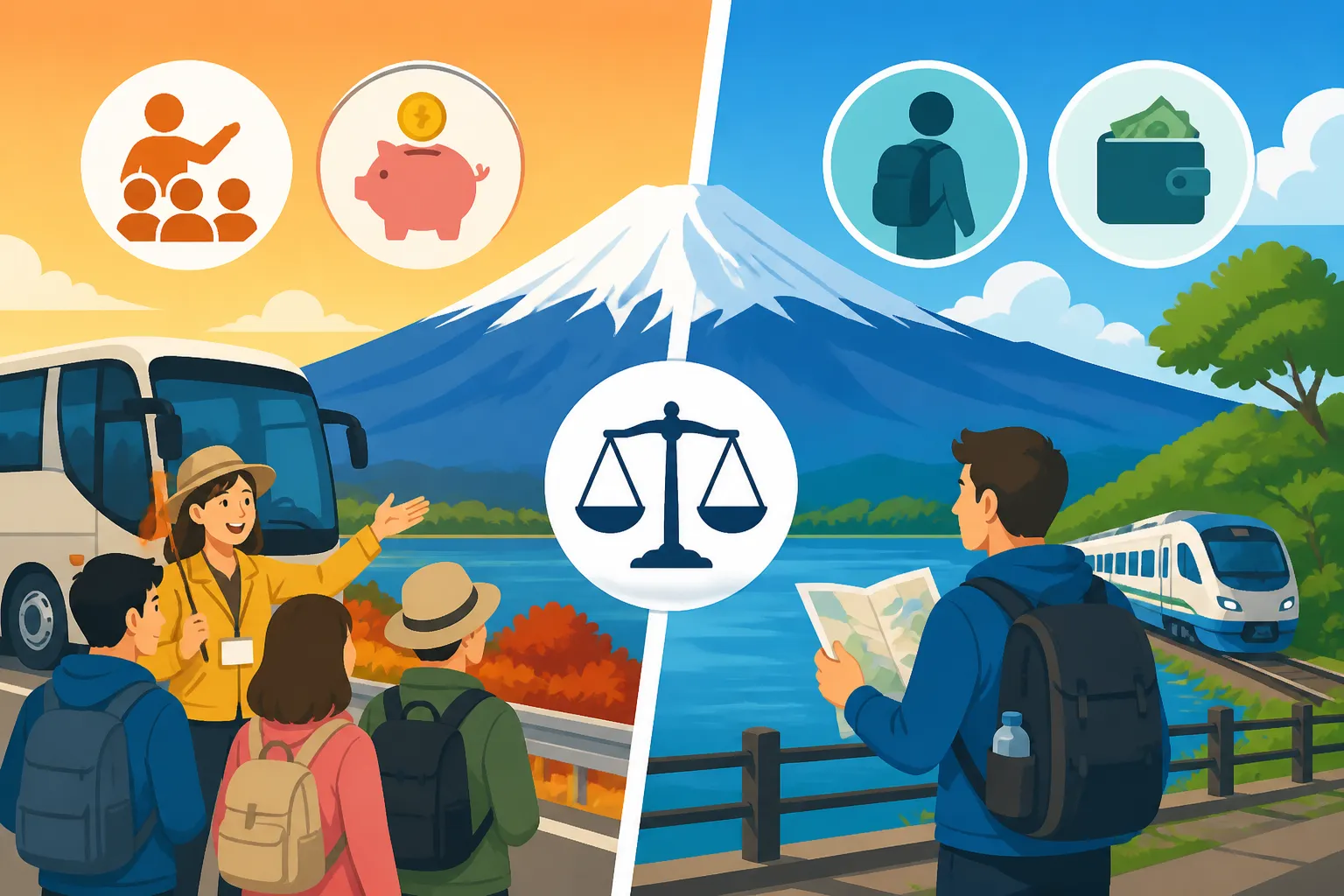
The gap between the cheapest tour standard option, ¥11,600, and the bus-based DIY trip, about ¥5,500, is ¥6,100. Against the Fuji Excursion route, the cheapest standard tour costs ¥1,700 more. Once you see it that way, the question changes. It isn’t “is a tour expensive?” It’s “is ¥1,700 to ¥6,100 worth the planning, the navigation and the guide?” The answer depends heavily on who you are and how your week has gone.
Time Comparison: Where Your Hours Actually Go
Money is easy to compare. Time is harder to compare. A day trip to Fuji is a long day whichever way you go. The real difference is how much of that day you spend making decisions, waiting at bus stops, or staring at timetables in a language you’re still learning.
The Tour Day Timeline
A guided tour day starts early and runs to a script. You check in around 07:40 to 08:20 in Shinjuku, depending on the listing. The coach takes the expressway out toward Yamanashi, and the guide narrates, hands out timing instructions, and tells you exactly when to be back on the bus at each stop.
The big advantage is that you never think about the next leg. You don’t need to know which line goes to the pagoda or whether the lake bus runs clockwise or anticlockwise. The coach is simply there. For someone who has spent the week deciphering city hall forms or a new job’s internal systems, that mental break counts for more than it might seem.
The trade-off is that the schedule isn’t yours. If the clouds part over Fuji just as the group is called back, you leave anyway. If one stop bores you and another is breathtaking, you still get the same time at each. Return times also depend on expressway traffic, and weekend and holiday traffic heading back into Tokyo can be slow.
The Independent Day Timeline
On your own, the core travel times as of October 2026 are:
- Highway bus Busta Shinjuku to Kawaguchiko: about 1 hour 45 minutes each way, so roughly 3 hours 30 minutes on the bus for the round trip.
- Fuji Excursion Shinjuku to Kawaguchiko: about 1 hour 54 minutes each way, so roughly 3 hours 48 minutes on the train for the round trip.
Once you arrive, you use the Fujikyu sightseeing buses, the Red, Green and Blue lines, to get between viewpoints, lakes and attractions. This is where the hours go. Buses come at intervals, popular stops fill up, and you may watch a full bus pull away. Walking between stops is possible but slow, especially uphill to viewpoints.
The upside is total freedom. You can stay at the Chureito Pagoda viewpoint for an hour if Fuji is clear, skip a museum you don’t care about, and grab a coffee by the lake whenever you like. You can also turn it into an overnight trip if the weather forecast changes. See Where to Stay Near Mt. Fuji: Kawaguchiko, Fujiyoshida, and Gotemba if that tempts you.
Comparing Time and Effort Side by Side
| Factor | Guided tour | Independent bus | Independent Fuji Excursion |
|---|---|---|---|
| Start point | Shinjuku check-in about 07:40 to 08:20 | Busta Shinjuku | Shinjuku Station |
| Seated travel each way | Coach, varies with traffic | About 1h45m | About 1h54m |
| Round trip seated travel | Varies with traffic | About 3h30m | About 3h48m |
| Planning effort | Very low | Medium to high | Medium |
| Waiting at local stops | Minimal | Depends on lake bus intervals | Depends on lake bus intervals |
| Flexibility on the day | Low | High | High, within your reserved train times |
| Exposure to road traffic | Yes | Yes | No, rail |
The Fuji Excursion is the only option with no road traffic risk on the main leg. On a holiday weekend that can be the difference between getting home for dinner and getting home exhausted. For more on why timing matters so much on this route, see Avoiding Crowds: Travel Timing Tips by Season.
Route-by-Route Breakdown for Independent Travelers
If you’re leaning toward going it alone, this section covers the practical detail of each route. These are the things I wish someone had told me before my first independent Fuji trip, when I stood confused in Busta Shinjuku at 7 a.m. without a seat reservation for a bus that was already full.
Highway Bus From Busta Shinjuku
The Busta Shinjuku to Kawaguchiko highway bus is the cheapest way there, and it’s genuinely comfortable. As of October 2026, it runs with reserved seats, is operated by Fujikyu and Keio, and costs from ¥2,200 per adult, or ¥2,000 when paid online. Child fares start from ¥1,100. The journey takes about 1 hour 45 minutes.
The steps for a smooth bus day:
- Book your outbound and return seats online in advance, which also gets you the ¥2,000 fare instead of ¥2,200.
- Save the booking confirmation to your phone and take a screenshot, in case your mobile data drops.
- Arrive at Busta Shinjuku early. It’s a big terminal on an upper floor above the station, and the signs, though bilingual, take a minute to follow.
- Find your departure gate on the boards and queue at the marked gate number.
- Show your booking to the driver or attendant and take your reserved seat.
- On arrival at Kawaguchiko Station, buy or activate your lake bus pass before heading to the first viewpoint.
Book the return seat when you book the outbound. Afternoon returns on clear-weather weekends can sell out, and being stranded is no fun. Large suitcases are a problem on any of these routes, so see Traveling With Large Luggage: Rules and Courtesies if you’re travelling on to somewhere else.
Fuji Excursion Limited Express
The Fuji Excursion is the comfortable, traffic-proof option. As of October 2026, it costs ¥4,200 one way from Shinjuku to Kawaguchiko, made up of a ¥2,580 fare and a ¥1,620 limited express charge, and takes about 1 hour 54 minutes. You don’t need to change trains, which is the main appeal over the Otsuki route.
It works especially well for people who get carsick on coaches, families with small children who need to walk around, and anyone travelling on a holiday weekend when the expressway backs up. Reserve seats for both directions, and give yourself time at Shinjuku Station, which is famously huge and easy to get lost in. If you’re unsure which seat class to pick, see Japan Train Seat Types: Reserved, Non-Reserved, Green.
The Fuji Excursion round trip, ¥8,400, plus a ¥1,500 lake bus day pass brings you to about ¥9,900. That’s only ¥1,700 less than the cheapest standard tour option. At that point, some travellers will find the tour’s convenience worth the small extra cost. Others prefer to keep their freedom and the rail reliability.
The Otsuki Transfer Route
The third option is to get yourself to Otsuki on JR lines and change there to the Fujikyu Railway. As of October 2026, the Fujikyu Railway fare from Otsuki to Kawaguchiko is ¥1,170 per adult, or ¥590 per child. If you board a Fujikyu limited express on that section rather than a local train, there’s a ¥400 surcharge. The JR leg from Tokyo to Otsuki is a separate fare, which you pay on top.
This route suits people who already ride the Chuo Line regularly, people who like scenic local trains, and people who want to break up the journey. The Fujikyu section climbs toward the mountains, and on a clear day the views from the window are part of the trip. The downside is the transfer at Otsuki, which needs a little confidence with station signage and timing.
If you’re paying by IC card, check before you travel how your card works across the JR and Fujikyu sections. See IC Cards Explained: Suica, PASMO, ICOCA (Where They Work) for a general overview.
Getting Around the Lakes Once You Arrive
This is the part that decides how good an independent day turns out. Arriving at Kawaguchiko Station is easy. Getting between the viewpoints, lakes and attractions efficiently is where the planning pays off. Tours handle all of this. On your own, you’ll be using the Fujikyu sightseeing buses.
Red, Green and Blue Line Passes
As of October 2026, the Fujikyu sightseeing buses around the lakes run on three colour-coded lines: Red, Green and Blue. The passes are:
- 1 Day Pass: ¥1,500 adult, ¥750 child.
- 2 Day Pass: ¥2,000.
Each line covers a different part of the area. Roughly speaking, they loop through different stretches of the lakeside and connect the main sightseeing spots. Before you go, look at the line map on the operator’s site and decide which line takes you to the places you care about most. Riding the wrong colour loop is an easy way to lose an afternoon.
A typical independent day might start with the pagoda viewpoint early, when the light and crowds are best, then move to the lakeshore and a ropeway or museum, and finish with a lakeside walk before the bus home. Plan this around bus frequency, not just distance on a map. For more on the best viewpoints and photo angles, see Kawaguchiko: Best Mt. Fuji Viewpoints and Photo Spots.
Two-Day Pass Versus the Kawaguchiko Sightseeing Pass
If you stay overnight, the passes get more interesting. As of October 2026, there are two main multi-day options:
| Pass | Price | What it covers |
|---|---|---|
| 1 Day Pass | ¥1,500 adult, ¥750 child | One day on the Red, Green and Blue line sightseeing buses |
| 2 Day Pass | ¥2,000 | Two days on the Red, Green and Blue line sightseeing buses |
| Kawaguchiko Shuyu Pass | ¥3,300 | Two days of sightseeing buses, a Panoramic Ropeway round trip, and a lake cruise |
The Kawaguchiko Shuyu Pass, written 河口湖周遊パス, is the bundle to look at if you plan to ride the ropeway and take the cruise anyway. It costs ¥1,300 more than the plain 2 Day Pass and adds both of those experiences.
A two-day independent trip using the highway bus both ways (¥4,000 online) and the Kawaguchiko Shuyu Pass (¥3,300) comes to about ¥7,300 in transport and those two attractions, before accommodation and food. That’s less than a single day on a guided tour. The catch is that you need to book and pay for a night’s stay, which can be expensive in peak seasons.
Making the Lake Buses Work for You
A few habits from my own trips make the lake buses much less stressful:
- Photograph the timetable at your first stop, because the next bus time decides your whole schedule.
- Note the last bus back to Kawaguchiko Station before you set off anywhere remote.
- Leave a comfortable buffer before your return highway bus or train. Missing it can mean a long wait or a costly last-minute fix.
- On busy days, start at the stop furthest from the station and work back, so you’re travelling against the crowd.
- Keep small change or a charged IC card handy for any section your pass doesn’t cover.
Overtourism has become a real issue around the Fuji area, especially at the most photographed spots. Bus queues are often long at peak times. For tips on visiting responsibly, see Overtourism in Japan: How to Visit Kyoto and Mt. Fuji Respectfully in 2027.
When a Klook Day Tour Wins
After a lot of trips out to the lakes, both solo and with visiting friends, I’ve come to a clear view. Independent travel saves money, but a well-chosen guided tour booked through Klook is often the better day overall, for a large share of people. Here’s when that holds true.
First-Timers on a Tight Schedule
If you’re visiting Japan for a week, or you’ve just moved here and haven’t learned the transport system yet, every hour is precious. Spending your Saturday morning working out which bus line goes where isn’t a good use of your only free day. A tour removes all of that. You turn up at the check-in point in Shinjuku, and the rest is taken care of.
Klook is especially handy here because you can compare several Fuji itineraries side by side in one app. You can see which ones stop at the Chureito Pagoda, which include Oshino Hakkai, which offer a lunch upgrade, and where the pickup points are. Recent reviews from other travellers tell you a lot about guide quality and how realistic the schedule is. That kind of real-world feedback is hard to get when you plan independently.
The cost difference of ¥1,700 to ¥6,100 between the VELTRA standard tours and the DIY options looks much smaller when you set it against your time. If you’re only in Japan for a few days, one wasted afternoon is worth far more than that. If you’re weighing Fuji against other day trips from the capital, see Tokyo Day Trips: Best Klook Tours for Mt. Fuji, Hakone, Nikko, and Kamakura (Ranked by Value).
Families, Groups and Low-Energy Days
Children change the calculation completely. Bus queues, missed connections and long walks between stops wear little legs out fast. A coach with a reserved seat, a set lunch option and a guide counting heads at every stop makes the day much easier for parents. You get to enjoy the views instead of managing logistics.
Groups gain in a similar way. Coordinating six friends through Busta Shinjuku, the lake buses and a return booking is a project in itself. With a tour booked on Klook, everyone gets the same voucher, the same meeting time and the same coach. Nobody has to be the person holding the timetable.
There’s also the low-energy reason, which I don’t think gets enough credit. Expat life in Japan can be draining. Some weekends you just want to see something beautiful without making a single decision. That’s a perfectly valid reason to book a tour. If you live here and use tour platforms regularly, see Weekend Trips for Residents: Using Tour Platforms When You Actually Live in Japan.
How to Choose and Book a Tour on Klook
Here’s the process I follow every time I book a Fuji tour for myself or for visitors:
- Open Klook and search for Mt. Fuji day tours departing from Tokyo.
- Filter by your travel date, because availability and prices change with the season and the day of the week.
- Compare the itineraries stop by stop, checking for the Chureito Pagoda, Oshino Hakkai, the lakeside parks and any ropeway or cruise.
- Check the pickup point and check-in time, and confirm it’s somewhere you can reach easily that morning.
- Read the inclusions closely, especially whether lunch, entry fees and attractions are included or extra.
- Read the cancellation policy on the listing, noting the deadline for a refund.
- Look through recent reviews for comments on guide quality, time at each stop and the return journey.
- Book, save the voucher to your phone, and screenshot the meeting point instructions.
Weather is the biggest wild card on any Fuji trip. The mountain can disappear behind cloud for days. A refundable booking gives you the freedom to move your date if the forecast looks grey. For more on how tour cancellations usually work, see Cancellation Policies on Japan Tours: What You Get Back and When. For ways to cut the cost of a Klook booking, see Klook Japan Discount Guide: How to Stack Coupons, App Deals, and Seasonal Promotions 2026.
Decision Guide and Practical Booking Checklist
By now you have the numbers. Let’s turn them into a decision. I’ve walked many visiting friends and new arrivals through this exact choice, and it usually comes down to three things: budget, confidence with Japanese transport, and how much you value flexibility.
Matching Your Travel Style to the Right Option
| Your situation | Best fit | Why |
|---|---|---|
| First visit to Japan, short trip | Guided tour booked on Klook | No planning, guaranteed route, guide on hand |
| Tight budget, comfortable with transport | Independent, highway bus | About ¥5,500 total for the day |
| Prone to carsickness or travelling on a holiday weekend | Independent, Fuji Excursion | Rail avoids road traffic, about ¥9,900 total |
| Family with young children | Guided tour booked on Klook | Reserved seats, set stops, head-counting guide |
| Photographer chasing clear skies | Independent or overnight | Freedom to stay put when the clouds lift |
| Overnight stay with ropeway and cruise | Independent with the Kawaguchiko Shuyu Pass | About ¥7,300 for bus plus pass over two days |
| Group of friends | Guided tour booked on Klook | One booking, one meeting point, no coordinating |
There’s no wrong answer, only the one that fits your day best. If the ¥6,100 saving on the bus route matters to you and you enjoy working out transport, go independent and enjoy the freedom. If you’d rather hand over the logistics and spend the day just looking at the mountain, a Klook tour is the smoother choice.
One more thought from experience: the first Fuji trip is usually the one where a tour makes most sense. Once you’ve seen the area and know how the lake buses work, a return trip on your own becomes easy and cheap. Many of my friends did their first visit with a tour and their second independently, and enjoyed both.
Final Pre-Trip Checklist
Whichever option you choose, these steps will save you trouble on the day:
- Check the Mt. Fuji weather and visibility forecast the evening before and again early in the morning.
- If you’re going independently, book your highway bus or Fuji Excursion seats in both directions in advance.
- If you’re on a tour, confirm your meeting point and check-in time, which for the two VELTRA tours above is about 07:40 to 08:20 in Shinjuku.
- Charge your phone and a portable battery, because maps, vouchers and timetables all live on it.
- Pack layers. The lake area is often noticeably cooler than central Tokyo, especially in the morning and evening.
- Carry some cash for small purchases at stalls and smaller shops.
- Decide in advance whether you want the hoto lunch option on a tour, or where you’ll eat on your own.
- Leave large luggage in Tokyo or send it ahead. See Luggage Forwarding (Takkyubin): How to Travel Hands-Free for how.
If you’re planning to climb the mountain rather than admire it from the lakes, that’s a very different trip, with its own season and health considerations. See Climbing Mount Fuji: Health Preparations and Safety Tips for Expats before committing to that.
My Honest Recommendation
If you’re new to Japan, short on time, travelling with family or simply tired, book a Mt. Fuji day tour on Klook. Compare a few itineraries, choose one with a cancellation window that suits the weather risk, and let someone else handle the timetables. The extra cost over going independently is modest compared with what you get back: a calm day, a guide, and no risk of a missed connection.
If you’re on a tight budget, confident with transport, and like to linger where the view is best, the highway bus route at about ¥5,500 is excellent value. The Fuji Excursion at about ¥9,900 is the traffic-proof alternative.
Either way, when Fuji finally appears from behind the clouds over the lake, you’ll forget about the timetables. Open Klook, check the Fuji tours for your date, and get that day on the calendar.
Disclaimer
This article is for general informational purposes only and does not constitute professional advice. Laws, prices and regulations vary by location and change over time. Consult a qualified professional for guidance on your specific situation.