Overcoming Culture Shock and Homesickness: Mental Health Tips for Expats
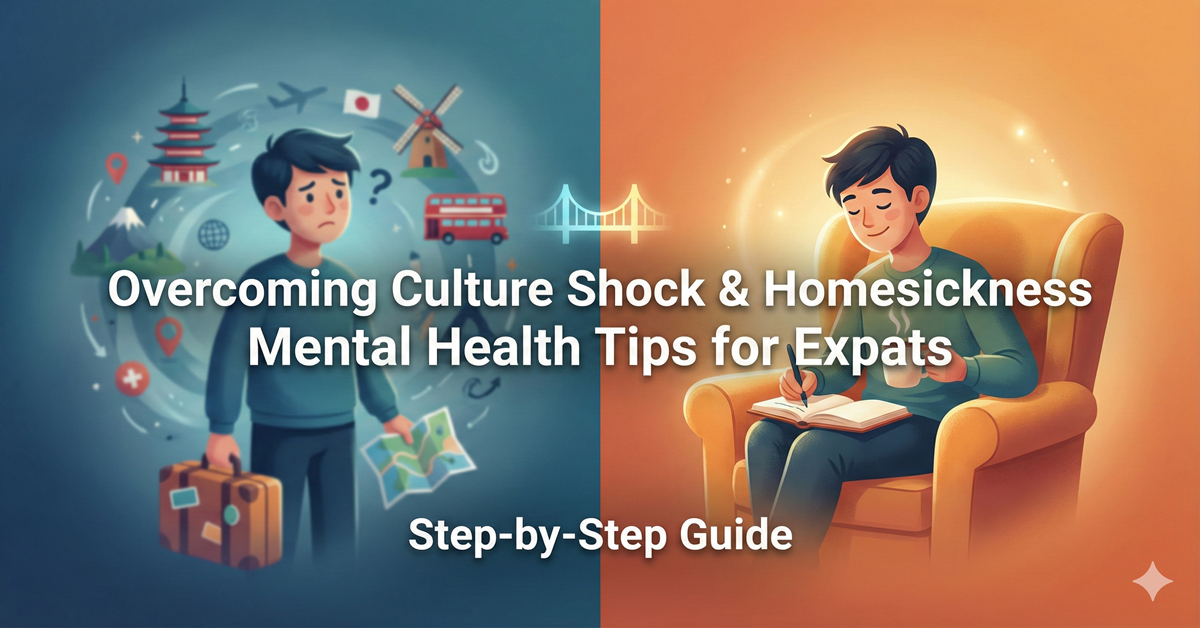
Culture shock and homesickness are normal when you move to Japan, but they can still feel heavy. This guide explains what is happening, why it affects your mental health, and simple, realistic steps to feel calmer, connected, and more at home as an expat.
Disclosure: This post may contain affiliate links. We may earn a commission at no extra cost to you if you make a purchase through these links. Read full disclosure.
Why culture shock and homesickness are completely normal
Moving to Japan is exciting: neon city lights, quiet temples, convenience stores on every corner, spotless trains. At the same time, many expats quickly discover a less “Instagrammable” side: confusion, loneliness, and emotional ups and downs.
Psychologists describe culture shock as the stress and emotional reaction to living in a very different culture. It usually develops over time, rather than on day one. Common stressors include language barriers, different social rules, work culture, and loss of familiar routines.
Homesickness is your mind’s way of saying, “I miss my support system.” It often shows up as sadness, strong nostalgia, or even physical symptoms like low energy or trouble sleeping when you think about home. For expats, homesickness often appears after the first “honeymoon” weeks.
Global health research on migrants and international residents shows that:
- Moving to a new country is a major life stressor.
- Social support and community are powerful protective factors for mental health.
In other words, if you feel overwhelmed in Japan, you are not “failing” at being an expat. Your brain is simply adjusting to a big change.
Understanding the stages of culture shock
Most expats go through phases of adjustment. You might move back and forth between stages rather than follow a perfect timeline.
Experts often describe culture shock using a U-curve or similar model: honeymoon, frustration (or negotiation), adjustment, and adaptation.
Honeymoon
At first, everything in Japan feels exciting and charming. You notice the good things: safety, efficiency, politeness, delicious food. You may feel like you are on a long holiday.
Frustration
After weeks or months, daily life becomes more real. You are tired of paperwork, confused by workplace hierarchies, or frustrated by indirect communication. Small problems—like sorting trash correctly or making a doctor’s appointment—may suddenly feel huge. Many expats say this is when the real culture shock hits.
Adjustment
Slowly, your brain learns patterns. You figure out basic phrases in Japanese, get used to social rules (like when to bow or how to exchange business cards), and build a routine. Life still has challenges, but you feel less lost.
Adaptation
Over time, Japan starts to feel like a second home. You still miss your original culture, but you can enjoy both. You understand that some things are just “different”, not better or worse.
Knowing this curve helps you remember: feeling low is often temporary and part of the process, not proof that you made a mistake by moving.
For a broader look at how to use the medical system while you adjust, you can also read Navigating Japan’s Healthcare System: A Comprehensive Guide for Expats.
What homesickness really means
Homesickness is not a sign of weakness. It is a natural reaction to losing:
- Familiar people
- Familiar places
- Familiar routines and language
Studies on expats show that homesickness often increases when:
- You lack a local support network
- You have difficulty communicating
- You feel like you do not belong, either at work or socially
Common feelings include:
- Strong longing for home or your “old life”
- Romanticizing your home country as perfect
- Feeling guilty for not feeling “grateful” enough about your life in Japan
- Worry that the sadness will never go away
The good news: with time, support, and small, consistent habits, homesickness usually becomes much lighter.
If your homesickness feels overwhelming or lasts for many months, it can help to learn more about professional support options, such as those discussed in Mental Health Support in Japan: Expat Support Groups & Hotlines.
Signs your mental health needs extra attention
Some stress is normal, but there are times when you should take your mental health especially seriously. Mental health experts who work with expats often highlight:
Emotional signs
- Feeling sad or empty most days
- Sudden bursts of anger or irritation over small things
- Strong anxiety about leaving your apartment or meeting people
- Feeling numb, disconnected, or as if you are “watching your life from outside”
Physical and behavior signs
- Trouble sleeping, or sleeping much more than usual
- Big changes in appetite or weight
- Drinking more alcohol or using substances to cope
- Losing interest in activities you used to enjoy
- Calling in sick often or avoiding work or school
If you notice several of these signs for a few weeks or more, it might be time to:
- Talk to someone you trust
- Contact a counselor or therapist (online or in person)
- Discuss your feelings with a doctor
For practical steps to access care, see Health Insurance for Self-Employed Expats in Japan or Japan’s National Health Insurance: What You Need to Know (2025 Guide) to understand how to cover costs.
Culture shock and mental health: what research tells us
Research on expats and migrants shows a few important points:
- Social support (friends, family, community groups, faith groups) strongly protects mental health and reduces culture shock stress.
- Loneliness and isolation are major risk factors for anxiety and depression among people living abroad.
- Many expats describe a mix of identity confusion (“Who am I here?”) and role change (different work status, different lifestyle), which can affect self-esteem.
For expats in Japan specifically, studies and counseling services often mention:
- Stress around language barriers and perfectionism
- Pressure to “fit in” to group harmony and long working hours
- Difficulty reading unspoken rules and expectations
This means you are not alone if you feel confused by communication styles, group decisions, or Japanese work culture. Many others are going through the same adjustment.
Practical mental health tips for expats in Japan
Let’s move from theory to daily life. Below are realistic, low-pressure strategies you can start today. You do not need to do all of them. Pick one or two that feel possible right now.
Build a steady daily routine
A simple routine creates a sense of safety for your brain. Try:
- Going to sleep and waking up at similar times
- Setting regular meal times
- Having small “anchors” like a morning walk, a coffee at the same café, or reading time before bed
Even if your job schedule changes a lot, anchor just one or two parts of the day. For extra structure around health appointments or medications, Navigating Japan’s Healthcare System: A Comprehensive Guide for Expats can help you plan.
Create a “home base” in your Japanese space
Your apartment may be small, but it can still feel like yours.
- Bring a few meaningful objects from home (photos, a blanket, a mug).
- Use soft lighting, plants, or a small rug.
- Keep one area (a chair, a corner of the table) as your relaxing zone.
For practical tips on shopping and living space, see Ultimate Expat Housing Guide in Japan – Renting, Bills, and Beyond and Cleaning Your Japanese Apartment: Tips for Mold, Bugs, and More.
Learn “good enough” Japanese for emotional comfort
You do not need perfect Japanese to feel less anxious. Start with phrases that reduce daily stress, like:
- Ordering food
- Asking for directions
- Simple phrases for doctors and pharmacies
Small language wins build confidence and reduce the feeling of being “lost”. For more language-focused tips, Communicating with Doctors: Language Tips for Non-Japanese Speakers and Overcoming Language Barriers at the Hospital: Using Interpreters & Translation Services are useful starting points.
Balance connection to home and life in Japan
Staying in touch with home is healthy, but if you are awake all night on video calls, you may feel even more tired and disconnected locally. Try:
- Scheduling regular call times that do not destroy your sleep
- Sharing more about your Japan life with family and friends
- Gently limiting social media if you find yourself comparing your life to people back home
Join communities and make low-pressure social plans
You do not have to become super extroverted. Start with low-pressure options:
- Join online expat groups for your city or hobby
- Attend small language exchange meetups or board game nights
- Try co-working spaces if you work remotely
You can explore more options in Expat Communities in Japan: Online & Offline Groups to Join.
Take care of your body to support your mind
Physical health strongly affects mental health. Simple steps matter:
- Move your body regularly: walking, cycling, home workouts, or joining a gym
- Eat balanced meals with enough protein, vegetables, and whole grains
- Limit heavy drinking, especially if you are using alcohol to escape feelings
You can find practical tips in Healthy Eating in Japan: Grocery Shopping & Nutrition Tips and Fitness and Gyms in Japan: How Expats Can Stay Fit.
Use Japan itself as a mental health resource
Japan offers many calming experiences. Consider:
- Walks in local parks, shrines, or temple grounds
- Short trips to hot springs (onsen) or quiet towns
- Exploring new neighborhoods by train on weekends
Short breaks can reset your stress levels and remind you why you came. If you live around the capital, Weekend Getaways from Tokyo: Best Destinations for Expats is a good place to start planning.
Culture shock coping strategies at a glance
Here is a quick overview of common challenges and healthy ways to respond:
| Challenge | What it might feel like | Helpful coping strategies | What to be careful about |
|---|---|---|---|
| Language barrier | Embarrassment, fear of making mistakes, staying silent | Learn key phrases, use translation apps, take casual classes, celebrate small progress | Avoid isolating yourself because you feel shy |
| Social rules and workplace norms | Confusion, worry about offending others, stress before meetings | Observe quietly, ask trusted coworkers, accept that it is okay to make gentle mistakes | Trying to “perform perfectly” all the time |
| Loneliness and isolation | Long evenings alone, feeling invisible, overthinking | Join groups, start one regular meetup, talk to neighbors, volunteer | Filling the whole day with scrolling or binge-watching |
| Homesickness | Strong longing for home, idealizing your old life | Plan visits or calls, bring comfort objects, cook food from home, share culture with locals | Telling yourself “I should be over this by now” |
| Work stress and long hours | Exhaustion, irritability, less joy in Japan life | Set small boundaries, use days off, practice relaxation, talk to HR if needed | Ignoring stress until burnout |
| Identity confusion | Not knowing “who you are” in the new culture | Reflect through journaling, talk with other expats, explore therapy, embrace mixed identity | Forcing yourself to be exactly like locals or exactly like before |
Use this table as a gentle check-in tool: you can come back to it when you feel stuck.
When to seek professional mental health support
Sometimes self-help is not enough, and that is okay. Mental health experts who work with expats note that early support can prevent more serious problems later.
Consider speaking with a professional if:
- Your mood has been low or anxious most days for more than a month
- You are having trouble functioning at work or school
- You have frequent panic attacks or strong, unpredictable emotions
- You are having thoughts of self-harm or feel like life has no meaning
Options include:
- International or expat-focused counseling services in major Japanese cities (often English-speaking, some online)
- Online therapy platforms that specialize in expats and cross-cultural adjustment
- Psychiatrists or mental health clinics that accept Japanese health insurance
- Community support groups and hotlines for foreign residents
To understand emergency options, it is wise to review Safety in Japan: Emergency Numbers and Expat Support Centers so you know what to do in urgent situations.
If possible, keep a small “mental health info card” in your wallet or phone, including:
- The number of at least one trusted friend in Japan
- Contact details of a counseling service you might use
- Emergency numbers and your local hospital
Everyday micro-habits that make a big difference
You do not need a perfect wellness routine. Instead, think about micro-habits—tiny actions that gently support your mental health:
- Take three slow deep breaths before you open your email or messages.
- When you walk to the station, notice five things you can see, four you can hear, three you can feel.
- Write down one small “win” each day (found the right train, handled a phone call, tried a new phrase).
- Once a week, do one thing that connects you to your home culture (cook a dish, listen to music, watch a show).
- Once a week, do one thing that connects you to Japan (visit a new place, try a new snack, join a local event).
These small steps may look simple, but over time they help your brain feel safer and more balanced. Research on expat adjustment highlights that a good “fit” between your skills and the demands of your environment is key to well-being; building skills slowly is more realistic than trying to change everything overnight.
You are allowed to take up space and ask for help
Culture shock and homesickness can feel very lonely, especially in a country where people rarely talk openly about mental health. But you are not alone in this experience, and you are absolutely allowed to:
- Take your emotional health seriously
- Say “I am struggling; I need support”
- Choose rest over endless productivity
- Seek community and professional help
As you move through your Japan journey, remember:
- It is normal for your feelings to change from month to month.
- Missing home does not mean you cannot build a good life here.
- You can create a third space that blends the best parts of your old and new cultures.
The Japan Handbook hub has many other guides—like Expat Communities in Japan: Online & Offline Groups to Join, Mental Health Support in Japan: Expat Support Groups & Hotlines, and Weekend Getaways from Tokyo: Best Destinations for Expats—to help you turn survival into something closer to comfort, and eventually, to belonging.
Most importantly: you deserve to feel safe, supported, and respected in Japan, both physically and mentally. Step by step, you can build that kind of life for yourself.
Disclaimer
This article is for general informational purposes only and does not constitute professional advice. Laws, prices and regulations vary by location and change over time. Consult a qualified professional for guidance on your specific situation.