Nightlife in Japan: Bars, Izakayas & Karaoke Etiquette for Expats
From ordering your first beer at a bustling Izakaya to mastering the karaoke remote, this guide helps expats navigate Japan’s vibrant nightlife. Learn about hidden table charges, the magic of all-you-can-drink deals, and the essential etiquette to ensure you have a fun and respectful night out.
Disclosure: This post may contain affiliate links. We may earn a commission at no extra cost to you if you make a purchase through these links. Read full disclosure.
The Izakaya: Your New Living Room
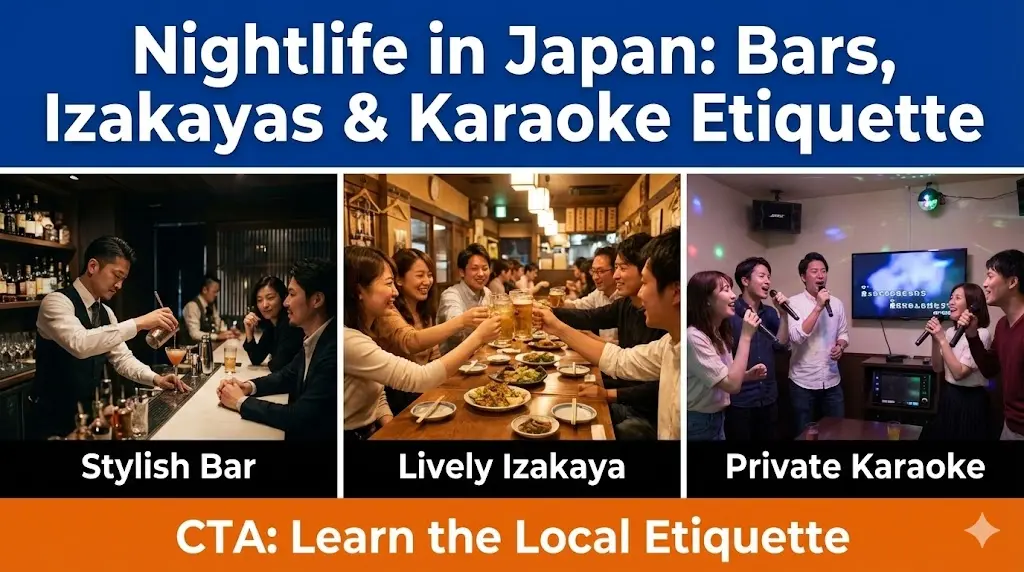
The cornerstone of Japanese nightlife is the Izakaya. It is often translated as “gastropub,” but that doesn’t quite capture the vibe. An Izakaya is a place to share. You don’t order one big plate of pasta for yourself; you order five or six small dishes—fried chicken (Karaage), edamame, sashimi, grilled skewers (Yakitori)—and everyone at the table picks at them while drinking.
The Mystery of the “Otoshi” (Table Charge)
One of the most common shocks for new expats is the bill. You might check your receipt and see a charge of 300 to 500 yen per person that you don’t recognize.
This is the Otoshi (sometimes called Tsukidashi in Kansai). When you sit down, the staff will bring you a small appetizer. It might be a tiny bowl of potato salad, some stewed vegetables, or pickled fish. You did not order this, but you cannot refuse it. It serves as your table charge or “cover charge.”
Think of it as a rental fee for your seat that comes with a snack. It is a standard part of the culture, so accept it with a smile and enjoy the mystery dish.
Read more about Dining in Japan: Etiquette and Tipping Culture
Mastering “Nomihoudai” (All-You-Can-Drink)
If you see the characters 飲み放題 on a menu, you are in luck. This is Nomihoudai, or “All-You-Can-Drink.”
Unlike happy hours in the West which might offer discounted prices, Nomihoudai is a fixed-price system. For a set time (usually 90 or 120 minutes), you can drink as much as you want from a specific menu for a flat fee (often 1,500 to 2,500 yen).
The Rules of Nomihoudai:
- Glass Exchange: You must finish your current drink before ordering the next one.
- Last Order: The staff will come to your table 10 to 15 minutes before your time is up to take your “Last Order.”
- The Menu: The all-you-can-drink menu is often separate from the full drink menu. It usually includes draft beer, whiskey highballs, sour cocktails (Chuhai), and soft drinks.
The Art of Drinking Etiquette
In Japan, drinking is a team sport. Whether you are with coworkers or new friends, there are specific behaviors that show respect and build harmony (Wa).
The Golden Rule: Never Pour Your Own Drink
If you are drinking bottled beer or sake, do not pour it for yourself. This is considered lonely and slightly rude. Instead, pour for the person next to you.
When someone sees your glass is getting empty, they will pour for you. When this happens:
- Stop eating: Put down your chopsticks.
- Hold your glass: Lift your glass with both hands to receive the drink.
- Take a sip: Take a small sip immediately before putting the glass back down.
If you are drinking from a personal glass (like a pint of beer or a cocktail), this rule doesn’t apply as strictly, but offering to order the next round for someone is always good manners.
The Toast: “Kanpai!”
Do not take a sip until everyone has a drink in their hand. Someone will lead the toast. Raise your glass, shout “Kanpai!” (Cheers), and tap glasses.
- Pro Tip: If you are drinking with your boss or someone senior, try to touch the rim of your glass slightly below the rim of their glass. This shows humility.
Check out Japanese Business Etiquette: Dos and Don’ts
Navigating Different Types of Bars
Beyond the Izakaya, Japan has a massive variety of drinking establishments. Knowing the difference prevents you from walking into a place that costs 10,000 yen when you just wanted a quick beer.
1. Tachinomi (Standing Bars) These are casual, cheap, and lively. As the name suggests, there are no chairs. You stand at a counter or a barrel.
- Vibe: Very social. It is easy to strike up a conversation with the person standing next to you.
- Payment: Often “Cash on Delivery” (COD). You put money in a bowl on the counter, and the staff takes it as they bring drinks.
2. Shot Bars / Authentic Bars In Japan, a “Shot Bar” doesn’t mean doing tequila shots. It refers to a bar where you buy drinks one by one (a shot at a time). These are often small, dimly lit, and run by a master bartender who takes cocktails very seriously.
- Vibe: Quiet, sophisticated.
- Cost: Higher. Expect to pay a cover charge and premium prices for cocktails.
3. Snack Bars (“Sunakku”) You will see signs for “Snack” everywhere. These are not places to buy potato chips. A Snack Bar is a unique cultural institution, usually run by a female owner called “Mama-san.”
- The System: You pay a high cover charge (3,000 yen+) which often includes unlimited house whiskey and water, plus dry snacks.
- The Point: You are paying for the Mama-san’s conversation and the chance to sing karaoke on a shared machine. It is a community hub for older locals. It can be intimidating for first-time expats, but very welcoming if you go with a regular.
Read more about Making Friends in Japan: Socializing Tips
Karaoke: The National Pastime
Karaoke in Japan is generally not performed in front of a room full of strangers (unless you are at a Snack Bar). Instead, you rent a private room (Karaoke Box) with your friends. This creates a safe space where you can sing your heart out without embarrassment.
How to Use a Karaoke Box
- Reception: Tell them how many people and how long you want to sing (e.g., “Two hours”).
- The Deal: You usually must order at least one drink per person (One Drink Order), or you can choose a Nomihoudai plan.
- The Controller: The room will have a tablet called a “Denmoku.” You use this to search for songs. Yes, there is an “English” language button that switches the interface!
- The Phone: There is a phone on the wall. Use it to order food and drinks from the staff.
Karaoke Etiquette
- Don’t “Cut In”: Wait your turn. Don’t add your songs to the queue instantly after singing. Let others go.
- Don’t Hog the Mic: Singing two songs in a row is generally frowned upon unless it’s a small group and everyone agrees.
- Be a Good Audience: When someone else is singing, don’t look at your phone. Clap, shake the tambourine, and cheer them on. Even if they are terrible, say “Umai!” (You’re good!).
The Phenomenon of “Shime” (The Finish)
In the West, you might grab a kebab or a slice of pizza after a night out. In Japan, the night ends with Shime.
The word means “closure” or “finish.” After drinking, Japanese people crave carbohydrates to soak up the alcohol.
- Shime-Ramen: The most popular choice. A steaming bowl of ramen at 2:00 AM is a cultural staple.
- Ochazuke: Rice with tea poured over it. Lighter and gentler on the stomach.
If your Japanese friends suggest getting ramen after the bar, this signals that the night is officially ending.
Staying Safe and the “Last Train”
Japan is incredibly safe. You can walk home alone at 3:00 AM in most cities without fear. However, there are logistical dangers you need to be aware of.
The Shuden (Last Train) Trains in Japan do not run 24 hours. In Tokyo and most major cities, the last train leaves around 12:00 AM or 12:30 AM.
- The Panic: Around 11:30 PM, you will see people checking their watches and running to the station.
- Missing It: If you miss the Shuden, taxis can be incredibly expensive (long-distance fares increase at night). Your options are:
- Stay at a Karaoke box until the first train (around 5:00 AM).
- Find a Manga Cafe (Internet Cafe) to sleep in.
- Find a Capsule Hotel.
The Touts (Kyaku-hiki) In nightlife districts like Kabukicho (Tokyo) or Dotonbori (Osaka), you will see men standing on the street trying to get you to come into their bar.
- Rule: Never follow them.
- Legitimate Izakayas do not need to drag people in off the street. These touts often lead tourists to “Rip-off Bars” where you will be charged exorbitant fees. Ignore them and walk away.
Read more about Safety in Japan: Emergency Numbers and Support
Comparison of Drink Types
To order like a pro, you need to know what you are drinking. Here is a quick guide to the standard menu items.
| Drink Name | Description | Popularity |
| Nama Biiru | Draft Beer (usually a lager like Asahi or Kirin). | The standard first drink. |
| Highball | Whiskey mixed with soda water. | Extremely popular, low calorie. |
| Chuhai / Sour | Shochu (distilled spirit) mixed with soda and fruit juice (Lemon, Grapefruit). | Sweet and refreshing. |
| Nihonshu | Sake (Rice wine). Can be served hot (Atsukan) or cold (Reishu). | Traditional choice. |
| Umeshu | Plum wine. Sweet and often drunk on the rocks or with soda. | Great for those who dislike beer. |
| Oolong Hai | Shochu mixed with Oolong tea. | Non-sweet, tastes like tea. |
The Bill and Tipping
When you are ready to leave, you can cross your index fingers in an “X” shape to signal the staff for the check (O-kaikei).
No Tipping Remember, there is no tipping in Japan. Do not leave change on the table. If you try to tip, the staff will likely run after you to return your “forgotten” money. The service fee is often already included in the table charge (Otoshi) or late-night surcharge.
Warikan (Splitting the Bill) Splitting the bill is very common. However, it is usually done evenly, or the boss pays more. It is rare to calculate exactly who ate which chicken skewer. Usually, one person pays the whole bill at the register, and everyone pays that person back immediately.
Explore Money & Finance: Cashless Payment Options in Japan
Useful Phrases for Nightlife
Equip yourself with these phrases to smooth out your evening.
- “Nama biiru, hitotsu.” (One draft beer, please.)
- “O-susume wa nan desu ka?” (What do you recommend?)
- “Sumimasen!” (Excuse me! – used to call staff.)
- “O-kaikei onegaishimasu.” (The bill, please.)
- “Kurejitto kaado wa tsukaemasu ka?” (Can I use a credit card?)
- “Kanpai!” (Cheers!)
Conclusion
Japanese nightlife is a chaotic, delicious, and fascinating world. It is a place where the strict social fabric of the day loosens up, allowing for laughter and genuine connection.
Don’t be afraid to push open the sliding door of a small, smoky Izakaya. Don’t be afraid to sing a terrible rendition of “Dancing Queen” in a Karaoke box. And don’t be afraid to try the mystery appetizer.
By understanding these simple rules of etiquette and keeping an open mind, you will find that the friendships made over a shared plate of Yakitori are often the ones that last a lifetime. So, grab a glass, wait for the toast, and enjoy the night.
Disclaimer
This article is for general informational purposes only and does not constitute professional advice. Laws, prices and regulations vary by location and change over time. Consult a qualified professional for guidance on your specific situation.





