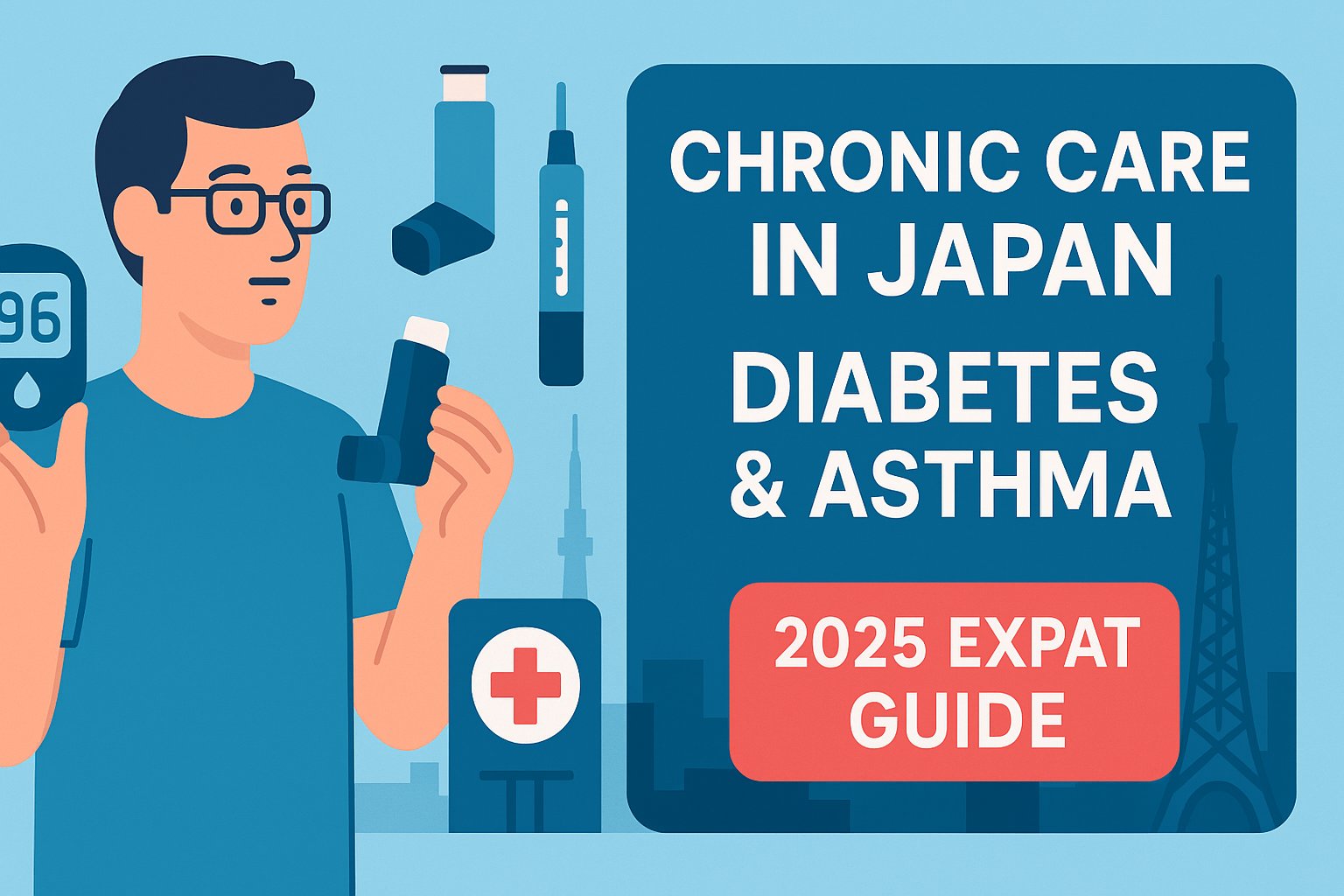
Managing Chronic Conditions as an Expat in Japan – Diabetes and Asthma
New to Japan with diabetes or asthma? This guide explains insurance, refills, English-friendly booking, and what to expect at clinics and pharmacies. Learn how to navigate prescriptions, CGM options, inhalers, costs, emergencies, and day-to-day self-management in Japan.
Disclosure: This post may contain affiliate links. We may earn a commission at no extra cost to you if you make a purchase through these links. Read full disclosure.
Why this guide matters
Living abroad is exciting—until your routine medications run low or you need a check-up in a new system. Japan’s healthcare is high quality and dependable, but the rules (insurance copays, prescription validity, refills, device coverage) work a bit differently. Below is a clear, step-by-step playbook tailored to expats managing diabetes or asthma.
For help booking in English, keep these services handy: Tokyo’s “Himawari” medical information line and the AMDA International Medical Information Center. Both provide multilingual clinic referrals and system guidance.
How Japanese health insurance pays for chronic care
Most working-age adults with public health insurance pay 30% at the point of care; the insurer covers the remaining 70%. Copay rates depend on age (e.g., many over-70s pay less), and there’s a High-Cost Medical Expense Benefit that caps large monthly bills.
If hospitalization or repeated outpatient visits push costs up in a single month, you can apply for that ceiling-amount certificate in advance so you only pay up to your income-based maximum at the cashier (you can also apply later for reimbursement). Municipal and insurer pages explain the steps.
Learn the basics first: Japanese National Health Insurance Basics for Foreigners and Claiming Health Insurance Reimbursements in Japan.
Prescriptions, refills, and medication pick-up
Paper prescriptions are time-sensitive. In Japan, an outside-pharmacy prescription is valid only for four days, including the date of issue. If you miss the window, you’ll need a new script.
Refill prescriptions exist—and are expanding. Since fiscal 2022, doctors can issue a refill prescription for stable conditions (up to three dispensings within a specified period). Japan’s digital health roadmap is also adding refill support into e-prescriptions. Ask your doctor if a refill format makes sense for you.
At the pharmacy, you’ll be offered a medication notebook (okusuri techō, paper or app). Bring it to each appointment and pharmacy visit; it helps pharmacists check interactions and track chronic meds accurately.
New here? See International Patient Services: Getting English Help at Hospitals for interpreter options and appointment tips.
Diabetes care in Japan
What routine diabetes follow-up looks like
Expect regular visits for HbA1c, fasting glucose or SMBG review, kidney and lipid panels, blood pressure checks, foot and eye screening (per your doctor’s schedule). Japanese labs report HbA1c using international standards (NGSP) after a national standardization effort; your printouts should be directly comparable to international targets.
If you’re 40–74 and insured, ask about the annual Specific Health Checkup focusing on metabolic risks; it includes waist, blood pressure, lipids, liver enzymes, glucose/HbA1c, and urine, with follow-up “specific health guidance” for higher-risk results.
Backgrounder: Japan’s insurer-run Specific Health Checkups aim to reduce diabetes and cardiovascular risk through routine screening and coaching.
Copays and protecting your budget
You’ll usually pay 30% of insured visit and test costs. If your monthly bills get high (for example, imaging plus specialist visits), apply for the High-Cost Medical Expense ceiling so you only pay up to your income-based maximum and avoid cash-flow shocks.
SMBG, CGM, and devices
Self-monitoring of blood glucose (SMBG) supplies are widely prescribed; coverage frameworks support insulin-treated patients, with clinical programs evaluating outcomes under Japan’s reimbursement. Your physician will document medical necessity and quantities.
Continuous glucose monitoring (CGM) is increasingly available. In 2022, Japan expanded insurance coverage for Abbott’s FreeStyle Libre to all people with diabetes who use insulin at least once per day—broadening access beyond multiple-daily injections only. Ask your clinic if you qualify and whether the device can be dispensed locally.
Dexcom CGM is also present in Japan; in 2024 the company shifted to direct distribution (ending a previous third-party arrangement). For availability and coverage under your plan, ask your clinic or Dexcom’s Japan channel.
Related: Full-Body Health Screenings in Japan: How to Book & What to Expect. If you bundle tests in a Ningen Dock, confirm what diabetes labs are included and bring prior reports for comparison.
Medications and generics
Japan actively promotes generic drug use to keep care affordable. If a generic exists, pharmacists may substitute (when allowed), and recent policy adds fees for choosing brands over generics in some cases—ask your pharmacist about your options and prices.
Food, travel, and daily life
- Carb counting with Japanese staples: rice portions can be large. Measure at home, and check convenience-store labels for carbs and “salt equivalent” when choosing bento or onigiri.
- Heat and insulin: summers are hot and humid. Keep insulin within labeled temperature ranges, avoid freezing, and use an insulated pouch during commutes.
- Bring meds legally: if you travel to Japan with insulin or supplies, review Yunyu Kakunin-sho (“Yakkan Shoumei”) import rules before flying.
Meal planning in tiny kitchens is doable. See Cooking in Japan Guide for simple tools and storage ideas.
Asthma care in Japan
Guidelines and treatment approach
Asthma management follows Japanese Asthma Prevention and Management Guidelines (JGL) and related society guidance. Modern care emphasizes inhaled corticosteroid (ICS)–based control, with step-ups such as ICS/LABA for persistent symptoms. Dissemination of ICS-based care has been linked to Japan’s decline in asthma deaths over time.
What you’ll see at clinics: spirometry (when appropriate), symptom/trigger review, and an action plan with controller and reliever inhalers. Many combinations familiar from abroad (e.g., budesonide-formoterol) are available; bring your prior medication names (or ingredient list) to match Japanese equivalents.
If you need language support at booking, call Himawari or AMDA to locate clinics with English-speaking staff or access phone interpretation.
Triggers and environment
Seasonal cedar/cypress pollen and humid summers can worsen asthma. During peaks, keep your controller going, step up per your plan, and carry a reliever. On severe days or if symptoms escalate, dial 119 for an ambulance; Tokyo Fire Department handles calls in multiple languages 24/7.
Costs and insurance
As with diabetes, insured patients typically pay 30% at visits and pharmacies (age-based reductions may apply). If you require expensive tests or repeated visits, apply for the High-Cost Medical Expense system to cap monthly out-of-pocket costs.
Table: What to expect at the clinic
| Visit step | Diabetes | Asthma |
|---|---|---|
| Intake | Medication list, SMBG/CGM data, diet/exercise notes | Symptoms, triggers, current inhaler technique |
| Key tests | HbA1c, fasting glucose, lipids, renal labs; eye/foot checks as advised | Spirometry/PEF when indicated; oxygen saturation |
| Scripts | Renewal or refill script if suitable (ask your doctor) | Controller/reliever inhalers; spacer; action plan |
| Pharmacy | Bring medication notebook; discuss generics and device supplies | Check inhaler technique; ask for spacer/mask if needed |
| Payment | Usually 30% copay; keep receipts; consider ceiling-amount certificate for high months | Same; ask clinic if frequent visits qualify you for documentation to support caps |
Getting your medicines without surprises
- 4-day rule: Fill paper prescriptions within four days including issue date.
- Refills: For stable conditions, ask if your script can be written as a refill prescription (up to three dispensings within a doctor-set period). Pharmacists check safety at each pick-up.
- E-prescriptions: Japan’s Digital Agency tracks adoption; e-prescriptions are expanding and support refills, reducing clinic visits for stable chronic care.
- Bring your notebook: The okusuri techō helps prevent interactions and speeds up care across different clinics.
Need a same-day option? Ask your clinic if they can fax or e-send prescriptions to your preferred pharmacy, then bring ID/insurance when you pick up.
Table: Diabetes and asthma essentials in Japan
| Topic | Diabetes essentials | Asthma essentials |
|---|---|---|
| Monitoring | SMBG supplies; CGM if insulin-treated (e.g., FreeStyle Libre coverage expanded in 2022) | Peak flow diary if advised; pulse oximeter for home use when appropriate |
| Devices | CGM reader/sensors; sharps disposal guidance from pharmacy | Spacer device; check fit; mask for children if needed |
| Insurance | 30% copay typical; High-Cost Medical Expense caps big months | Same; inhalers and visits covered when medically necessary |
| Refills | Up to three within physician-set period for stable cases | Same (doctor decides suitability) |
| Travel & import | Check Yunyu Kakunin-sho/Yakkan Shoumei for insulin and supplies | Same for inhalers if you bring extras from abroad |
| Emergencies | Hypoglycemia kit; clinic numbers | Dial 119 for severe attacks; multilingual support in Tokyo |
Booking in English and finding the right clinic
- Himawari (Tokyo Metropolitan Government): Multilingual phone help to locate English-speaking clinics/hospitals and explain the system.
- AMDA International Medical Information Center: Nationwide phone consultations and remote medical interpretation support hours posted in English.
- Emergency: 119 for ambulance; Tokyo Fire Department handles several languages around the clock.
Start here: International Patient Services and Top 5 English-Speaking Hospitals in Tokyo.
Practical weekly routine for stable control
For diabetes
- Capture data: Download CGM or log SMBG; review trends before appointments. Libre coverage for insulin users has expanded—ask if you qualify.
- Prep prescriptions: If stable, request a refill prescription to reduce monthly visits.
- Budget check: If you anticipate higher-cost months (e.g., imaging + specialist), apply for the ceiling-amount certificate beforehand.
- Labs: Ensure HbA1c is reported in NGSP (standard in Japan since the national shift).
For asthma
- Controller first: Take your daily ICS or ICS/LABA as prescribed; confirm technique with the pharmacist. JGL emphasizes ICS-based control.
- Action plan: Keep a written plan for step-up therapy during flares and know when to seek urgent care (119).
- Seasonal triggers: During high-pollen weeks, double-check controller adherence and carry a reliever everywhere.
Planning ahead? Read Surviving Japan’s Allergy Season: Health Tips for Expats and Vaccinations and Health Check-ups for Expats in Japan.
Frequently asked questions
Can I bring several months of insulin or inhalers from abroad?
It depends on quantity and type. Many travelers need a Yunyu Kakunin-sho (formerly Yakkan Shoumei) import certificate for personal meds beyond standard limits or for certain controlled substances. Check MHLW guidance or your embassy before travel.
Do Japanese pharmacies carry my exact brand?
Often yes, but brand names can differ. Bring the generic names (e.g., insulin glargine, budesonide-formoterol). Pharmacists can recommend Japan-market equivalents and generics as appropriate. Policy continues to encourage generic uptake.
How do refills actually work at the counter?
With a valid refill prescription, you can receive medication up to three times within the physician-specified period. Pharmacists must check appropriateness at each dispensing and may advise seeing the doctor sooner if your condition changes.
I misplaced my paper prescription. Can I still get my meds?
If the four-day window has lapsed or the slip is lost, contact your clinic; they may need to reissue a script. For e-prescriptions, adoption is increasing and can simplify this process.
What about CGM choices?
Libre has broad coverage for insulin users since 2022; other CGMs are available and may be dispensed via different channels as companies adjust distribution (Dexcom moved to direct distribution in 2024). Confirm coverage and supply logistics with your clinic.
Sample questions to copy into your next visit
- “Could we use a refill prescription so I can pick up meds without monthly visits while stable?”
- “Please confirm my HbA1c is reported in NGSP units.”
- “Am I eligible for the High-Cost Medical Expense certificate this month?”
- “Is there a generic option with the same active ingredient?”
- “Can you check my inhaler technique and spacer fit?” (Ask your pharmacist.)
Read More: International Patient Services: Getting English Help at Hospitals, Japanese National Health Insurance Basics for Foreigners, Claiming Health Insurance Reimbursements in Japan, Full-Body Health Screenings in Japan: How to Book & What to Expect, Top 5 English-Speaking Hospitals in Tokyo, Surviving Japan’s Allergy Season: Health Tips for Expats, Vaccinations and Health Check-ups for Expats in Japan and Mental Health for Expats: Counseling and Support in Japan
One-page checklist to print
Before you run out:
- Book your next appointment two weeks ahead (or secure a refill prescription if appropriate).
- Keep scans/photos of your prescription and insurance card.
- Carry your medication notebook to every clinic and pharmacy.
- If costs may spike, apply for the ceiling-amount certificate in advance.
- For asthma, verify controller use and keep a reliever on you; for diabetes, confirm your HbA1c schedule and device supplies.
- In an emergency, dial 119 and follow the dispatcher’s instructions.
With these steps—and the right contacts—you can manage diabetes and asthma smoothly in Japan. Build your routine, automate refills when possible, and use the ceiling-amount system to avoid cost surprises. You’ve got this.
Disclaimer
This article is for general informational purposes only and does not constitute professional advice. Laws, prices and regulations vary by location and change over time. Consult a qualified professional for guidance on your specific situation.





