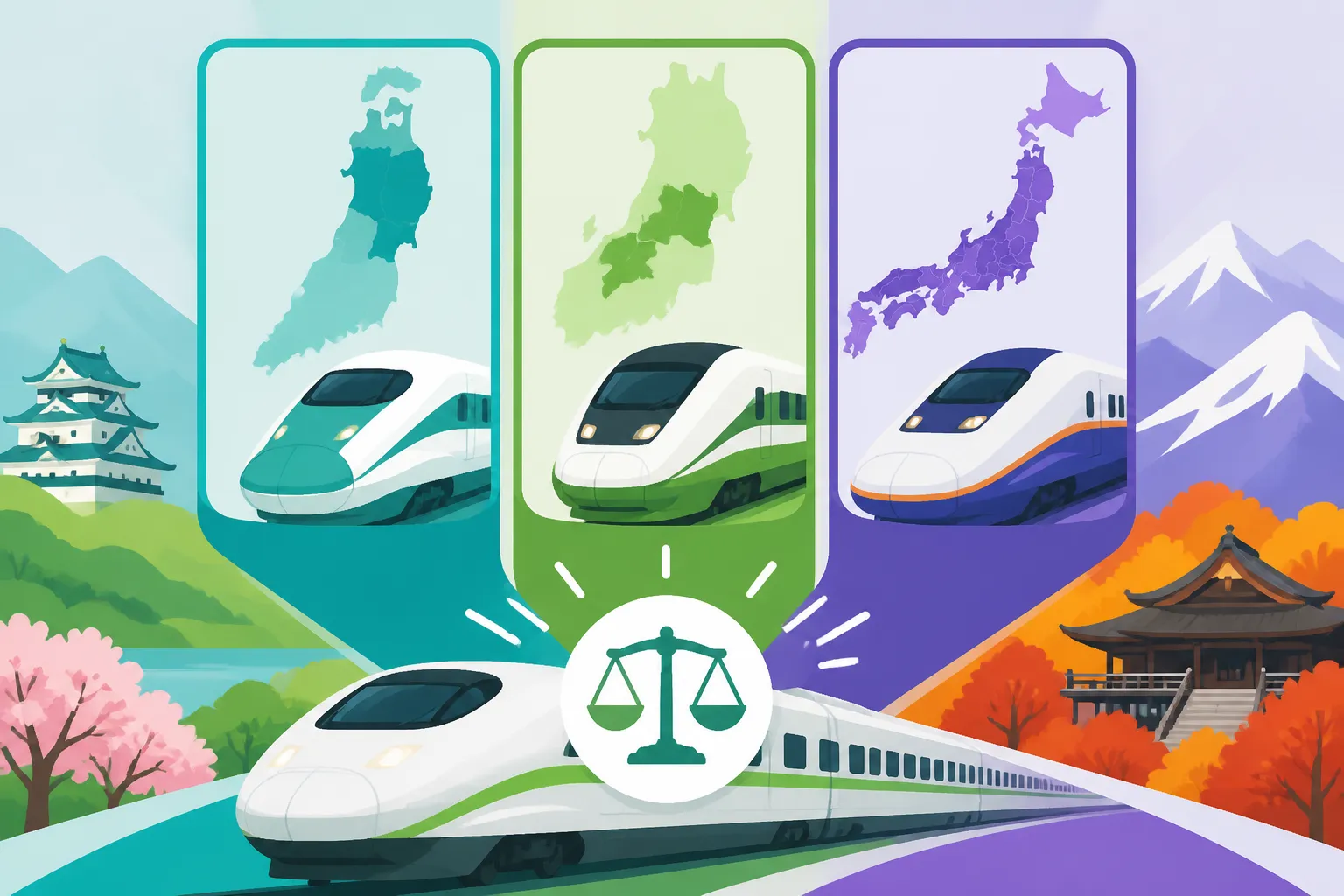
JR East Passes Compared: Tohoku, Nagano-Niigata, and Wide Options
Picture yourself at Tokyo Station with a rough plan of Sendai one day, snow monkeys the next, and maybe Nikko at the weekend. Then you find that JR East sells several regional passes, and each one draws its borders differently. This guide compares the Tohoku, Nagano-Niigata and Tokyo Wide options, shows who each one suits, and explains how to book the right one on Klook before you land.
Disclosure: This post may contain affiliate links. We may earn a commission at no extra cost to you if you make a purchase through these links. Read full disclosure.
Why JR East Passes Are Hard to Choose Between
I still remember my first trip north of Tokyo. I had read about the nationwide pass, then about the JR East passes, and I ended up with three browser tabs of coverage maps that looked almost the same. The confusion is fair. JR East’s territory covers Tokyo, the whole Kanto plain, the Tohoku region up to Aomori, and the Nagano and Niigata side of central Japan. Each regional pass cuts that territory into a different shape.
The good news is that the choice gets simple once you see the logic. The passes are not ranked from better to worse. Each one is built around a cluster of Shinkansen lines. Tohoku is for the long northern corridor. Nagano-Niigata is for the Hokuriku and Joetsu Shinkansen lines toward the Japan Alps and the Sea of Japan coast. Tokyo Wide is for short-range trips from the capital. If you have not settled on regional versus national yet, read JR Pass 2026: Is the National Pass Still Worth It After the Price Increase? first, then come back here for the JR East breakdown.
The Three Passes at a Glance
This table gives the overall picture before we go through each pass. Check the official coverage map, or the product page on Klook, for the exact line list before you buy. Partner railways and bus add-ons can change.
| Feature | JR East Pass Tohoku Area | JR East Pass Nagano-Niigata Area | JR Tokyo Wide Pass |
|---|---|---|---|
| Core Shinkansen lines | Tohoku, Yamagata and Akita Shinkansen | Hokuriku Shinkansen within JR East territory and Joetsu Shinkansen | Short sections of Shinkansen inside the Kanto area |
| Signature destinations | Sendai, Matsushima, Yamadera, Ginzan, Kakunodate, Aomori | Nagano, Karuizawa, Niigata, Yuzawa ski areas, Joetsu-Myoko | Nikko, Karuizawa, Kawaguchiko, Gala Yuzawa, Izu coast |
| How the days work | Flexible days chosen within a longer validity window | Flexible days chosen within a longer validity window | Consecutive days |
| Kanto lines included | Yes, so you can reach the Shinkansen from Tokyo | Yes, so you can reach the Shinkansen from Tokyo | Yes, this is its main area |
| Best for | Long northern journeys and multi-city loops | Ski trips, Alps gateways, Sea of Japan coast | Day trips from a fixed Tokyo hotel |
| Typical traveler | Itinerary covering Tohoku in depth | Winter sports or central Japan scenery | First-timers based in Tokyo |
Flexible Days Versus Consecutive Days
This difference matters more than any other detail, and it changes how you plan. The Tohoku and Nagano-Niigata passes are flexible. You get a set number of travel days that you can use at any point within a longer validity window. You can take the Shinkansen to Sendai, spend two slow days walking and eating gyutan without spending a pass day, and then start the pass again when you head north to Hiraizumi or Morioka.
The Tokyo Wide Pass runs on consecutive days. The clock starts on day one and keeps running whether you ride or not. Plan your rail-heavy days back to back: Nikko on the first day, Karuizawa on the second, Kawaguchiko on the third. Put museum and shopping days around them.
A practical habit helps here. Write out your trip day by day and mark each day either “long train” or “local only.” Any day marked local only does not need a pass day. With flexible passes you just skip those days. With a consecutive pass, move them before or after the pass window. Local-only days run on your IC card. IC Cards Explained: Suica, PASMO, ICOCA (Where They Work) explains how those cards behave across regions.
JR East Pass Tohoku Area
The Tohoku pass covers the most ground of the three and gives the clearest return when your trip includes the far north. The Tohoku Shinkansen runs from Tokyo to Shin-Aomori. The Yamagata and Akita mini-Shinkansen branches reach smaller cities through mountain valleys. The trains are fast and comfortable, and the region gets far fewer visitors than Kyoto or Osaka. You get autumn leaves, onsen towns and festival culture with much smaller crowds.
Where the Tohoku Pass Takes You
Coverage includes JR East lines across Tohoku plus the Kanto area, so your trip can begin at Tokyo, Ueno or Omiya without a separate ticket. Typical highlights include:
- Sendai, the regional hub, and the islands around Matsushima Bay.
- Yamadera’s cliffside temple and the snowy Taisho-era streets of Ginzan Onsen.
- Kakunodate’s samurai district and the Nyuto Onsen area, reached via the Akita Shinkansen.
- Hiraizumi’s World Heritage temples, Morioka’s food culture and the Aomori coast.
Matsushima is an easy half-day from Sendai. Matsushima Bay Cruise: Scenic Islands Near Sendai covers the boat options in detail. In winter, Ginzan and the frozen trees on the Zao ropeway are worth the trip on their own, and Ginzan Onsen: Winter Scenery and Booking Strategies and Zao Snow Monsters: Access, Viewing, and Safety Tips cover the logistics.
The Tohoku pass also covers some partner railways that link JR sections, plus a through-route to Nikko on a connecting private line. Some coastal and mountain lines are third-sector railways and are not part of JR East. Check the coverage list for any small local line you plan to ride.
A Realistic Tohoku Itinerary Scenario
Take Maya, a designer from Melbourne with ten days in Japan. Three days are for Tokyo and the rest for the north. She buys the Tohoku pass on Klook a few weeks ahead and spends her Tokyo days on her IC card.
Day one of the pass: an early Hayabusa to Sendai, then the Senseki Line to Matsushima in the afternoon. Next comes a free day in Sendai, which uses no pass day. Day two: the Senzan Line to Yamadera in the morning, then on to Yamagata and the Yamagata Shinkansen toward Oishida for a night at Ginzan. Day three: back via Yamagata and up the Tohoku Shinkansen to Morioka, then the Akita Shinkansen to Kakunodate. Day four: north to Shin-Aomori for the Nebuta museum and seafood markets. Day five: the long ride back to Tokyo.
Maya covers the whole Tohoku region on five travel days and still gets slow days in between. Compare that with buying each Shinkansen leg separately, and the flexible pass covers the expensive long legs while the slow days cost nothing. Use the Klook price calculator against your own route to confirm, because savings depend on your route. If Aomori appeals, Aomori Culture Trip: Nebuta, Apples, and Coastal Views has plenty of ideas.
When the Tohoku Pass Is the Wrong Choice
This pass suits long distances. If you only plan a single return trip to Sendai, check the route before you buy. The pass may cost more than it saves. Buy the individual Shinkansen tickets instead and run the comparison.
The pass also does not reach the Nagano or Niigata side of the map in a useful way. If your dream trip pairs Tohoku with Hokuriku, look at the wider JR East-South Hokkaido pass or the national pass. JR West’s passes are a different system again, and JR West Passes Compared: Kansai, Hokuriku, and Sanyo-San’in Routes covers the Kanazawa-and-beyond side.
JR East Pass Nagano-Niigata Area
This pass covers the mountain side of JR East. It uses the Hokuriku Shinkansen toward Karuizawa and Nagano, and the Joetsu Shinkansen through the long tunnels to Echigo-Yuzawa and Niigata. The Kanto lines are included. Partner railways such as the Shinano Railway and Echigo Tokimeki Railway fill gaps that JR no longer runs. For anyone chasing snow, alpine air or sake country, this is the pass to look at first.
Coverage and Highlights
The core destinations are Nagano city and Zenkoji Temple, the resort town of Karuizawa, the Yuzawa ski area, Niigata city and the Joetsu-Myoko region. From Nagano, buses and private railways lead on to Jigokudani’s snow monkeys and the Togakushi shrines. Those connections may not be included, so check before you go. For the monkeys, Jigokudani Snow Monkeys: Winter Visit Planning Guide explains the last-mile transport.
Niigata is a strong reason to pick this pass over Tokyo Wide. It reaches the full length of the Joetsu Shinkansen to Niigata city, where you find sake breweries, fresh seafood and ferries toward Sado Island. Food-focused trip plans are in Niigata Getaway: Sake, Snow, and Seaside Towns.
A Ski and Snow Scenario
Daniel and his partner are flying in from Singapore for a winter week. They want three ski days plus some city time, and they love onsen. Their plan uses the Nagano-Niigata pass across a week.
Day one: the Joetsu Shinkansen to Echigo-Yuzawa. Skis are forwarded ahead by courier, so they ride light. After two days on the slopes they use a pass day to cross toward Nagano via the partner railways. The next morning they take a bus to see the snow monkeys. A later pass day takes them back down the Hokuriku Shinkansen with a stop in Karuizawa for outlet shopping, then on to Tokyo.
Luggage matters on ski trips. Shinkansen carriages have rules for oversized bags, and courier delivery makes everything easier. Luggage Forwarding (Takkyubin): How to Travel Hands-Free covers how to send skis and suitcases between hotels.
Limitations Worth Knowing
The Hokuriku Shinkansen continues past JR East territory into JR West territory, toward Toyama and Kanazawa. This pass covers only the JR East section. If you stay on the train past the boundary, you pay the extra fare. Kusatsu Onsen is reached by bus from JR stations, and those buses fall outside the pass. Kusatsu Onsen: Bathhouses, Streets, and Day Trips explains the connections.
The pass is weak for Tohoku. If your plans include both Sendai and Nagano, compare the cost of two separate regional passes with one wider product.
JR Tokyo Wide Pass
The Tokyo Wide Pass is the most compact option. It covers JR East lines in the Kanto area plus selected private railways that reach popular day-trip spots. It suits travelers who stay in one Tokyo hotel and want a few big outings without changing beds.
Coverage and Classic Day Trips
Within its area, the pass reaches:
- Nikko, via the through-service connection, for the shrines and mountain scenery.
- Karuizawa, via a short section of the Hokuriku Shinkansen.
- The Fuji Five Lakes area around Kawaguchiko, via the partner Fuji Kyuko line.
- The Izu Peninsula coast, via partner lines.
- Gala Yuzawa, a ski resort with its own Shinkansen station, reached via the Joetsu Shinkansen.
These trips are well-worn favourites for good reason. Nikko Day Trip: Shrines, Nature, and Transport Tips and Karuizawa Day Trip: Cafés, Shopping, Forest Walks give the on-the-ground detail.
When Tokyo Wide Beats the Regional Passes
Choose Tokyo Wide when every trip starts and ends in Tokyo and you can fit your outings into a few days in a row. It is ideal for a first trip, for travelers with young children who want one hotel, or for business travelers who have a long weekend free.
The consecutive-day rule decides most cases. If your outings are spread across a long stay with free days in between, the flexible regional passes can work out better even for nearby trips. Mark your calendar first, then compare.
| Your situation | Strongest choice | Why |
|---|---|---|
| Fixed Tokyo hotel, three big day trips in a row | JR Tokyo Wide Pass | Covers the classic outings, and the consecutive days line up |
| Multi-city northern loop with rest days | JR East Pass Tohoku Area | Long Shinkansen legs, and flexible days skip the rest days |
| Ski trip to Yuzawa plus Nagano sightseeing | JR East Pass Nagano-Niigata Area | Covers both Shinkansen lines and partner railways |
| Single return trip to Sendai only | Individual tickets | A pass may cost more than one return journey |
| Tohoku and Nagano in the same trip | Compare a wider pass with two regional passes | Neither single regional pass covers both well |
How to Buy and Redeem Your JR East Pass on Klook
Once you know which pass you want, booking ahead saves stress at the station. I now book regional passes on Klook as a matter of habit. I can compare passes side by side in English, see the coverage summary on the product page, and pay with my home card before I fly. That leaves me one less thing to sort out on arrival.
Step-by-Step Booking and Redemption
- Map your rail days on a simple day-by-day list, marking long-train days and local-only days.
- Open the Klook app or website and search for the JR East pass that matches your plan. Read the eligibility, coverage and redemption sections on the product page.
- Choose your intended start date and the number of passengers. Make sure each traveler’s name matches their passport exactly.
- Pay and save the confirmation voucher on your phone, and take a screenshot as a backup.
- After you land, go to a designated JR East station or ticket machine that handles pass exchange. Bring the passport of every traveler on the booking.
- Redeem the voucher for your physical pass, then reserve seats on the trains you plan to take.
- Keep the pass and your passport together for the whole trip, because staff may ask to see both.
Ticket machines with English menus handle much of this. Using Ticket Machines: English Menus and Common Buttons walks through the screens.
Why Booking Ahead Through Klook Helps
The main benefit is certainty. Peak seasons such as cherry blossom time, Golden Week and the winter ski months fill station counters with long queues. A pass bought on Klook in advance means you arrive knowing which pass you hold and roughly what it covers. You only need to redeem it, not make the purchase decision while jet-lagged.
You also get the full English product page to read slowly at home. That page lists eligibility, what to bring and where to redeem. Klook also often runs app promotions and seasonal deals. Check the current offers on the Klook product page instead of assuming a discount, because terms change.
There is the comparison benefit too. Pull up the Tohoku, Nagano-Niigata and Tokyo Wide listings on Klook one after another and you can line up their coverage descriptions against your day plan. That is much easier than switching between several official PDFs.
Seat Reservations After Redemption
Your pass covers the fare. On many Shinkansen services you still want a reserved seat. Some trains on the Tohoku line, including the Hayabusa and the Komachi, are all-reserved, so you need a seat reservation before boarding. Pass holders can usually reserve at ticket machines or staffed counters. Book early on peak days.
Know the difference between ordinary, Green and Gran Class cars before you reserve. Japan Train Seat Types: Reserved, Non-Reserved, Green explains what each class gets you. Shinkansen Tickets: Booking, Seat Types, and Luggage Rules covers the oversized baggage reservation rule that applies on many Shinkansen routes.
Choosing the Right JR East Pass for Your Trip
By now the outline should be clear. The last step is to check your choice against your real itinerary and your eligibility.
Five Questions That Settle the Choice
- Does your trip go north of Utsunomiya toward Sendai and beyond? If so, the Tohoku pass is your starting point.
- Is your trip focused on Nagano, Niigata or ski resorts on the Joetsu line? If so, the Nagano-Niigata pass is the natural fit.
- Will every rail trip start and end in Tokyo, within a run of consecutive days? If so, Tokyo Wide likely wins.
- Do you have rest days between long rides? Flexible passes reward that pattern.
- Do the long legs, added up at individual fares, come to more than the pass price? Run that comparison on your own route using the price shown on Klook.
Eligibility and Residency Checks
JR East passes are aimed at foreign visitors, and eligibility rules depend on your passport and your status of residence. Check the eligibility section on the product page and the official JR East terms before you buy. If you are staying long-term on a special status, Traveling Japan with a 6-Month Nomad Visa: Are You Eligible for the JR Pass? works through that situation. For a general look at which regional product suits which style of trip across all of Japan, see Regional Rail Passes: Which One Fits Your Itinerary?
Final Pre-Departure Checklist
- Your day-by-day plan shows which days need the pass and which are local only.
- The pass you chose covers every Shinkansen and partner line on your long days.
- Each traveler’s booking name matches their passport exactly.
- Your Klook voucher is saved offline and backed up.
- You know which station you will redeem at on arrival.
- Seat reservations are planned for all-reserved trains and peak dates.
- Large luggage is either reserved on the train or forwarded by courier.
Northern and central Japan reward travelers who make the effort to get beyond Tokyo. You get misty temples on cliffs, snowbound onsen, harbour seafood and alpine towns. Pick the pass that fits your route, book it on Klook before you fly, and spend your trip on the train instead of in the ticket queue.
Disclaimer
This article is for general informational purposes only and does not constitute professional advice. Laws, prices and regulations vary by location and change over time. Consult a qualified professional for guidance on your specific situation.