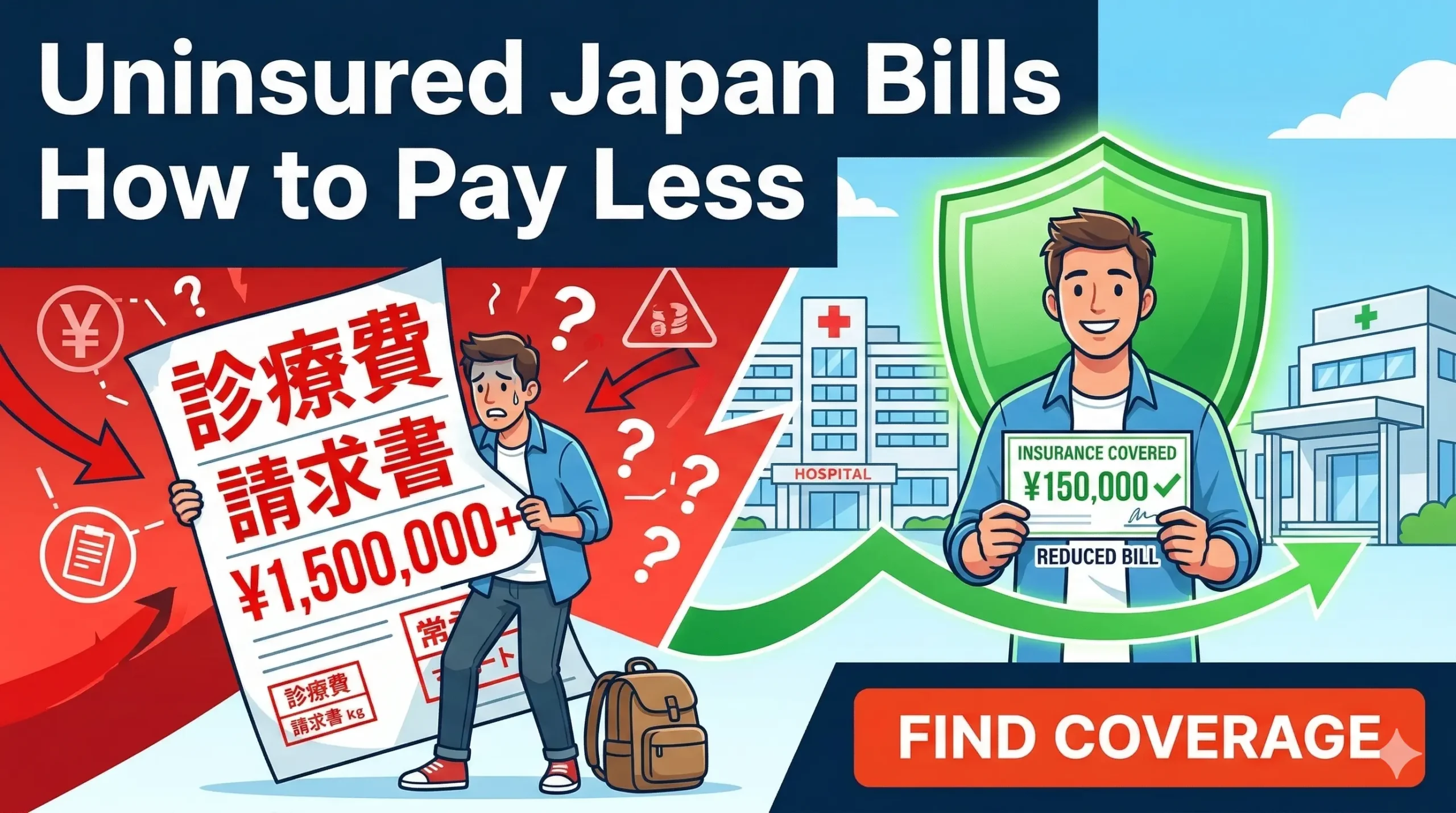
Japan Hospital Bills Without NHI: Real Cost Scenarios + How SafetyWing Helps
Navigating the Japanese healthcare system without National Health Insurance can lead to devastating out-of-pocket hospital bills. Discover the real financial costs of medical emergencies for uninsured expats, and learn how securing a digital nomad policy actively protects your savings abroad.
Disclosure: This post may contain affiliate links. We may earn a commission at no extra cost to you if you make a purchase through these links. Read full disclosure.
The Reality of Uninsured Healthcare in Japan
Japan is globally renowned for its exceptional, highly advanced medical infrastructure and pristine clinical hygiene. However, accessing this world-class medical system is not universally affordable for everyone who steps off a plane in Tokyo or Osaka. Understanding exactly how the domestic billing system functions is the crucial first step to avoiding a financial catastrophe during an unexpected health crisis.
How the National Health Insurance NHI Works
The cornerstone of Japanese medical care is the National Health Insurance system, commonly referred to as Kokumin Kenko Hoken. This system is heavily subsidized by the government, ensuring that enrolled residents have universal access to care without fearing bankruptcy. Under this system, the government covers 70% of all approved medical costs, leaving the patient responsible for a highly manageable 30% co-payment at the clinic reception desk.
Furthermore, the public system features an incredible safety net known as the High-Cost Medical Care Benefit (Kogaku Ryoyohi Seido). This benefit caps an individual’s absolute monthly out-of-pocket medical expenses based on their specific income bracket. If an enrolled resident requires a massive, multi-million Yen surgery, their out-of-pocket liability is strictly capped, with the government absorbing the rest. This robust system is exactly why Japan boasts some of the best health outcomes globally.
The Expat Vulnerability Gap
Unfortunately, access to this highly efficient, subsidized system is strictly governed by long-term residency status. If you enter Japan on a standard 90-day tourist visa waiver, or utilize the specific digital nomad visa designed for six-month remote work stays, you are legally prohibited from joining the public healthcare system. You are entirely excluded from the 70% subsidy and the monthly out-of-pocket caps.
Even if you enter Japan on a long-term working or student visa, there is an unavoidable administrative delay. Between landing at Narita or Haneda airport and waiting for your municipal ward office to process your paperwork and mail your physical health insurance card, you exist in a highly dangerous coverage gap. During this transition—which can easily take two to four weeks—you are considered a completely uninsured private patient. We explore the complexities of surviving this specific administrative window in our guide on SafetyWing vs Japan National Health Insurance How to Bridge the Gap Before Enrollment.
The Penalty Multiplier for Uninsured Patients
Being an uninsured patient in Japan does not simply mean paying 100% of the standard medical rate; the financial reality is much harsher. Japanese medical bills are calculated using a standardized, national point system where one point equals 10 Japanese Yen for patients enrolled in the NHI.
However, when a hospital treats a private, uninsured foreign patient (a practice known as Jiyuu Shinryou or “free medical care”), the hospital is no longer legally bound by the government’s 10 Yen per point valuation. Many clinics and hospitals will legally apply a multiplier, charging uninsured patients 20 to 30 Yen per medical point. This means that a simple procedure that costs an insured resident 3,000 JPY could easily cost an uninsured tourist 15,000 to 30,000 JPY simply because of the base rate multiplier. Without an international medical policy to absorb this inflated cost, you are entirely responsible for this massive markup.
Real Cost Scenarios for Common Medical Emergencies
To truly understand your financial exposure, we must look at the raw numbers. What does a medical emergency actually cost when you are hit with the 100% liability and the uninsured hospital point multiplier? Here are three incredibly common scenarios expats face in Japan.
Treating a Severe Respiratory Infection
The Japanese winter is notoriously dry, and packed commuter trains create the perfect environment for aggressive respiratory infections. If you contract a severe strain of influenza or a chest infection that requires a clinical diagnosis, you cannot simply buy strong antibiotics over the counter. You must visit a local internal medicine clinic (Naika).
For an insured resident, a consultation, a rapid diagnostic flu test, and a prescription for antiviral medications (like Tamiflu) will typically result in an out-of-pocket co-pay of roughly 3,000 to 5,000 JPY.
For an uninsured digital nomad, that exact same 20-minute clinic visit becomes a massive financial burden. Because you are absorbing 100% of the cost plus the hospital’s private patient multiplier, the consultation fee alone can spike to 10,000 JPY. Add in the inflated costs for the diagnostic tests and the full retail price of the prescription medications, and treating a simple case of the flu can easily cost between 20,000 and 35,000 JPY. If you must repeat this process for a follow-up visit, the costs double.
Managing Broken Bones and Orthopedic Trauma
Japan offers some of the best hiking and winter sports in the world. However, slipping on an icy sidewalk in Sapporo or taking a bad fall while hiking Mount Takao can result in severe orthopedic trauma, such as a fractured wrist or a broken ankle.
Treating a broken bone involves multiple steps: an emergency room consultation, highly detailed X-rays, the physical application of a fiberglass cast, and the issuance of crutches or a sling. For a patient protected by the National Health Insurance, this entire emergency procedure is heavily subsidized, usually costing the patient a highly manageable 15,000 to 20,000 JPY upfront.
For an uninsured expat, orthopedic trauma is financially brutal. The X-rays alone will be billed at full private market rates, and the orthopedic surgeon’s time is heavily marked up. An uninsured patient will easily face an emergency room bill ranging from 80,000 to 150,000 JPY for the initial stabilization, not including the mandatory weekly follow-up visits to check the bone’s healing progress or the eventual physical therapy required to restore mobility.
The Catastrophic Cost of Appendicitis
While respiratory infections and broken bones are stressful, internal medical emergencies requiring immediate surgical intervention represent a true financial catastrophe for the uninsured. Acute appendicitis strikes entirely without warning and requires an emergency appendectomy to prevent a fatal rupture.
An emergency appendectomy in Japan typically requires a four to five-day stay in a hospital ward to monitor for post-operative infections. For an enrolled resident, the high-cost medical care benefit (Kogaku Ryoyohi Seido) kicks in automatically, capping their maximum out-of-pocket expense for the surgery and hospital stay at roughly 90,000 JPY (depending on their income bracket).
If you are an uninsured tourist or remote worker, you are completely exposed to the raw, un-subsidized cost of the operating room, the anesthesiologist’s fees, the surgeon’s labor, and the daily hospital bed fees.
| Medical Emergency | Insured Cost (30% Co-pay) | Uninsured Private Cost (Estimated) |
| Severe Flu / Infection | 3,000 – 5,000 JPY | 20,000 – 35,000 JPY |
| Broken Bone (Casting & X-Rays) | 15,000 – 20,000 JPY | 80,000 – 150,000 JPY |
| Emergency Appendectomy | ~90,000 JPY (Income Capped) | 1,200,000 – 2,500,000 JPY |
Facing a 2.5 million JPY (roughly $17,000 USD) hospital bill in a foreign country is life-altering. This catastrophic financial exposure is the exact reason why securing an ironclad international safety net is non-negotiable before you board your flight.
Navigating the Pay and Claim System
If you rely on an international insurance policy rather than the domestic Japanese system, you must understand how to physically process the transaction at the clinic. Japanese medical facilities operate very differently from Western hospitals regarding international billing.
Upfront Cash Requirements at Clinics
Japan possesses a highly localized and incredibly efficient healthcare system. However, this localized nature means that neighborhood clinics and regional hospitals are completely disconnected from international insurance networks. If you walk into a Japanese clinic and hand the receptionist a foreign insurance card, they will politely decline it.
For standard outpatient visits, you must operate on a strict pay-and-claim basis. You will be required to pay the clinic’s total, un-subsidized bill upfront at the reception desk before you are allowed to leave the premises. Crucially, many smaller clinics do not accept international credit cards, requiring you to pay entirely in physical Japanese Yen. If you do not have sufficient cash on hand, you may be forced to leave your passport as collateral while you run to an ATM.
This immediate payment requirement highlights the absolute necessity of maintaining a highly liquid emergency fund in local currency, a strategy we map out perfectly in Emergency Fund for Expats Where to Keep Money Wise vs Japanese Bank vs Brokerage. To understand exactly what payment methods are accepted at larger hospitals, review our guide on How to Pay Medical Bills in Japan as a Foreigner Cash Card Bank Transfer Wise.
Securing the Right Medical Documents
When you pay your massive uninsured bill upfront, you cannot simply walk out with a basic credit card receipt and expect your international insurance to reimburse you. You must explicitly ask the clinic’s reception desk for two highly specific Japanese documents to support your eventual claim.
First, you need the official medical certificate, known as a Shindansho. This document is written and stamped by the attending physician, outlining your exact medical diagnosis and proving the medical necessity of the treatment. Second, you must secure the fully itemized receipt, known as a Ryoshusho or Meisaisho. This receipt provides a granular breakdown of the consultation fees, imaging costs, and administered medications. Without these two original documents, your international claims adjuster will likely deny your reimbursement. We provide a masterclass on executing this exact bureaucratic workflow in How to File a SafetyWing Claim From Japan Step-by-Step With Required Documents.
Overcoming Language and Bureaucratic Barriers
If you require prescription medication for your recovery, you will likely need to walk to an entirely separate, independent pharmacy (Yakkyoku) to have it filled, as Japanese clinics rarely dispense medication directly from the doctor’s office.
This introduces an entirely new layer of bureaucracy and language barriers. You must present your prescription, fill out a new medical questionnaire (Monshinhyo) entirely in Japanese, and pay for the un-subsidized medication out of pocket. You must then collect a second set of itemized receipts from the pharmacist to include in your insurance claim. Navigating this secondary medical hurdle while severely ill is incredibly stressful, which is why we highly recommend familiarizing yourself with the process through our guide on Navigating Japanese Pharmacies What You Need to Know.
Why SafetyWing is the Ultimate Financial Shield
To completely bypass the terrifying financial exposure of being an uninsured private patient, financially savvy expatriates and digital nomads universally rely on SafetyWing. This modern financial platform has revolutionized international health insurance, providing the absolute best medical safety net for those living in Japan.
Bridging the Residency Gap Flawlessly
The most profound innovation SafetyWing brings to the international insurance market is its billing structure. Instead of forcing you to predict the exact duration of your stay in Japan and demanding a massive upfront payment, the platform operates on an automatic, rolling 28-day subscription model.
This makes it the absolute perfect tool for expats moving to Japan on a long-term visa. You can activate a SafetyWing policy the day you land, ensuring you are fully protected from the 100% uninsured penalty rates during your vulnerable administrative transition phase. Once your paperwork clears the local ward office and your physical Japanese National Health Insurance card arrives in the mail, you simply log into your digital dashboard and cancel the subscription with a single click. There are no cancellation fees and no wasted premiums. You are perfectly bridging the gap.
Comprehensive Coverage Without the Premium Price
When evaluating insurance, the scope of coverage against the cost of the premium is paramount. SafetyWing is specifically engineered to handle unexpected, acute medical crises without draining your monthly budget.
For a highly affordable monthly fee, the policy covers the medically necessary treatments required to get you healthy and stabilize your condition. This comprehensive safety net includes coverage for hospital room and board, intensive care units, local ambulance transportation, and emergency diagnostic tests like X-rays or MRI scans. If you face the 2.5 million JPY appendectomy scenario outlined above, SafetyWing absorbs the catastrophic blow, ensuring your physical recovery does not trigger a permanent financial ruin.
It is important to understand what the policy does not cover: it is an emergency safety net, meaning it explicitly excludes routine wellness checkups, preventative dental care, and generally excludes coverage for pre-existing medical conditions. For a highly granular breakdown of these specific inclusions and exclusions, review our dedicated deep dive in SafetyWing Review for Japan 2027 What It Covers What It Doesnt and Who Its For.
Avoiding the Pitfalls of Traditional Travel Insurance
Attempting to save money, many digital nomads rely exclusively on the complimentary travel insurance bundled with premium travel credit cards, or they purchase legacy travel insurance policies. These outdated methods frequently fail expatriates in Japan.
Traditional travel insurance is riddled with residency traps. These policies are underwritten based on the assumption that you will return to your home country. If you sign a long-term apartment lease in Tokyo or enter Japan on a visa that allows you to establish a local address, many legacy insurers will instantly void your medical coverage. They will argue that you are a resident, not a traveler. We detail how to spot these dangerous clauses in How to Choose Short-Term Health Insurance Before You Get a Residence Card Checklist.
Furthermore, credit card insurance usually voids entirely if you fly into Japan on a one-way relocation ticket rather than a round-trip vacation ticket. SafetyWing completely abandons these outdated residency traps. The policy is designed specifically for people living borderless lives, meaning one-way tickets and long-term apartment rentals will not invalidate your emergency medical coverage.
Setting Up Your Digital Nomad Insurance Strategy
Securing your health and your financial future in Japan requires proactive action. By setting up your insurance infrastructure before an emergency strikes, you guarantee a stress-free recovery.
Activating Your Policy Before You Land
The most strategic move you can make is purchasing your SafetyWing policy before you board your flight to Narita or Haneda. By activating the policy in advance, you ensure that there are absolutely no dangerous lapses in your coverage. If you slip and fall in the airport terminal upon arrival, or if you contract a severe virus during the flight, your safety net is already active and ready to deploy.
Because the platform operates globally, the signup process is entirely digital and takes less than five minutes. You do not have to undergo complex medical underwriting or phone interviews. You simply select your start date, link your payment method, and download your digital insurance card directly to your smartphone wallet.
Coordinating Direct Billing in Emergencies
While the pay-and-claim method is standard for minor outpatient clinic visits, severe medical traumas require a different approach. If you are involved in a major accident that requires a multi-day hospital stay and expensive surgical intervention, paying the un-subsidized private rate upfront is financially impossible for almost everyone, particularly those dealing with the banking hurdles outlined in Arriving Without a Japanese Bank Account Payment Workarounds for Visa School Steps.
In these catastrophic, high-cost scenarios, you or a traveling companion should immediately contact the SafetyWing 24/7 global emergency assistance hotline. Their dedicated support team will urgently attempt to coordinate a Guarantee of Payment (GOP) directly with the Japanese hospital’s international billing department.
If successful, this arrangement allows the hospital to bill SafetyWing directly, bypassing your personal bank accounts entirely. This critical intervention spares you from the terrifying prospect of liquidating your life savings or calling relatives to wire emergency funds while you are strapped to a hospital bed.
Transitioning to the Public System
If you are a short-term digital nomad or a tourist, you will simply keep your SafetyWing policy active for the entire duration of your stay in Japan, utilizing it as your primary healthcare safety net.
However, if you are a long-term expatriate, your ultimate goal is to transition fully into the Japanese National Health Insurance system. Once you receive your physical Hokensho (health insurance card) from your local ward office, you are legally protected by the 70% government subsidy and the high-cost medical care caps.
At that precise moment, you no longer need primary emergency medical insurance for your daily life inside Japan. You simply log into your dashboard, cancel your subscription, and redirect those monthly premium funds into optimizing your life abroad, a strategy we map out in Cost of Living in Japan 2026 Expenses Breakdown. Do not leave your financial future to chance in a foreign medical system. Secure your digital nomad coverage today, and explore Japan with absolute confidence and total peace of mind.
References
Primary sources official
- Ministry of Health, Labour and Welfare (MHLW) Japan – Medical Insurance Systems: https://www.mhlw.go.jp/english/policy/health-medical/health-insurance/dl/health_insurance.pdf
- Ministry of Health, Labour and Welfare (MHLW) Japan – High-Cost Medical Care Benefit: https://www.mhlw.go.jp/english/wp/wp-hw9/dl/02e.pdf
- Japan National Tourism Organization (JNTO) – Guide for when you are feeling ill: https://www.jnto.go.jp/emergency/eng/mi_guide.html
Other helpful sources
- SafetyWing Official Nomad Insurance Policy Description of Coverage: https://safetywing.com/nomad-insurance/policy
Disclaimer
The medical billing estimates, un-subsidized cost scenarios, and Japanese healthcare enrollment rules discussed in this article are provided for general informational and educational purposes only. Insurance policies are highly complex legal contracts; all coverage, claims approvals, and reimbursements are strictly subject to the specific terms, conditions, deductibles, and exclusions outlined in the official SafetyWing Nomad Insurance policy documentation. Benefits, underwriting rules, and the issuance of Guarantee of Payment (GOP) agreements are subject to change without prior notice and depend heavily on the individual Japanese hospital’s willingness to accept international direct billing. Japanese National Health Insurance (NHI) eligibility, the calculation of the High-Cost Medical Care Benefit (Kogaku Ryoyohi Seido), and the uninsured patient point multiplier system are strictly governed by the Japanese Ministry of Health, Labour and Welfare and individual municipal governments, and are subject to continuous legislative changes. While we strive to ensure the accuracy and relevance of this guide for 2026, readers must independently verify all current coverage details and residency clause limitations directly with their chosen insurance provider before relocating or seeking medical treatment in Japan. This article does not constitute professional financial, medical, or legal advice.





