Foreign Exchange in Japan: Exchange Offices vs ATMs – Which to Use?
For most travellers and new residents in Japan, the cheapest and easiest way to get yen is usually from ATMs with a good debit or credit card. Exchange offices are still useful in some situations, especially at airports or for certain currencies.
Disclosure: This post may contain affiliate links. We may earn a commission at no extra cost to you if you make a purchase through these links. Read full disclosure.
Overview of foreign exchange in Japan
Japan is still a very cash-friendly country. Small restaurants, local shops, older guesthouses and even some clinics may only accept cash. At the same time, it is now very easy to get yen from ATMs all over the country, using major international cards.

When you arrive, you often face one big question:
Should I bring foreign cash and use an exchange office, or rely mainly on ATMs with my card?
The short answer:
- For major currencies (USD, EUR, GBP, AUD, etc.) with a debit/credit card that has low fees, ATMs usually give the best overall deal.
- Exchange offices are still helpful if:
- Your bank charges high foreign ATM fees
- You are carrying a lot of cash already
- Your card sometimes fails, or you have a more “cash-first” travel style
Throughout this guide, we will compare both options and show simple strategies you can use together. If you are planning a longer stay, also check our guides on using ATMs in Japan, cashless payments in Japan, and opening a bank account in Japan.
How foreign exchange costs really work
To choose between exchange offices and ATMs, you need to understand all the parts of the cost. It is not just “0% commission” vs “3% fee”.
1. Exchange rate margin
Both exchange offices and card networks make money by giving you a slightly worse rate than the mid-market rate (the rate you see on Google or XE).
- Airport exchange counters and hotel desks usually have the largest mark-up. Guides and comparison articles often warn that airport desks and hotels are the most expensive options in Japan.
- ATMs using Visa/Mastercard typically use the card network rate plus a small margin from your home bank.
2. Visible fees
- Exchange offices sometimes say “no commission”, but the cost is already hidden in the exchange rate.
- Japanese ATMs that accept foreign cards (Seven Bank, Japan Post Bank, many convenience stores) usually charge a domestic ATM fee, for example 220 yen at Japan Post Bank for international cards.
- Your home bank may also add an “international ATM” fee or “cash advance” fee.
3. Dynamic currency conversion (DCC)
At some ATMs and card terminals you may see:
“Do you want to be charged in your home currency or in Japanese yen?”
This is Dynamic Currency Conversion (DCC). If you choose your home currency, the ATM or merchant sets the rate, usually with a large hidden mark-up. Consumer and bank guides strongly recommend choosing local currency (JPY) and letting your own bank handle the conversion.
4. Your own card’s rules
Every card is different. Some have:
- 0% foreign transaction fee
- A small 1–3% foreign transaction fee
- Extra charges for cash advances
Before you travel, check your bank’s fee table and, if possible, bring at least one travel-friendly card.
If you plan to stay long-term, also see our guide on Best banks in Japan as a foreigner so you can combine local accounts and foreign cards wisely.
Exchange offices in Japan: where and when to use them
Airport exchange counters
At Narita and Haneda airports, you will find many exchange counters run by:
- Major Japanese banks (e.g. Mizuho Bank, Chiba Bank, Keiyo Bank)
- Specialist FX companies like Travelex and GPA.
Airport websites clearly warn that exchange rates vary from store to store, so you should always compare rates before you decide.
Pros:
- Open long hours, sometimes 24/7 in international terminals
- Easy to use right after landing
- Good if your card happens to be blocked or you prefer to start with cash
Cons:
- Rates are usually worse than ATMs and city exchanges
- Some desks handle only major currencies; exotic currencies may get a very poor rate or may not be accepted
Most travel money blogs and comparison sites suggest changing only a small amount at the airport (for your first train ticket and snacks), and then using ATMs or better-rate city exchanges later.
Bank branches and city exchange shops
In big cities like Tokyo, Osaka, and Nagoya you can exchange money at:
- Major banks’ main branches
- Private exchange booths in busy areas (Shinjuku, Shibuya, Ueno, etc.)
Pros:
- Often better rates than airports and hotels
- More currencies available than small town banks
- You can compare several shops in a short walk in tourist areas
Cons:
- Limited opening hours (bank branches usually weekdays, daytime only)
- Some shops require ID for larger amounts
If you will be based in one city for a while, it can be worth finding one or two good exchange offices and always using the same ones.
Hotel front desks and tourist traps
Many hotels, especially higher-end ones, offer currency exchange at reception.
Pros:
- Very convenient
- Open when you check in or out
Cons:
- According to multiple travel guides, hotel desks tend to have the worst rates of all options.
This is usually a “last resort” option if you need a little cash and cannot find an ATM or city exchange.
If you want to understand how cash fits into your overall spending, our Japan travel budget and cost of living guide is a good companion reading.
ATMs in Japan: how they work for foreign cards
Where to find international-friendly ATMs
You can find ATMs that accept international cards at:
- Convenience stores – especially 7-Eleven (Seven Bank), FamilyMart, Lawson
- Post offices – Japan Post Bank ATMs
- Train stations, department stores, and large supermarkets
- Airports and major tourist spots
Guides for visitors often say that Seven Bank and Japan Post Bank are the most reliable options for foreign cards.
Card brands accepted
- Seven Bank ATMs accept major international card brands (Visa, Mastercard, UnionPay, American Express, JCB, Discover, Diners Club). For cards issued overseas, the limit per withdrawal is 100,000 yen (30,000 yen for magnetic stripe cards).
- Japan Post Bank ATMs also accept Visa, Plus, Mastercard, Maestro, Cirrus, JCB, UnionPay, Discover and others for cash withdrawals.
ATM fees in Japan
Information from banks and travel money guides shows:
- Japan Post Bank charges around 220 yen per withdrawal when using an international card.
- Seven Bank ATMs may charge 0–220 yen depending on card network and time; older data notes zero fees for some foreign MasterCard/Maestro cards and 110/220 yen for Visa, but this can change, so always check the latest fee page or on-screen notice.
- Many ATMs show the local fee clearly before you confirm the withdrawal.
On top of this, your home bank may add:
- A fixed international ATM fee
- A 1–3% foreign transaction fee
- Extra charges if it treats the withdrawal as a credit card cash advance
This is why using a debit card with low or zero foreign transaction fees is very helpful.
If you know you will use ATMs a lot, our detailed guide on using ATMs in Japan can help you plan.
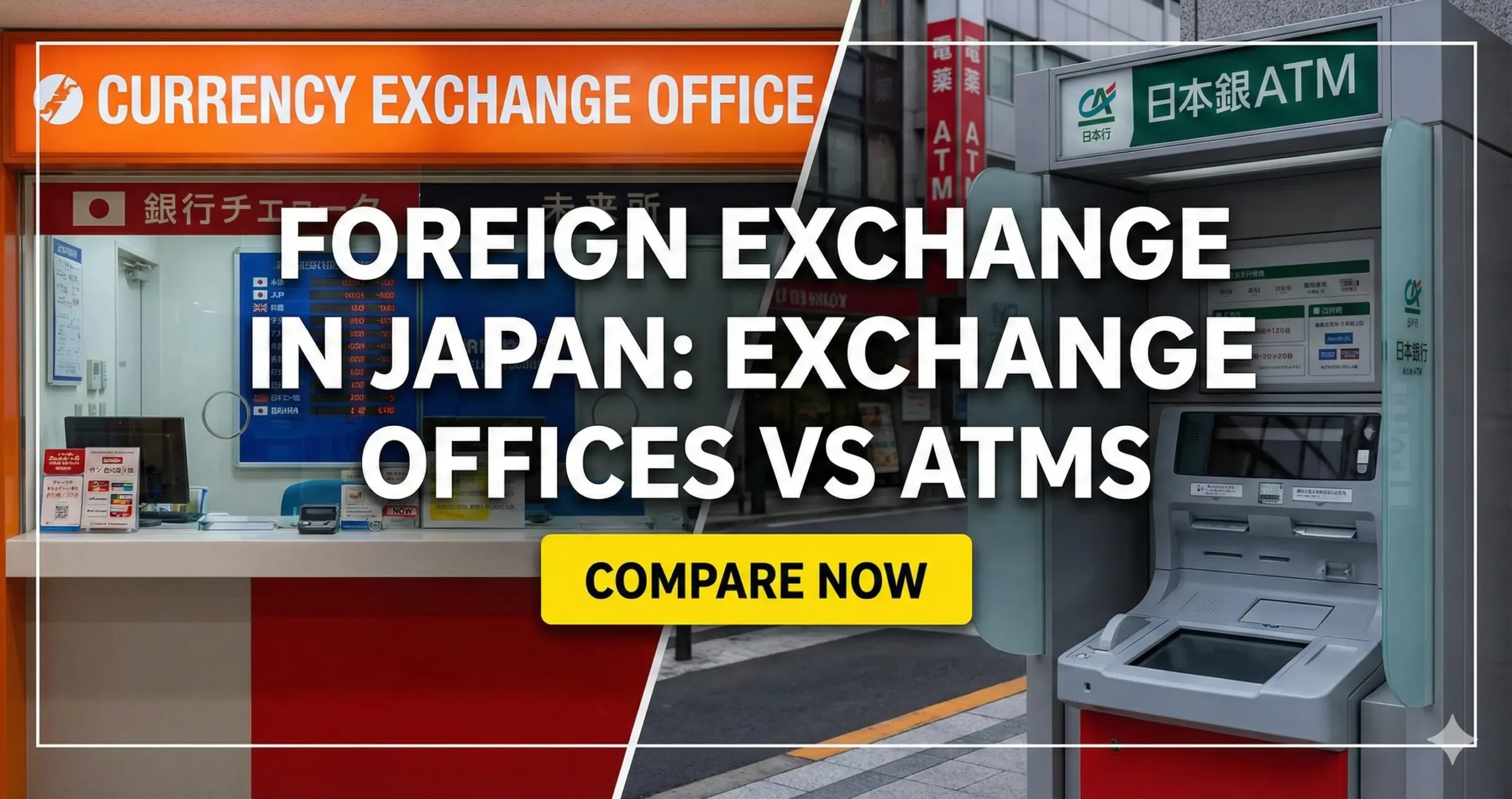
Exchange offices vs ATMs in Japan: cost comparison
Now let’s compare the two methods side by side. Remember that actual numbers change with the exchange rate and your bank’s rules. These are typical patterns, not exact promises.
Typical cost profile
| Method | How it works | Typical rate/fees pattern | Overall cost (rough) | Best for |
|---|---|---|---|---|
| Airport exchange counter | You hand over foreign cash and receive yen | Large rate margin; “0% commission” but poor rate | Usually most expensive | Emergency cash right after landing |
| City exchange office | You bring cash to a bank branch or exchange shop in town | Better than airport; still a margin vs mid-market | Medium cost, sometimes competitive | Converting cash you already have |
| Hotel front desk | Change small amounts at reception | Very poor rate, limited transparency | Very high cost | Last-minute, small amounts only |
| ATM with good travel card | Withdraw yen from Seven Bank, JP Bank or other ATM using Visa/Mastercard debit/credit card | Visa/Mastercard rate + small ATM fee + your bank’s FX fee | Often cheapest overall for major currencies | Regular withdrawals during your trip |
| ATM with high-fee card | Same as above, but your bank adds high FX and ATM fees | Good core rate, but your bank eats the saving | Can be medium or high cost | Only option if your bank charges high fees |
Recent 2024–2025 travel guides summarise it this way:
- Best combination of rate and convenience: ATMs with a Visa or Mastercard debit or credit card.
- Easiest but expensive: airport and hotel exchange counters.
- Good backup: city exchange shops and major bank branches.
When to prefer exchange offices
Even though ATMs are usually cheaper for major currencies, exchange offices still make sense in several situations.
You already hold a lot of foreign cash
If you are carrying a large amount of USD, EUR or another major currency, changing some of it in Japan is reasonable.
- Exchange only part at the airport, then compare city exchanges later.
- For moderate amounts, you can treat exchange shops as a backup to your cards.
Your bank charges very high foreign ATM fees
Some banks add a flat fee to each foreign ATM withdrawal. If that fee is large, your cost per withdrawal may become worse than a decent exchange office rate.
In that case:
- Either switch to a better card before travel, or
- Use exchange offices for larger one-time conversions rather than many small ATM withdrawals.
Your card sometimes fails
Card networks are very reliable in Japan, but problems can still happen:
- Bank fraud systems blocking foreign transactions
- Damaged magnetic stripe or chip
- Temporary network issues
Having some foreign cash to exchange gives you peace of mind.
If you plan to stay in Japan longer term, you can reduce this risk by setting up local accounts and cards, as explained in our bank account opening guide for foreigners in Japan.
When to prefer ATMs
You want the best overall exchange rate
Multiple up-to-date travel money guides for Japan say the same thing:
“To get the best exchange rates in Japan, skip airport exchange counters and head straight to 7-Eleven ATMs or major banks.”
For most travellers from major-currency countries, a good debit card + Japanese ATM beats physical exchange offices.
You want to avoid carrying lots of cash
Japan is very safe, but carrying the equivalent of thousands of dollars in cash still feels risky.
Using ATMs means you can:
- Withdraw smaller amounts more often
- Keep most of your funds in the bank until needed
- Track spending more easily through online banking
Articles on safe travel and money in Japan also highlight that a mix of card + limited cash works very well today.
You are a long-term resident
If you live in Japan, you will likely:
- Have local income paid into a Japanese account
- Use local debit cards or cash cards at Japanese ATMs
In this case, you will usually avoid exchange offices completely, unless you are converting yen back to foreign currency before a trip or when leaving Japan. For that, see our guides on taking money out of Japan when you leave.
Practical strategy: combining ATMs and exchange offices
The best approach is usually not “ATMs only” or “exchange offices only”, but a smart mix:
Before you travel
- Check your cards
- Confirm your PIN works.
- Ask your bank about foreign ATM fees and FX mark-ups.
- If possible, get a card with no foreign transaction fee.
- Bring some emergency cash
- Enough for a taxi or train, one night of food, and maybe a SIM card.
- USD or EUR are easiest to change if needed.
- Save ATM locations
- Use your card network’s ATM locator or the Seven Bank / Japan Post Bank ATM locators to pin a few machines near your hotel and major stations.
After you land in Japan
- Change a small amount or use the first ATM
- At the airport, you can either:
- Use an international ATM right away, or
- Exchange a small amount at a counter for immediate needs.
- At the airport, you can either:
- Test your card at a major ATM
- Once in the city, try a Seven Bank or Japan Post Bank ATM to confirm your card works and see the on-screen fees.
- Compare with one city exchange shop
- If you have foreign cash, compare the effective rate between:
- ATM withdrawal (including fees), and
- A city exchange office rate posted on a board.
- If you have foreign cash, compare the effective rate between:
During your stay
- Use ATMs for most of your cash needs.
- Keep one or two good exchange offices in mind as a backup if your card has problems.
- Always choose “charge in yen” (local currency) and decline DCC when an ATM or terminal offers to charge you in your home currency.
Common questions about foreign exchange in Japan
Should I exchange money before I arrive, or after I land in Japan?
Most recent travel guides say:
- Exchange a small amount before departure or at your home airport if it makes you feel safer.
- But plan to get most of your yen in Japan, ideally at ATMs or good city exchanges, not at home or at hotel desks.
How much cash should I carry?
It depends on your style, but many visitors are comfortable with:
- Around ¥10,000–¥30,000 (roughly one or two days of normal expenses), and
- More cash if you are travelling to rural areas with fewer ATMs or card terminals.
Check our Japan cost of living guide to estimate how much cash you personally need.
Do ATMs in Japan always work 24/7?
Not always.
- Convenience store ATMs (7-Eleven, Lawson, FamilyMart) are usually close to 24/7.
- Post office and bank branch ATMs can have limited hours, especially in smaller towns.
This is another reason to carry a small cash buffer and not wait until the last minute.
Are there any safety issues with using ATMs in Japan?
Japan is one of the safest countries in the world. ATM-related crime is rare, especially in well-lit locations such as convenience stores and stations.
Still, follow basic precautions:
- Cover the keypad when entering your PIN
- Avoid leaving cash visible
- Use indoor ATMs (convenience stores, banks, stations) rather than isolated street machines at night
Is it better to use a credit card, debit card, or cash?
For many visitors and residents, a mixed approach works best:
- Debit card at ATMs for cash
- Credit card with no foreign transaction fees for hotels, big shops, and online bookings
- Cash for small restaurants, local shops, and rural areas
Our guide on credit card use in Japan explains where cards are accepted and how to avoid surprises.
Final tips
- ATMs with a good card usually beat exchange offices on both rate and convenience, especially for major currencies.
- Use airport and hotel exchange counters only for small amounts or emergencies.
- Always choose to be charged in yen, not your home currency, to avoid DCC mark-ups.
- Keep a small amount of foreign cash and know at least one reliable city exchange shop as backup.
With a little planning, you can keep your foreign exchange costs low and enjoy Japan without worrying about where the next yen is coming from.
Disclaimer
This article is for general informational purposes only and does not constitute professional advice. Laws, prices and regulations vary by location and change over time. Consult a qualified professional for guidance on your specific situation.