Biking in Japan: Renting Bicycles and Cycling Rules
A guide to renting bikes in Japan and riding legally and safely—covering city bike-shares, costs, insurance, helmets, e-bike rules, sidewalk etiquette, parking, impound fees, and how to bring your bike on trains with a rinko bag. Great for residents and travelers.
Disclosure: This post may contain affiliate links. We may earn a commission at no extra cost to you if you make a purchase through these links. Read full disclosure.
Why biking in Japan is worth it
Cycling is one of the easiest ways to get around Japanese cities. It’s affordable, healthy, and often faster than buses in dense neighborhoods. From quick trips to the station to weekend rides along rivers, bikes fit daily life. To enjoy it stress-free, you need two things: a simple way to rent (or share) a bicycle and a clear understanding of Japan’s cycling rules.
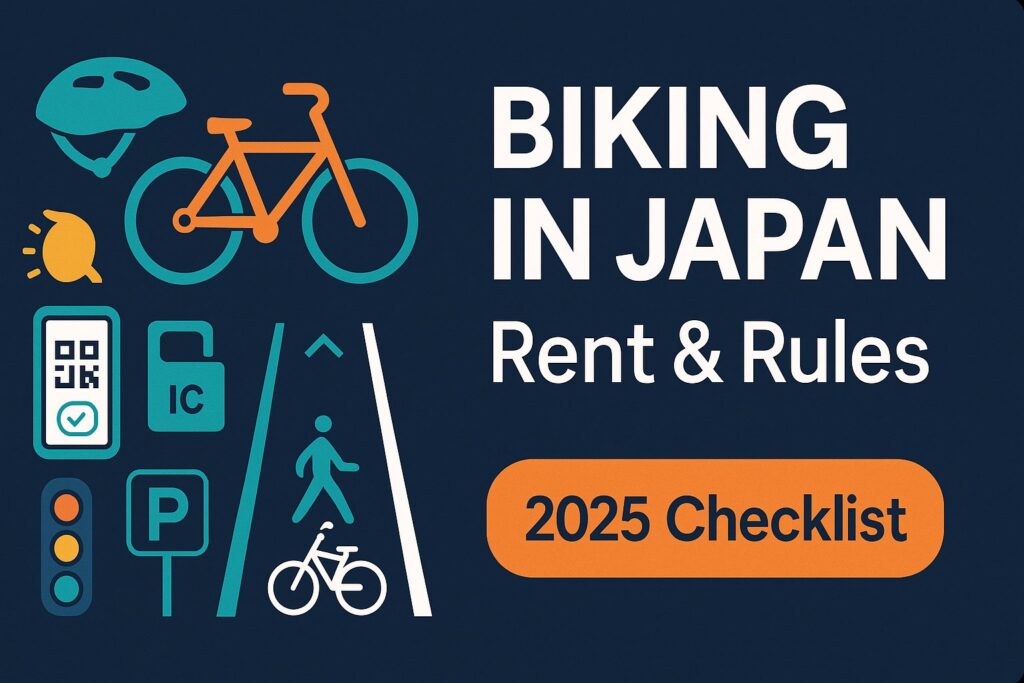
Quick start: Renting and sharing bikes in Japanese cities
City bike-shares are everywhere—especially in Tokyo, Yokohama, Osaka, Kyoto, Kobe, Nagoya, Hiroshima, and more. The biggest names are Docomo Bike Share, HELLO CYCLING, and LUUP (e-bikes and e-scooters).
Bike-share at a glance
| Service | Where it operates (examples) | Typical pricing model | Registration and app notes | Good to know |
|---|---|---|---|---|
| Docomo Bike Share | Tokyo (multiple wards) and other cities | One-time or monthly plans; charged from unlock until return (tax-included) | Register in-app; return to a designated Bike Station only. Extension fees apply if you park outside a station. | All bikes are electric-assist. Popular for short hops and sightseeing. |
| HELLO CYCLING | Broad coverage in major cities | Pay-per-30-minute blocks; easy point-to-point returns | Known for lower prices and user-friendly flow; English guidance available via third-party explainers. | Availability varies by neighborhood; good option when Docomo stations are full. |
| LUUP (e-bikes & e-scooters) | 25+ cities; growing network | Time-based per minute | No driver’s license for e-scooters (16+), but you must follow “specified small motorized bicycle” rules; app required. | Handy for short intra-city trips and first/last-mile connections. |
Tip for visitors: Some guides note that certain Docomo flows expect a Japanese mobile number at registration. If you only have a foreign SIM, check current app requirements before you head to a station.
Planning more than a quick stay? Buying a basic “mamachari” or an e-assist city bike can be cost-effective. If you buy, learn about bicycle registration (防犯登録; bouhan tōroku)—it’s legally required and takes minutes at bike shops. Also Read: Trash and Recycling in Japan , Cost of Living in Japan 2025 – Expenses Breakdown
Must-know cycling rules in Japan
Japan treats bicycles as “light vehicles” under the Road Traffic Act. That means you’re expected to follow traffic signals and ride predictably, mostly on the left side of the roadway—sidewalk riding is the exception, not the rule. National and local agencies publish clear guidance:
- Keep left on the road. When you must use a sidewalk that’s signed/marked for bicycles, ride slowly, keep to the side nearest the roadway, and yield to pedestrians.
- Obey all traffic lights and stop signs. Bicycles must stop; signals apply to you.
- Lights at night, reflectors required. Ride with a working front lamp and rear reflector after dark.
- Use the bell sparingly. Many prefectures require a bell on the bike, but you shouldn’t ring it to “push” pedestrians—only to prevent danger.
- One person per bike (unless you’re 16+ carrying a child under 6 in an approved child seat). Side-by-side riding is generally prohibited unless specifically permitted.
- No drunk cycling; no phones while riding. Police can issue citations and, for serious cases, impose heavier penalties. National and local safety campaigns emphasize enforcement.
- Helmet rule (since April 1, 2023). All riders have a duty of effort to wear a helmet—the law encourages helmets for all ages. Many cities promote it with active campaigns.
Tokyo’s police also mark lanes and turn guides: watch for bicycle navigation marks on the left and painted guides in intersections.
Table: Key cycling rules and what they mean day-to-day
| Rule | What it means for you |
|---|---|
| Ride on the left; sidewalks only where signed; pedestrians first | Expect to be on the roadway most of the time. On shared sidewalks, you’re a guest—slow down, keep right next to the curb, and dismount when crowded. |
| Stop at red lights and stop signs | Treat signals like a driver would—no rolling through reds. |
| Headlight + rear reflector at night | Carry a compact light or make sure your rental has one; it’s required after dark. |
| Bell equipped; use only to avoid danger | Don’t “bell” pedestrians to clear your path; slow or dismount instead. |
| No riding under the influence; no phones while rolling | Walk the bike if you need to text or call. |
| Helmet “duty of effort” for all riders | Not a fine-based mandate, but strongly encouraged—especially on busy roads. |
Coming in 2026: Several media and expat outlets report that stricter fine schedules (e.g., for smartphone use) are slated under broader enforcement updates. Follow official NPA and local announcements as 2026 approaches. See Also: Trash and Recycling in Japan , Cost of Living in Japan 2025 – Expenses Breakdown
Insurance, registration, and ID checks
Third-party liability insurance
Many prefectures now require cyclists to carry liability insurance. In Tokyo, enrollment has been mandatory since April 2020 (applies to children too). Osaka, Hyogo, and others have similar ordinances. Policies are inexpensive and often bundled with renters’, fire, or auto insurance, or sold at convenience stores.
Bicycle registration (防犯登録)
When you buy, inherit, or bring in a bike, register it with the police via a shop. The fee is small (shops handle paperwork) and lets police return stolen or impounded bikes. If you give away or sell your bike, cancel or transfer the registration. Expect spot checks—police routinely confirm ownership.
Read More: Using Taxis and Ride Apps in Japan: Fees, Tips, and Safety, Top 10 Tips for Using Tokyo Subways and Trains , Japanese SIM Card and Internet Plan,
E-bikes and e-scooters: what’s legal on the road
Japan is strict about what counts as a bicycle vs a motorized vehicle. If you plan to rent or buy an electric model, know these differences:
Electric-assist bicycles (pedal-assist only)
- Motor assists pedaling; no throttle riding.
- Assist cuts out above 24 km/h, and assist power is capped against human input. National agencies warn about non-compliant imports/conversions.
Throttle e-bikes or modified conversions
- Treated as motorized bicycles (like mopeds), which require registration, plates, insurance, and a license—not allowed as bicycles.
Shared e-scooters (new category since July 1, 2023)
- Classified as “specified small motorized bicycles” with special rules: 16+, license not required (if meeting the category specs), device-specific speed caps, and other traffic rules. Operators such as LUUP adjusted services to comply.
Table: What you can ride where
| Vehicle | Ride on roadway | Ride on (signed) sidewalks | License needed | Age limit | Notes |
|---|---|---|---|---|---|
| Standard bicycle | Yes (keep left) | Yes, where designated; pedestrians first | No | None | Lights at night; bell; follow signals. |
| Electric-assist bicycle (legal, pedal-assist) | Yes | Yes, where designated | No | None | Assist must stop at 24 km/h; beware non-compliant models. |
| Throttle e-bike / converted bike | Only if registered/licensed as a motorized bicycle | No | Yes | 16+ (as motorized rules apply) | Treated like a moped if throttle/over-spec. |
| Specified small e-scooter | Yes (category rules) | In limited conditions per law | No (if within category) | 16+ | Operator apps enforce safety/education steps. |
Read More: Using Taxis and Ride Apps in Japan: Fees, Tips, and Safety, Top 10 Tips for Using Tokyo Subways and Trains , Japanese SIM Card and Internet Plan,
Renting with children
Many families use electric “mamachari” with child seats. The law allows a rider 16+ to carry one child under 6 in an approved seat; carrying two children requires a bike that meets specific safety standards (look for BAA or SG + “double child-seat” markings). Follow local signage and avoid sidewalks unless marked.
Sidewalks, bike lanes, and painted guides
Japan is building out more bicycle markings. In Tokyo you’ll see bicycle navigation marks on the left edge of the road and navigation lines in intersections, showing preferred paths through turns. Treat them like visual “rails” to stay predictable for drivers and pedestrians.
When a sidewalk is signed for bikes, roll slowly, keep to the roadway side, and be ready to stop or walk when pedestrians are present. (This is where manners matter most.)
Where and how to park a bicycle
Unauthorized street parking—especially near stations—is heavily enforced. Many wards designate no-parking zones and immediately impound bicycles blocking sidewalks or entrances.
- Example: Minato City (Tokyo) charges ¥2,000 to retrieve an impounded bicycle (scooters ¥3,000). Expect similar fees in other wards.
Look for municipal bike lots (short-term racks near stations; long-term paid garages for commuters). If you see 駐輪禁止 (no bicycle parking), do not leave your bike there—expect removal.
Bringing your bike on trains: the rinko system
One of Japan’s best bike hacks is rinko: you disassemble or fold your bike and put it in a rinko bag to ride any train (including Shinkansen) without extra fees, subject to each railway’s baggage rules. Key points:
- JR companies and many private railways allow bikes only when fully bagged; typical baggage limits apply (e.g., combined dimensions ≤ 250 cm, weight ≤ 30 kg).
- Most cyclists use cars at the front or rear of the train and avoid rush hours. Guides from Japan’s cycling community explain bag types and packing steps if you’re new to rinko.
If you plan to intermix public transport and cycling regularly, a small, quick-pack rinko bag can change the way you explore regions like the Arakawa/Tama rivers and coastal Kanagawa. (Some JR “cycle trains” even let you keep the bike assembled on specific services.)
Safety checklist before each ride
- Fit and brakes. Squeeze both levers; wheels should spin true and stop cleanly.
- Lights on. Rentals usually switch on automatically when riding; check before dusk.
- Bell present, don’t overuse. Keep it as a last-resort warning.
- Insurance proof (where required). Tokyo and several prefectures mandate third-party liability coverage.
- Route preview. Prefer river paths and marked lanes. Expect drivers to be cautious but assume they may not see you.
- Phone off the handlebar. Pull over to use it.
Renting vs buying: costs and considerations
If you’ll cycle occasionally, stick to Docomo Bike Share or HELLO CYCLING. You’ll avoid maintenance and parking hassles, and you can return bikes near your destination.
If you’ll ride daily, consider buying a used city bike and a paid monthly spot at a bike garage near your station. Register the bike, add liability insurance, and budget for a helmet and a small LED light.
Sample itineraries for new riders
- Tokyo riverside sampler: Pick up a Docomo e-bike near Asakusa, roll north along the Sumida/Arakawa levees, and return at a different ward station. Low stress, big views. (The Financial Times outlines classic Greater Tokyo routes if you get the bug.)
- Kyoto family day: Rent an electric mamachari with a child seat, stick to riverside paths and signed sidewalks, and park only in marked lots. Double-check child-seat standards (BAA/SG) when renting.
Read More: Using Taxis and Ride Apps in Japan: Fees, Tips, and Safety, Top 10 Tips for Using Tokyo Subways and Trains , Japanese SIM Card and Internet Plan,
Common mistakes to avoid
- Riding on any sidewalk at full speed. Sidewalk cycling is an exception and always pedestrian-first.
- Parking anywhere “for just a minute.” Near stations, that minute can become an impound and a fee.
- Assuming throttle e-bikes are fine. If it moves without pedaling, it’s likely not a legal bicycle—treat it like a moped with license/plate requirements.
- Skipping insurance in Tokyo/Osaka. It’s required; policies are cheap and protect you from huge claims.
- No lights at night. Rentals usually include them, but check—police enforce night-lighting.
Frequently asked questions
Can I rent a bike if I only have an overseas phone number?
Possibly, but some flows require a Japanese number, particularly with certain Docomo registration paths. Check the latest app requirements and consider HELLO CYCLING as a fallback.
Can I bring my rental on a train?
Usually no—city bike-share bikes must be returned to their stations. If you want to combine train + cycling, rent a private shop bike that allows rinko, or ride your own and bag it. Railway rules require complete enclosure in a bag; typical size/weight limits apply.
Are helmets mandatory?
Japan has a duty-of-effort rule for all ages since April 1, 2023. There’s no nationwide fine for adults, but wearing one is strongly encouraged and widely promoted. Kids’ helmet rules can be stricter under local ordinances.
What about e-scooters?
If they’re classified as “specified small motorized bicycles,” riders must be 16+ (no license), follow device limits, and obey category-specific traffic rules. When in doubt, check the operator’s legal summary in the app.
Read More: Using Taxis and Ride Apps in Japan: Fees, Tips, and Safety, Top 10 Tips for Using Tokyo Subways and Trains , Japanese SIM Card and Internet Plan, Trash and Recycling in Japan , Cost of Living in Japan 2025 – Expenses Breakdown
The bottom line
Cycling in Japan is safe, convenient, and fun—if you follow the rules. Keep left, respect pedestrians, light up at night, wear a helmet, insure yourself where required, and park only where allowed. For casual rides, city bike-shares like Docomo and HELLO CYCLING are perfect. For weekend adventures, learn rinko and take your bike by train. Do it right and you’ll discover quiet side streets, river paths, and daily life that you’ll miss from behind a car window.
Disclaimer
This article is for general informational purposes only and does not constitute professional advice. Laws, prices and regulations vary by location and change over time. Consult a qualified professional for guidance on your specific situation.