
JR Regional Passes vs Individual Tickets Which Pass Fits Your Route 2027 Scenarios
Watching your parents spend 50,000 yen each on nationwide JR passes for a simple Tokyo to Kyoto round trip is financially devastating. I once let visiting friends drastically overpay for domestic travel because I failed to understand how the new regional pass borders actually worked. This guide breaks down exactly when to buy regional JR passes versus individual tickets to save your itinerary.
Disclosure: This post may contain affiliate links. We may earn a commission at no extra cost to you if you make a purchase through these links. Read full disclosure.
The Post Price Hike Reality for Japan Travel
When you first move to Japan, you are constantly asked by friends back home about the mythical Japan Rail Pass. For decades, it was the ultimate travel cheat code, offering unlimited bullet train rides for a fraction of the actual cost. However, recent corporate shifts have completely destroyed this reality, forcing expats to become meticulous travel accountants for their visiting families.
Why the Nationwide JR Pass is Dead for Most
In late 2023, the Japan Railways Group executed a staggering 70 percent price increase on the nationwide JR Pass. A standard seven-day pass, which historically cost roughly 29,000 yen, suddenly skyrocketed to 50,000 yen. This single administrative decision fundamentally altered how tourists and their expat hosts must approach domestic travel planning, rendering old blog posts and outdated travel advice completely obsolete.
To understand the mathematical devastation, you must look at the standard Tokyo to Kyoto round trip. Buying individual point-to-point Shinkansen tickets for this route costs roughly 28,000 yen. Under the old pricing model, the nationwide pass paid for itself almost immediately. Under the new 50,000-yen pricing model, your visiting family members are losing 22,000 yen each unless they plan to spend their entire vacation sitting on a train traveling to the extreme ends of the archipelago.
As an expat, you are already disqualified from using these passes due to your residency status. However, your temporary visitor guests will instinctively try to buy them. You must aggressively step in and stop them. Managing your own tight local budget using the strategies outlined in Cost of Living in Japan 2026 Expenses Breakdown is hard enough; subsidizing massive, unnecessary travel losses for your family will completely derail your finances.
The Nightmare of Official JR Booking Sites
Once you realize the nationwide pass is mathematically dead, the logical pivot is to buy individual point-to-point tickets or cheaper regional passes. The immediate instinct is to use the official JR domestic booking platforms, such as JR East’s Ekinet or JR West’s SmartEX. In theory, going directly to the source should be the most reliable option. In practice, it is a deeply localized e-commerce nightmare.
Japan’s domestic ticketing sites utilize an extremely sensitive, outdated version of the 3D Secure anti-fraud protocol. This system is notoriously hostile to foreign-issued credit cards, routinely and violently rejecting Western Visa, Mastercard, and American Express transactions without any clear explanation. You will spend an hour painstakingly inputting your family’s passport details into the domestic site, only to have your card blocked at the final checkout screen.
When your card is rejected, the official sites often generate a payment code and force you to physically walk to a convenience store within 24 hours to pay for the reservations in physical cash. This is a profound administrative headache that perfectly mirrors the systemic financial lockouts we discuss heavily in Arriving Without a Japanese Bank Account Payment Workarounds for Visa School Steps. Attempting to handle group transit bookings directly through domestic channels almost always ends in extreme frustration and wasted time.
Why Klook is the Expat Travel Hack
To completely bypass this logistical and financial nightmare, financially intelligent expats universally rely on Klook. As a massive Asian travel platform, Klook has fundamentally solved the Japanese ticketing crisis by bridging the gap between rigid domestic infrastructure and modern international payment gateways.
Because Klook operates globally, their payment processor gladly accepts nearly every foreign-issued Visa, Mastercard, American Express, and Apple Pay transaction without throwing the dreaded Japanese 3D Secure errors. You can secure Shinkansen tickets and regional passes for your entire family from the comfort of your living room, ensuring the payments clear on the very first attempt. This removes the anxiety of losing your carefully planned reservations.
Furthermore, booking through Klook plunges you into a highly lucrative loyalty ecosystem. Every time you purchase a massive batch of transit tickets for your visiting relatives, you earn Klook Credits. You can later apply these accumulated credits to heavily discount your own domestic travel. We detail the exact mathematics of this double-discount strategy extensively in our Klook Japan Discount Guide How to Stack Coupons App Deals and Seasonal Promotions 2026. By routing all guest expenses through this platform, you actually subsidize your own expat lifestyle.
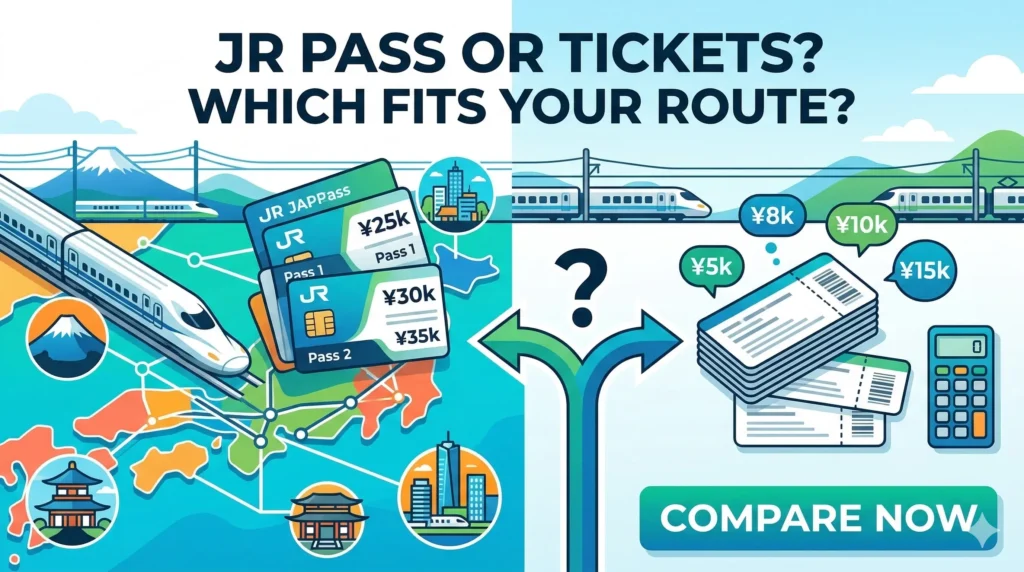
Scenario One The Golden Route Debate
The vast majority of first-time visitors to Japan want to travel the “Golden Route,” moving from Tokyo down to Kyoto and Osaka, and then returning to Tokyo for their flight home. Because the nationwide pass no longer makes sense for this, you have two primary options to evaluate carefully.
Breaking Down Tokyo to Osaka Costs
As established, a round-trip ticket from Tokyo to Osaka via the Tokaido Shinkansen costs roughly 29,000 yen. The journey takes exactly two and a half hours each way if you ride the Nozomi, which is the fastest class of bullet train. For a family of four, this represents a massive, unavoidable travel expense that must be managed efficiently.
Many tourists will try to convince you to book domestic budget flights instead to save money. You must immediately shut this down. Once you factor in the cost of the Narita Express train to get to the airport, the mandatory luggage fees charged by low-cost carriers, and the transit from Kansai International Airport into central Osaka, the “cheap” flight costs exactly the same as the bullet train but takes five stressful hours. We thoroughly debunk the budget airline illusion in Shinkansen vs Domestic Flights Cheapest Way to Travel Between Major Cities.
For the standard, fast-paced Golden Route, buying individual point-to-point Shinkansen tickets is unequivocally the best option. Using Klook to buy these individual tickets guarantees you access to the Nozomi trains (which were historically heavily restricted under the old JR Pass rules) and allows you to instantly reserve the mandatory oversized luggage seats required for large suitcases, protecting your family from onboard fines.
The Hokuriku Arch Pass Alternative
If your visiting family has a slower travel pace and wants to see the Japanese Alps, there is a regional pass loophole that perfectly covers the Tokyo to Kyoto journey: the Hokuriku Arch Pass. This pass costs roughly 30,000 yen for seven consecutive days of unlimited travel.
Instead of taking the direct coastal route on the Tokaido Shinkansen, the Arch Pass routes you north through Nagano, Toyama, Kanazawa, and Fukui before curving down into Kyoto and Osaka. It creates a massive arch across the main island of Honshu. Because the pass costs almost exactly the same as a direct round-trip Shinkansen ticket, it essentially gives your family a free multi-day detour through some of Japan’s most stunning, culturally rich prefectures.
If you are hosting relatives who want to see traditional samurai districts, eat fresh seafood at the Omicho Market in Kanazawa, and visit the famous Kenrokuen Garden, the Hokuriku Arch Pass offers staggering financial value. You can purchase this pass effortlessly via Klook and have the digital exchange order instantly emailed to you, bypassing the manual ticket counters entirely.
When to Stick to Individual Shinkansen Tickets
However, you must be completely realistic about your family’s stamina and travel experience. Taking the Hokuriku Arch route takes roughly five hours of total train time to reach Kyoto, compared to the two and a half hours on the direct Nozomi train. If your guests are exhausted, jet-lagged, and only have a strict seven-day vacation window, forcing them to take the long scenic route will ruin their trip.
If speed and convenience are the priority, do not buy any passes at all. Stick to individual Shinkansen tickets. The stress of trying to maximize a pass often leads to terrible, rushed itineraries that leave everyone miserable.
When you book these individual tickets on Klook, you receive a digital QR code. You bypass the massive, chaotic lines at the manual ticket counters, walk directly up to the Shinkansen ticketing machine at Tokyo Station, scan your smartphone screen, and instantly print your physical boarding passes. It is the absolute pinnacle of streamlined travel logistics.
Scenario Two Deep Exploring the Kansai Region
If your family is flying directly into Kansai International Airport (KIX) and using Osaka or Kyoto as their base camp for the entire week, their transit needs shift dramatically. Point-to-point Shinkansen tickets from Tokyo are no longer the primary concern; regional flexibility becomes the priority.
The Kansai Wide Area Pass Explained
The Kansai region is heavily interconnected, making day trips to neighboring prefectures incredibly popular and accessible. If your guests want to see the deer in Nara, eat premium beef in Kobe, visit the spectacular Himeji Castle, and take a quick Shinkansen ride down to Okayama, paying for these local and express trains individually will quickly drain their budget.
This is where the JR Kansai Wide Area Pass becomes the undisputed champion of Japanese travel. For roughly 12,000 yen, this pass grants five consecutive days of unlimited travel on local JR trains, limited express trains (like the Haruka airport express), and even the Sanyo Shinkansen between Shin-Osaka and Okayama.
The mathematics of this pass are undeniably excellent. A single round-trip Shinkansen ride from Shin-Osaka to Okayama costs around 11,000 yen. By making just that one day trip to see the famous Korakuen Garden, the pass nearly pays for itself, rendering all subsequent travel to Kyoto, Nara, and Kobe completely free for the rest of the week.
Bypassing Ticket Office Lines in Osaka and Kyoto
The major caveat to regional passes is the physical redemption process. Historically, you had to take your paper voucher to the “Midori no Madoguchi” (the JR green ticket office) to exchange it for the actual magnetic pass. At Kyoto Station and Shin-Osaka Station, these ticket office lines routinely stretch out the door, forcing you to stand in a suffocating queue for up to 90 minutes.
When you are trying to maximize a tight Kyoto itinerary, standing in a train station line is disastrous. We highlight how to avoid similar time-wasting traps at major temples in Kyoto First-Timer Plan Best Temples Klook Experiences That Save Time Avoiding Lines. You must fiercely protect your time when hosting visitors.
Fortunately, Klook has modernized this redemption process. When you purchase the Kansai Wide Area Pass on their platform, you receive a digital e-voucher with a QR code. You do not need to wait in the manual ticket office line. You simply locate a green JR ticket machine that has a physical passport scanner attached to it. You scan the Klook QR code, scan your family member’s passport chip, and the machine instantly spits out the physical rail pass.
Integrating City Passes for Maximum Value
It is critical to remind your visitors that JR passes only cover trains operated by the Japan Railways Group. They do not cover municipal subways, such as the Osaka Metro, or private city bus networks in Kyoto, which are essential for reaching inner-city temples.
To ensure your family can navigate the inner-city grids without constantly digging for loose change, you should integrate regional transit with dedicated city attraction passes. You can use Klook to bundle regional transit alongside the Klook Pass Osaka, which grants free entry to major observation decks and museums. We thoroughly analyze the massive financial savings of these bundles in Klook City Passes in Japan Are Attraction Bundles Actually Cheaper Tokyo Osaka Kyoto. By separating long-haul regional travel from inner-city subway transit, you build an impenetrable, highly efficient budget.
Scenario Three The Mount Fuji and Hakone Trap
The most common and financially punishing mistake first-time tourists make is assuming that a “Japan Rail” pass covers every single train track in the country. This assumption completely falls apart the moment they try to visit the Mount Fuji and Hakone regions.
Why JR Passes Fail in the Fuji Region
Mount Fuji and the surrounding hot spring town of Hakone are located just south of Tokyo. Because they are so famous, tourists blindly buy JR passes expecting to ride the bullet train directly to the mountain. This is geographically impossible and demonstrates a severe lack of route planning.
The transit networks surrounding Mount Fuji, Hakone, and the Fuji Five Lakes are almost entirely owned and operated by private railway conglomerates, primarily the Odakyu Electric Railway and the Fujikyu Railway. Your expensive JR pass is completely useless on these tracks. If your family tries to use their JR pass to get to Lake Kawaguchiko, they will be forced to disembark halfway, buy completely new private railway tickets, and wait for obscure local transfers. We explore how to bypass this specific transit hell entirely using private chartered coaches in Tokyo Day Trips Best Klook Tours for Mt Fuji Hakone Nikko and Kamakura Ranked by Value.
The Hakone Free Pass Solution
If your guests insist on doing the Hakone journey independently to experience the traditional hot springs and ryokans, you must explicitly direct them to buy the Odakyu Hakone Free Pass instead of relying on a JR pass.
The Hakone Free Pass is an absolute masterclass in regional bundling. It covers the round-trip journey from Shinjuku Station in Tokyo down to Odawara, and provides unlimited access to every single mode of transportation within the Hakone loop. This includes the steep mountain switchback trains, the cable cars, the ropeway over the boiling volcanic vents of Owakudani, and the famous pirate ship cruise across Lake Ashi.
If you attempt to pay cash for each of those scenic transit rides individually, the cost will be astronomical. The Hakone Free Pass pays for itself almost instantly, completely insulating your family from unexpected transport fees while exploring the national park.
Securing Private Railway Tickets as a Foreigner
Attempting to book Odakyu tickets or the Hakone Free Pass through the official Japanese Odakyu website can be just as frustrating as dealing with JR’s payment gateways. The domestic sites often require complex registrations, demand full-width katakana inputs, and frequently reject foreign cards.
Once again, Klook serves as the ultimate digital mediator for these private lines. You can purchase the Hakone Free Pass directly through their app. The digital pass lives safely on your smartphone, allowing you to simply flash your screen to the station attendants as you board the pirate ships and cable cars. It completely removes the anxiety of losing physical paper tickets while hiking through the volcanic mountains, keeping your logistics perfectly streamlined.
Scenario Four Northern Japan and Kyushu Adventures
If you are hosting experienced travelers or looking to escape the crowded Golden Route to explore deeper prefectures—a strategy we highly encourage in Choosing Where to Live in Japan A Region by Region Expat Guide—regional passes become absolutely mandatory for survival.
Conquering Hokkaido with Regional Passes
Hokkaido, the massive northern island, is defined by staggering geographical distances. Traveling from the southern port city of Hakodate up to the capital of Sapporo, and then onward to the flower fields of Furano, involves hundreds of kilometers of rail through harsh, beautiful terrain.
Buying individual point-to-point tickets in Hokkaido is financially ruinous. The JR Hokkaido Rail Pass is the only viable way to survive this region. Because the island’s rail network is heavily subsidized to maintain connectivity through brutal winters, the regional pass offers unlimited access to limited express trains that bridge these massive gaps. Purchasing a 5-day or 7-day Hokkaido pass via Klook allows your family to traverse the entire island without constantly worrying about distance-based fare calculations.
Navigating the Kyushu Rail Network
Conversely, the southern island of Kyushu offers some of the most scenic, beautifully designed luxury trains in the world, such as the Yufuin no Mori. Traveling from the food mecca of Fukuoka down to the volcanic bay of Kagoshima requires the use of the Kyushu Shinkansen, which can be incredibly expensive if bought a la carte.
The JR Kyushu Rail Pass is elegantly split into Northern, Southern, and All-Kyushu variants. If your family only wants to visit the hot springs of Beppu and Yufuin, the cheaper Northern Kyushu pass is perfect. This flexibility prevents you from overpaying for geographical zones you have no intention of visiting, keeping your travel budget lean and focused.
How to Digitize Your Rural Travel Logistics
When traveling deep into rural Hokkaido or Kyushu, you cannot rely on station attendants speaking English. Many small, unstaffed stations literally do not have a ticket window or an attendant on duty. You must have your logistics perfectly locked down before you leave the major metropolitan hubs.
By pre-booking all of your obscure regional passes on Klook, you ensure that your transit is fully paid for and securely stored on your device or exchanged at a major airport before you venture into the countryside. You do not want to be stranded in a snowy Hokkaido village trying to explain a complex transit route to a local conductor using broken Japanese. Secure your passes digitally, bypass the archaic domestic payment systems, and navigate the extreme ends of Japan with total confidence.
| Transit Strategy | Best Used For | Typical Cost | Value Rating |
| Nationwide JR Pass (7-Day) | Extreme cross-country travel (e.g., Tokyo to Hiroshima to Sapporo) | ~50,000 JPY | Poor (Unless traveling 5+ hours daily) |
| Individual Shinkansen Tickets | The standard Golden Route (Tokyo to Kyoto/Osaka direct) | ~28,000 JPY (Round trip) | Exceptional (Fastest travel time) |
| Hokuriku Arch Pass | Slower scenic travel between Tokyo and Osaka via the Alps | ~30,000 JPY | High (Great for 7-day leisurely trips) |
| JR Kansai Wide Area Pass | Base-camping in Osaka/Kyoto with day trips to Nara, Kobe, Okayama | ~12,000 JPY | Exceptional (Pays off in one trip) |
| Hakone Free Pass (Odakyu) | Escaping Tokyo to see Mt. Fuji views and hot springs | ~6,100 JPY | High (Covers all local ropeways/boats) |
Navigating Japanese domestic travel requires a tactical, mathematical approach. Stop fighting with domestic ticketing websites that actively reject your credit cards. Use Klook to secure your individual Shinkansen tickets for the Golden Route, deploy targeted regional passes for Kansai and Hokkaido, and protect your expat budget while showing your family the absolute best of Japan.
References
Primary sources (official)
- Japan Rail Pass Official Site: https://japanrailpass.net/en/
- East Japan Railway Company (JR East) Official Site: https://www.jreast.co.jp/multi/en/
- West Japan Railway Company (JR West) Official Site: https://www.westjr.co.jp/global/en/
Other helpful sources
- Japan Guide – Comprehensive JR Pass Details: https://www.japan-guide.com/e/e2361.html
- Klook Official Japan Rail Portal: https://www.klook.com/japan-rail/
Disclaimer
The transportation costs, transit times, and specific regional rail pass borders discussed in this article are provided for general informational and educational purposes only. Ticket prices for the Shinkansen, the nationwide Japan Rail Pass, and all regional variants are subject to continuous change by the Japan Railways Group and associated private railway companies without prior notice. The nationwide JR Pass and the vast majority of regional JR passes are strictly limited to foreign tourists entering Japan on a “Temporary Visitor” visa status; foreign residents, students, and working expats are legally disqualified from purchasing or using these specific tourist passes. The domestic Japanese anti-fraud protocols that block foreign credit cards on official JR booking sites (such as SmartEX) are managed by domestic financial institutions and may vary based on your specific card issuer. The digital e-vouchers, instant QR code integrations, and specific pass partnerships provided by Klook are managed exclusively by Klook Travel Technology Limited and are subject to their specific terms of service. While we strive to ensure the absolute accuracy of this travel logistics guide for 2026, readers must independently verify all current ticket prices, eligibility requirements, and redemption locations directly on the official Klook platform before making financial commitments. This article does not constitute professional travel agency or financial advice. Ensure all visiting family members secure the proper travel insurance before arriving in Japan.





