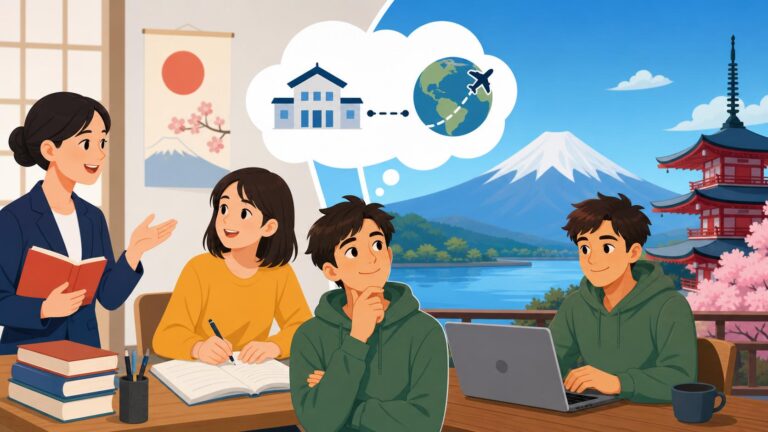
International Schools in Japan: Guide for Expat Families
International schools in Japan give expat kids a familiar, English-based education while they enjoy life in Japan. This guide explains school types, costs, locations, admissions, and how to choose the right school for your family’s long-term plans.
Disclosure: This post may contain affiliate links. We may earn a commission at no extra cost to you if you make a purchase through these links. Read full disclosure.
Understanding Your Education Options as an Expat Family
Japan’s public school system is excellent and basically free, but it runs almost entirely in Japanese. Foreign children can attend local public schools, paying only for things like uniforms, lunches, and materials.

Private and international schools are much more expensive. On average, private or international schools can cost around 2,000,000 yen or more per year in tuition alone—often five to six times the indirect costs you’d pay in public schools.
For many expat families, international schools are the best fit because they offer:
- English or other foreign-language instruction
- International curricula (IB, American, British, etc.)
- Smooth transitions if you move countries again
- A multicultural environment with many expat children
Later, you might also want to explore how school choice connects with your wider life in Japan, such as Cost of Living in Japan 2025 – Expenses Breakdown, Ultimate Expat Housing Guide in Japan – Renting, Bills, and Beyond as your situation changes.
What Is an International School in Japan?
In Japan, an international school usually means:
- Main language of instruction is English (or another foreign language)
- Curriculum is based on a foreign or global standard (IB, American, British, Canadian, etc.)
- Student body is highly international, including expat, bicultural, and globally minded Japanese families
- Credits, diplomas, and exams are recognized by universities overseas
Japan has a growing international school sector. Recent guides estimate dozens of international schools across Japan, with the largest concentration in Tokyo and the Kansai region (Osaka–Kobe–Kyoto), plus more schools in mid-size cities like Nagoya, Fukuoka, Hiroshima, and Sendai.
The Japan Council of International Schools (JCIS), for example, supports more than 25 member schools across major cities.
Why Expat Families Choose International Schools
Here are the main reasons expat parents choose international schools in Japan:
- Language continuity
- Children can keep learning in English (or their home language) and avoid falling behind.
- Many schools also teach Japanese as a second language.
- Global curriculum and diplomas
- Programs like the IB Diploma, IGCSE, AP, or A-Levels are widely accepted by universities worldwide.
- Easier transitions between countries
- If your family moves again, your child’s new school abroad may use a similar curriculum, making the move smoother.
- Multicultural environment
- Classrooms include children from many countries.
- Kids learn to communicate across cultures and build a global mindset.
- Support for expat life
- Many international schools are used to handling arrival mid-year, visa issues, and academic gaps.
- Counseling and language support are often stronger for non-Japanese speakers.
If you’re also planning your own career or studies, articles like Labor Laws in Japan: 10 Rights Foreign Workers Should Know, Job Hunting in Japan: How Foreigners Can Find Opportunities, or Scholarships for International Students – Japan 2025 connect well with planning your child’s education and your family’s long-term stay.
Types of International Schools in Japan
Different international schools in Japan follow different curricula. Understanding this is key to school choice.
IB Schools
Many schools in Japan offer the International Baccalaureate (IB):
- PYP (Primary Years Programme): roughly ages 3–11
- MYP (Middle Years Programme): ages 11–16
- DP (Diploma Programme): ages 16–19
IB focuses on:
- Inquiry-based learning
- Critical thinking
- Global citizenship and community service
IB is very popular with internationally mobile families and is accepted by top universities around the world.
American Curriculum Schools
These schools follow a US-style K–12 system and often offer:
- Courses aligned with US standards
- AP (Advanced Placement) classes at high-school level
- US-style report cards and GPA
- A direct pathway to American and Canadian universities
British Curriculum Schools
British-style schools in Japan commonly offer:
- Early Years and Primary based on the UK National Curriculum
- GCSE / IGCSE in lower secondary
- A-Levels for university preparation
They are a strong match if you expect your child to apply to UK or Commonwealth universities, or you come from a country familiar with the British system.
Canadian and Other National Curricula
Some schools in Japan follow other national systems, such as:
- Canadian curriculum with provincial diplomas
- Hybrid programs that mix local and global standards
These are good if you want a direct path back to that specific country for university.
Japanese–International “Fusion” Schools
You will also find “Japanese international schools” that:
- Teach in both Japanese and English
- Follow a mix of Japanese national curriculum plus IB or Cambridge
- Often serve bicultural families or Japanese families wanting more English exposure
These can be a nice bridge if your child might later transition to a Japanese public school or a Japanese university.
Table: Common International School Curricula in Japan
| Curriculum Type | Main Language | Typical Ages / Grades | Key Strengths | Best For Families Who… |
|---|---|---|---|---|
| IB (PYP / MYP / DP) | English | 3–19 (K–12) | Global focus, inquiry learning, strong DP | May move countries often; aim for global universities |
| American (US) | English | K–12 | Familiar US grades, AP, broad electives | Plan for US/Canada or US-style education |
| British (GCSE / A-Levels) | English | Primary–Year 13 | Clear exam path, strong subject depth | Prefer UK system or UK/Commonwealth universities |
| Canadian | English | Primary–High School | Provincial diploma, balanced academics | Plan to return or move to Canada |
| Japanese–International | Japanese + English | K–9 or K–12 | Bilingual, understanding of Japanese system | Want strong Japanese plus international exposure |
Where Are International Schools in Japan?
International schools tend to follow expat populations and international business hubs. Recent overviews show that most schools are concentrated in:
- Tokyo and Yokohama – largest number of options, many IB/American/British schools
- Kansai region (Osaka, Kobe, Kyoto) – several long-established international schools
- Nagoya, Fukuoka, Sapporo, Hiroshima – smaller but growing international school options
- Regional cities – a few smaller schools serving local international communities
Table: Major Regions with International Schools
| Region | Main Cities | What to Expect for Expat Families |
|---|---|---|
| Kanto | Tokyo, Yokohama | Highest number of schools, widest choice of curricula and facilities |
| Kansai | Osaka, Kobe, Kyoto | Strong, established schools; good mix of local and expat communities |
| Chubu | Nagoya | Fewer options but solid choices; serves auto and manufacturing expats |
| Kyushu | Fukuoka | Growing expat community and more English-friendly services |
| Hokkaido | Sapporo | Cooler climate, smaller community, some international school options |
| Other cities | Hiroshima, Sendai, etc. | Smaller schools, tight-knit communities |
When checking locations, think about commute. Young children may struggle with very long train rides. If you are still picking a home area, read something like Best Neighborhoods in Tokyo for Expats (Families vs Singles) or Best Neighborhoods in Osaka for Expats to match housing and school location.
How Much Do International Schools in Japan Cost?
Costs vary widely, but recent data gives some helpful ranges:
- Many international schools in Japan charge around 1,500,000–3,000,000 yen per year in tuition, depending on grade and city.
- In Tokyo, average tuition often falls around 2,000,000–3,000,000 yen per year at major schools.
- Public school tuition is essentially free, making international schools several times more expensive overall.
Remember that tuition is only part of the total cost.
Typical Fee Breakdown
| Cost Item | Typical Range (rough, per child) |
|---|---|
| Application fee | 20,000–80,000 yen (often non-refundable) |
| Enrollment/registration fee | 500,000–1,800,000 yen (one-time) |
| Annual tuition (Tokyo) | 1,500,000–3,000,000+ yen |
| Building / development fees | Varies by school, sometimes yearly |
| School bus | 100,000–300,000 yen per year |
| Uniforms and PE kits | 30,000–100,000 yen initial cost |
| Lunches / cafeteria | Monthly, depending on school and city |
| Trips & activities | Several tens of thousands of yen per year |
To manage your family budget, it helps to connect this with general life planning. Guides such as Money-Saving Guide for Families in Japan, Budgeting in Japan: How Expats Can Save Money (Tips & Apps), or Utility Costs in Japan: What to Expect and How to Save on Bills can help you see the big picture.
Admissions Timeline and Requirements
Most international schools in Japan follow a similar admissions process.
Application Timing
- Main intake: for an August/September start (many schools follow a Western school year)
- Some schools follow Japan’s April start, so applications open earlier (often in autumn/winter)
- A few offer rolling admissions if there is space, useful for families moving mid-year
Always check each school’s calendar carefully; popular schools may have waiting lists.
Common Application Requirements
Most schools will ask for:
- Application form and fee
- School reports / transcripts from the last 1–3 years
- Teacher recommendation(s)
- Copy of your child’s passport and residence card
- Immunization and medical records
- Proof of visa or current immigration status
Assessments and Interviews
Depending on your child’s age, admissions may include:
- Basic English and math assessments to check appropriate grade placement
- Simple play-based observation for younger children
- English language screening if your child is not a native speaker
- A student and/or parent interview to discuss your child’s needs and your expectations
If your child has special learning needs, ask early about support options. Some international schools have strong learning support teams, while others may have limited capacity.
How to Choose the Right International School
Choosing a school is both a logical and emotional decision. Use these steps as a checklist.
1. Think About Your Long-Term Plan
Ask yourself:
- How long will we stay in Japan?
- Where might our child go to university (Japan, home country, or elsewhere)?
- Are we likely to move again in 2–3 years?
If you expect more moves, an IB or other widely used curriculum can make transitions easier. If your child might attend university in the UK, an A-Level school could be a strong match. For US/Canada, American or Canadian curricula can be a natural fit.
2. Decide on Curriculum and Language
- Do you want full English education, or strong bilingual English–Japanese?
- Is your child already fluent in English, or will they need English as an Additional Language (EAL) support?
Check whether the school offers:
- EAL classes and how they are scheduled
- Japanese language classes for non-Japanese speakers
- Additional language options (French, Spanish, etc.)
3. Consider Location and Commute
A shorter commute means:
- Less stress for your child
- More time for homework and activities
- Less risk of burnout in busy cities like Tokyo
Look at school bus routes and train access. When choosing housing, guides like Finding an Apartment in Japan: Using Real Estate Agents & Websites or Serviced Apartments and Short-Term Rentals in Japan: Options for New Expats are helpful.
4. Check Accreditation and Reputation
Look for:
- Accreditation from bodies like CIS or WASC
- IB World School status, Cambridge approval, or local equivalent
- Exam results (IB scores, IGCSE or A-Level outcomes)
- University destinations of graduates
Read both official info and parent reviews—but remember that online comments can be one-sided. Visit in person if possible.
5. Look at School Size and Culture
Large schools often offer:
- Big campuses with sports fields and theaters
- Many clubs, sports teams, and advanced classes
Smaller “boutique” schools may offer:
- Very small class sizes
- A close-knit community feel
Try to match the environment to your child’s personality.
6. Visit Open Days and Ask Questions
When you visit:
- Watch how teachers talk to students
- Check if older students look relaxed and confident
- Ask about homework load, screen time, and discipline
- Ask how the school supports new students joining mid-year
International Schools vs Local Japanese Schools
Many expat families also consider Japanese public (or private) schools. Both paths have benefits.
Benefits of International Schools
- English or other foreign-language instruction
- Global curriculum and widely recognized diplomas
- Easier transition to schools abroad
- More experience working with non-Japanese families
Benefits of Japanese Public Schools
- Much lower cost
- Deep immersion in Japanese language and culture
- Direct connection with local community and neighbors
Mixed Paths
Some families:
- Start children in local kindergartens or elementary schools for language and social skills
- Switch to international schools later, especially around middle school or high school
- Or do the opposite—international early on, then Japanese schools if staying long-term
If you are thinking about your child’s future in Japan’s universities, check resources like Applying to Japanese Universities: Step-by-Step Guide and Japan Student Visa (College) Application Guide to connect today’s school choice with tomorrow’s study and visa plans.
Supporting Your Child’s Transition to a New School
Moving countries and schools at the same time is a big emotional change. Here are practical tips:
- Talk early and often
- Explain why you are moving and what to expect.
- Show photos or videos of the new school.
- Keep some routines stable
- Similar bedtime, similar weekend family time.
- Familiar hobbies (music, sports) can give comfort.
- Encourage social connections
- Join parent groups, PTAs, and local communities.
- Look into Expat Communities in Japan: Online & Offline Groups to Join or Making Friends in Japan: Clubs, Meetups & Social Tips for you and your child.
- Focus on health and well-being
- Make sure your child is registered with a pediatrician. Articles like Pediatric Care in Japan: Finding Doctors for Your Kids and Pregnancy and Childbirth in Japan: Guide for Foreign Parents can help if you have younger children.
- Encourage outdoor activity and rest, especially during busy school weeks.
- Support language learning
- Even in an English-medium school, basic Japanese helps children enjoy daily life.
- You can explore Learning Japanese: Top 10 Apps and Resources for Expats or JLPT Exam Guide: Boosting Your Japanese Language Skills as a family project.
Practical To-Do Checklist for Expat Parents
Below is a simple checklist you can adapt:
- Clarify your plan
- Length of stay in Japan
- Possible move to another country later
- Preferred university destinations
- Shortlist schools
- Decide on preferred curriculum and region
- Make a list of 3–5 schools that fit your budget and location
- Gather documents
- Past school reports and references
- Passport and residence cards
- Health and vaccination records
- Book school visits or online tours
- Prepare questions about support, homework, and school culture
- Plan your budget
- Add up tuition, fees, bus, lunches, and activities
- Cross-check with your full family budget using guides like Money-Saving Guide for Families in Japan or How to Save Money in Japan: Coupons, Apps, and Loyalty Programs.
- Align housing and commute
- Use school bus maps and train lines
- Read Guarantors and Rental Contracts in Japan: What Expats Need to Know and Setting Up Utilities in Japan: Electricity, Gas, Water & Internet when setting up your home.
- Prepare for arrival
- Register your address at city hall
- Enroll in health insurance (see Japan’s National Health Insurance: What You Need to Know (2025 Guide))
- Set up a bank account and local payment apps for school fees, using posts like Opening a Bank Account in Japan (Detailed Step-by-Step) or Mobile Payment and Banking Apps in Japan (Top 5 Apps).
Final Thoughts: Finding the Best Fit for Your Family
International schools in Japan give expat families a powerful combination: high-quality education, a familiar language, and a truly global environment. They can open doors to universities and careers all over the world, while your child experiences life in one of the safest and most interesting countries on earth.
Disclaimer
This article is for general informational purposes only and does not constitute professional advice. Laws, prices and regulations vary by location and change over time. Consult a qualified professional for guidance on your specific situation.