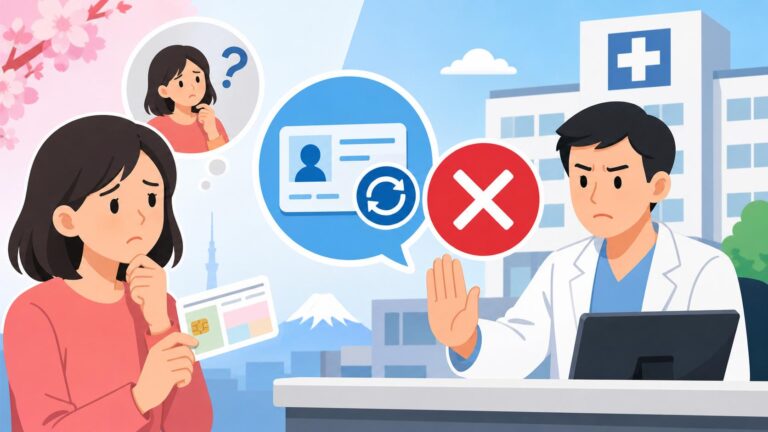
Adding Family Members to Your Health Insurance in Japan Dependent Coverage
There are two very different paths. If you have Employees’ Health Insurance (EHI), eligible “dependents” can be added under your plan—usually at no extra premium. If you use National Health Insurance (NHI), each family member enrolls individually at city hall and pays their own premium. Deadlines are short, paperwork matters, and income rules apply.
Disclosure: This post may contain affiliate links. We may earn a commission at no extra cost to you if you make a purchase through these links. Read full disclosure.
Why this matters
In Japan, almost everyone must be on public health insurance. For working households, the big decision is how to cover your spouse, children, or even parents. The rules are not the same across plans:
- Employees’ Health Insurance (EHI, a.k.a. shakai hoken): family members may qualify as dependents under your employment-based plan if they meet residency, relationship, and income conditions. Many associations publish the standards openly and expect notification within a few days when family status changes.
- National Health Insurance (NHI, a.k.a. kokuho): there is no “dependent” category. Every family member who lives in your municipality and isn’t already covered by another public plan must enroll individually—typically within 14 days of becoming eligible.
As you read, you may also find these related guides useful:
Japanese National Health Insurance Basics for Foreigners, Claiming Health Insurance Reimbursements in Japan, International Patient Services, Getting Prescription Medications in Japan.
At a glance: EHI dependents vs NHI family enrollment
| Topic | Employees’ Health Insurance (EHI) | National Health Insurance (NHI) |
|---|---|---|
| Can you “add family”? | Yes, as dependents, if certified by the insurer (income, relationship, residency checks). | No. Each person enrolls individually at city hall. |
| Typical deadline | Notify via your employer/Human Resources within ~5 days of the change (varies by society). | File at the municipal office within 14 days of moving, birth, job loss, etc. |
| Premium impact | Many plans state your premium does not change when you add dependents. | Premium increases with each insured person; amounts vary by municipality and household income. |
| Where to apply | Through your employer to your Health Insurance Association (e.g., Kyokai Kenpo or a corporate society). | City/ward office NHI counter. |
| Proofs & documents | Forms + proofs of relationship, residency, and income below threshold (commonly under ¥1.3M/year, or ¥1.8M if 60+ or with a disability). | ID, My Number, residence records; extra items if switching from another plan; late filing can trigger retroactive premiums. |
| Copay at clinics | Usually 30% for those under 70; other age bands have different rates. High-cost caps apply. | Same public copay structure and caps apply. |
Understanding “dependent” under Employees’ Health Insurance
Under EHI, your insurer (Kyokai Kenpo or your company’s health insurance society) decides whether a family member can be certified as a dependent. Three pillars are checked:
- Relationship scope
Spouse (including common-law), children, grandchildren, parents, grandparents, and certain in-laws; some relatives must live with the insured to qualify. Exact scope and “living together” requirements are clearly listed by many societies. - Residency in Japan
Generally, the dependent must reside in Japan. (Overseas dependents face strict conditions and are often not eligible.) Check your society’s rules if you’re supporting someone abroad. - Income threshold
The most-cited standard is annual income under ¥1.3 million (and lower than the insured’s income). For people age 60+ or with a disability, the cap often rises to ¥1.8 million. Insurers examine payslips/tax certificates to confirm.
Tip: If your spouse starts earning above the threshold (for example, after taking a new part-time job), the health insurance society will expect you to remove them as a dependent and they must join an appropriate plan (their employer’s EHI or NHI).
How to add a dependent under EHI step by step
- Tell your employer’s HR immediately.
Most societies ask you to submit the dependent application within five days of the change (marriage, a parent moving in, birth, etc.). HR routes the forms to the insurer. - Prepare documents.
Typical sets include:- Application/notification form for dependent certification.
- Proof of relationship (marriage certificate, birth certificate, or Japanese family registry if applicable).
- Resident record (juminhyo) for everyone involved when residency/living together matters.
- Income proof for the prospective dependent (recent payslips, tax exemption certificate, unemployment notices, or pension statements).
- Remittance evidence if the dependent lives separately (bank passbook showing regular transfers).
These checklists are spelled out by multiple societies in English.
- Await certification and card issuance.
Once approved, the insurer issues a health insurance card for the dependent. (Note: Japan is transitioning to the My Number health insurance system; the Japan Health Insurance Association has announced that traditional insurance cards are scheduled to stop being usable on December 1, 2025.) - Premium check.
Many official brochures emphasize that your EHI premium does not increase when you add dependents—it’s tied to your salary and plan rate.
Need broader background on the employment plan? See: Full-Body Health Screenings in Japan, International Patient Services.
Adding a newborn to EHI
- Register the birth at city hall within 14 days (including the day of birth). This local registration step is essential and time-bound.
- Have HR submit the dependent application for your baby to your health insurance society (together with the birth certificate details and resident records). Many societies also handle the lump-sum childbirth and childcare allowance paperwork.
- Use the newborn’s card (or My Number card when activated) at clinics once issued; coverage applies from eligibility, but always confirm with your insurer about the start date on the baby’s card. (For general copay bands and high-cost caps, see the section below.)
If your family uses National Health Insurance instead
If you or your spouse is not enrolled in EHI (for example, you freelance or work at a very small firm without social insurance), your family will rely on NHI. Key points:
- Each family member enrolls separately at your city/ward office. There is no “dependent” add-on. The head of household is usually responsible for paying the combined NHI bill.
- You must apply within 14 days whenever eligibility begins (move-in, job loss, birth, divorce). Municipal guides repeat this deadline consistently.
- Documents often include: residence card, My Number, proof of address, and (if switching plans) a certificate that your old insurance ended. Details vary by city.
- Late enrollment can cost you: many cities can retroactively bill premiums up to two years back if you miss the deadline.
For an easy primer on premiums and using your NHI card, read: Japanese National Health Insurance Basics for Foreigners.
What does it cost at the clinic or hospital?
Japan’s public insurance—EHI and NHI—uses standardized patient copayment rates:
- 30% for most people aged 6–69.
- 20% for children under school age (pre-elementary).
- 20% for 70–74, and 10% for 75+, except higher-income seniors who pay more.
- If your bills soar, High-Cost Medical Care rules kick in—monthly caps vary by income band.
Many EHI/NHI booklets also show how to apply for the “co-payment limit” certificate in advance so the hospital only charges you up to your cap at the counter.
If you plan medical care, these are good reads: Full-Body Health Screenings in Japan, Claiming Health Insurance Reimbursements in Japan.
Income rules that make or break EHI dependent status
Most associations apply similar income thresholds:
- Standard cap: under ¥1.3 million/year and less than the insured person’s income.
- If 60+ or with a disability: under ¥1.8 million/year.
- Evidence needed: recent payslips or tax exemption certificates for those not currently earning; for students, school enrollment proof; and bank remittance records if living apart.
Common pitfalls:
- Part-time work creep: small shifts in hours can push a spouse over the threshold. If that happens, notify HR and switch them to their own coverage (EHI via their employer or NHI).
- Overseas family: in general, living outside Japan disqualifies a person from being added as a dependent unless narrow conditions are met; societies are strict and ask for proof of support. Check your society’s policy before wiring tuition/living funds to overseas relatives.
Documents and proofs you’ll likely need (EHI)
Exact lists vary, but English checklists from multiple insurers give a clear picture:
- Notification/Application for Dependent Certification (society form)
- Resident record (juminhyo): to confirm address and who lives together
- Income proof: the society will check that the dependent’s projected annual income is below the threshold (payslips, tax certificates, unemployment documentation, or pension notices)
- Relationship proof: marriage certificate, birth certificate, or relevant family registry
- Remittance proof: bank passbook copies showing regular transfers if living apart
- Student status proof (if applicable): school certificate or student ID
Societies warn that they may ask for additional documents if anything is unclear. Submitting complete, unedited documents speeds up approval.
Practical timelines: what to do and when
| Situation | What to do | Where | Deadline |
|---|---|---|---|
| You got married and your spouse has no insurance | Apply to add spouse as EHI dependent (check income). | Employer → Health Insurance Society | Within ~5 days of marriage date. |
| Your baby was born | Register birth; apply to add as dependent. | City hall; then Employer → Insurer | Register within 14 days. |
| Parent moved in and relies on you | Apply to add as dependent (income + residency check). | Employer → Insurer | ASAP (many societies say five days). |
| You left your job and lost EHI | Enroll each family member in NHI. | City/ward NHI counter | Within 14 days (late fees may be retroactive). |
| Your spouse started earning over ¥1.3M/year | Remove spouse as dependent; they join their own plan. | Employer/City hall | Notify immediately. |
Frequently asked questions
Does adding dependents raise my EHI premium?
In many official social-insurance guides, the premium doesn’t change when you add dependents. Your contribution is based on your wage category and the plan’s rate, not on the number of family members. Always verify with your association.
Can a common-law spouse be a dependent?
Many health insurance societies explicitly include common-law spouses within the eligible family scope—subject to the same income and residency checks.
What if we’re on NHI now but my spouse just got a job with EHI?
You must leave NHI and switch to EHI for the employed spouse, then add eligible family as dependents under EHI. Remember to file the NHI withdrawal; otherwise, the city may keep billing you.
Are clinic copays different for dependents?
No. Copays follow national rules (e.g., 30% under age 70, with exceptions for children and seniors) and high-cost caps by income.
Do I need to do anything special for big hospital bills?
Yes—consider applying in advance for the Co-payment Limit Certificate (so you only pay up to your cap at reception). Both EHI and NHI provide this mechanism.
Is anything changing about the health insurance card?
Japan is consolidating health insurance cards into the My Number system. The Japan Health Insurance Association has announced that traditional cards are scheduled to stop being usable from December 1, 2025. Check how your clinic handles it.
When your EHI dependent doesn’t qualify
A few concrete examples—and what to do instead:
- Spouse earning above the threshold: remove them from your EHI; they should enroll in their employer’s EHI or NHI.
- Parent living abroad: most societies require dependents to reside in Japan; overseas dependents are rarely approved, and stringent proof is required even in special cases. Consider having them enroll locally if they are not residents of Japan.
- Relative beyond the recognized scope or not living together when required: some relatives (e.g., siblings or in-laws) must live with you to qualify. If they don’t, NHI is usually the path if they live in your city.
What to bring to city hall for NHI enrollment
Every city publishes its own NHI checklist. Typical items include: residence card, My Number, proof that your previous insurance ended (if switching from EHI), and documents for each person joining. If you miss the 14-day filing window, the city can back-bill up to two years.
Planning your broader setup? See: Japanese National Health Insurance Basics for Foreigners, Annual Work Health Check in Japan, Vision Care in Japan, Dental Care Beyond Basics.
Special note for new parents
- Register your child’s birth within 14 days; this triggers My Number issuance and lets you enroll them in EHI (as a dependent) or NHI.
- Ask your insurer/HR about the Lump-Sum Childbirth and Childcare Allowance workflow (often direct billing with the hospital).
You might also like: Pediatric Care in Japan, Full-Body Health Screenings in Japan.
Step-by-step: choosing the right path for your family
- Identify your base plan.
Are you (or your spouse) enrolled in EHI through an employer? If yes, try to add eligible dependents under that plan. If not, each family member should enroll in NHI at city hall. - Check the income piece carefully (EHI).
Use projected annual income after tax for the prospective dependent; gather payslips/tax certificates. The ¥1.3M (or ¥1.8M for 60+ / disability) guideline is a common benchmark. - Hit your deadlines.
~5 days to report changes to EHI via HR; 14 days at city hall for NHI triggers like moves/births/retirements. - Protect your wallet on big bills.
Apply for the co-payment limit certificate; learn your high-cost caps by income band.
Example paperwork table
| Scenario | Forms you’ll probably submit | Evidence that’s commonly requested | Where |
|---|---|---|---|
| Add spouse as EHI dependent | Dependent certification/notification | Marriage certificate, resident record, income proof under threshold | Employer → Health Insurance Society |
| Add parent as EHI dependent | Dependent certification | Resident records showing living together (if required), remittance records if living apart, income proof | Employer → Health Insurance Society |
| Newborn on EHI | Dependent certification; childbirth allowance paperwork | Birth certificate details, resident record | Employer → Health Insurance Society |
| Switch family to NHI after job loss | NHI application | ID, My Number, proof EHI ended; all family member details | City/Ward Office (NHI counter) |
| Late to enroll in NHI | NHI application + back billing | Same as above; expect retroactive premium up to two years | City/Ward Office |
Copays and caps: what your family will actually pay
Here’s a simplified view of national copay rules and high-cost caps:
| Age band | Standard clinic/hospital copay | Notes |
|---|---|---|
| Under school age | 20% | Municipal subsidies often cover more; ask your city. National standard shown here. |
| Ages 6–69 | 30% | Applies to both EHI insureds and dependents, and to NHI members. |
| 70–74 | 20% (some 30%) | Higher-income seniors pay more. |
| 75+ | 10% (some 30%) | Long-Life Medical Care System. |
| High-cost months | Capped by income band | See MHLW examples of monthly caps and how to apply in advance for limit certificates. |
Common life events and how to stay compliant
- Moving to a new city: NHI members must re-enroll in the new municipality; EHI members simply report address changes to their employer and city hall for the resident record. The 14-day NHI rule still applies.
- Divorce or separation: If your spouse was your EHI dependent, they’ll need their own coverage effective from the change date—either EHI via a new employer or NHI. Notify your society promptly.
- Study abroad: Many societies won’t approve (or may cancel) dependent status for family residing overseas. Confirm before your child moves abroad for school.
Key takeaways
- EHI dependents: Possible when the insurer certifies relationship + residency + income under ¥1.3M (¥1.8M for 60+/disability). Report changes within ~5 days.
- NHI family coverage: No dependents. Everyone enrolls individually at city hall within 14 days; premiums vary by city and number of insured. Late enrollment can be back-billed.
- Costs at the counter: 30% for most adults; national high-cost caps limit monthly out-of-pocket expenses.
- Cards are changing: Traditional insurance cards are slated to be phased out by Dec 1, 2025, moving to My Number.
If you’re planning further family admin in Japan, you may also be interested in: Pediatric Care in Japan, Annual Work Health Check in Japan, and Vision Care in Japan.
Disclaimer
This article is for general informational purposes only and does not constitute professional advice. Laws, prices and regulations vary by location and change over time. Consult a qualified professional for guidance on your specific situation.