Pharmacies in Japan: Buying Medicine Over the Counter
Here’s how Japan’s over-the-counter (OTC) system works—what you can buy, where to buy it, how pharmacists and registered sellers assist you, what the labels mean, recent rule changes (including emergency contraception), tax deductions, and customs rules for bringing medicine into Japan.
Disclosure: This post may contain affiliate links. We may earn a commission at no extra cost to you if you make a purchase through these links. Read full disclosure.
Quick orientation to Japanese pharmacies and drugstores
In everyday Japan you’ll see two main places to buy medicines:
- Dispensing pharmacies (yakkyoku/調剤薬局): Attached to clinics or independent, these fill prescriptions and also sell OTC items.
- Drugstores (druggu sutoa/ドラッグストア): Large retail chains that sell cosmetics, toiletries, household goods—and a wide range of OTC medicines in clearly marked sections.
Across both settings, Japan uses a risk-based OTC classification and legally defined sales roles. Some products can only be sold by a licensed pharmacist, while lower-risk items can be sold by a registered salesperson after basic counseling. The Ministry of Health, Labour and Welfare (MHLW) maintains the official categorization and sales rules.
If you get stuck or need a hospital instead, bookmark the official JNTO “feeling ill” page—it aggregates hotlines and English-friendly medical search tools.
You may also find these helpful later: International Patient Services: Getting English Help at Hospitals, Emergency Medical Services in Japan.
How OTC medicines are classified in Japan
Japan divides non-prescription medicines into four regulatory buckets. The first two require the most care when selling and counseling.
Guidance-requiring pharmaceuticals (要指導医薬品)
- Newer or higher-risk products that must be sold face-to-face by a pharmacist with mandatory counseling; online sales are restricted.
Class 1 (第一類医薬品)
- Higher-risk OTCs requiring pharmacist involvement and active information provision before sale.
Class 2 (第二類医薬品, including “Designated Class 2”)
- Moderate risk; may be sold by a pharmacist or registered salesperson with efforted counseling, and certain “Designated” items carry stronger warnings on packs and shelving.
Class 3 (第三類医薬品)
- Lower risk; general OTCs sold with basic guidance by pharmacists or registered salespeople.
MHLW’s dedicated page outlines the categories, the registered salesperson system, and the list of “abuse-prone” products requiring careful sales management.
Who serves you at the counter
- Pharmacists (薬剤師): For guidance-requiring and Class 1 products, a pharmacist must personally counsel you and complete the sale.
- Registered salespersons (登録販売者): Trained and licensed retail staff who may sell Class 2 and Class 3 medicines (with counseling). MHLW continually updates training requirements and Q&As for this role.
Many large drugstores post staff badges and nameplates so you can see who is qualified to advise on which items.
Table: Common symptoms and what you can usually buy
Use this as a starting point and always follow in-store counseling. Exact product class varies by brand/strength.
| Symptom or need | Typical OTC actives | Likely class | Who can sell | Notes |
|---|---|---|---|---|
| Pain/fever | Acetaminophen, ibuprofen | Class 2 or 3 depending on combo | Pharmacist or registered salesperson | Check stomach warnings with ibuprofen. Labels show 用法用量 (dose) and 注意 (warnings). |
| Cold/flu relief | Dextromethorphan, antihistamines, guaifenesin, acetaminophen | Often Class 2/Designated Class 2 | Pharmacist or registered salesperson | Some cough suppressants and combinations are tightly managed as “abuse-prone.” Expect questions. |
| Allergies/hay fever | Second-gen antihistamines; OTC nasal sprays | Class 2 or 3 | Pharmacist or registered salesperson | Ask staff to confirm drowsiness risk with specific antihistamines. |
| Stomach upset | Antacids, acid suppressors, probiotics | Class 2 or 3 | Pharmacist or registered salesperson | Proton-pump inhibitors may fall in higher-counseling categories depending on brand. |
| Minor skin issues | Hydrocortisone, antifungals | Class 2 or 3 | Pharmacist or registered salesperson | Ask about duration limits for steroid creams. |
| Motion sickness | Dimenhydrinate, scopolamine patches (OTC forms) | Class 2 | Pharmacist or registered salesperson | Drowsiness possible—verify with staff. |
| Eye drops | Lubricants, mild anti-inflammatory | Class 2 or 3 | Pharmacist or registered salesperson | Contact lens users: ask for lens-safe formulas. |
| Emergency contraception | Levonorgestrel (NorLevo) | Guidance-requiring/OTC per new approval | Pharmacist with on-the-spot counseling | Japan approved non-prescription access nationwide in Oct 2025 after pilot sales; counseling at purchase applies. |
For prescription-only items, see Telemedicine in Japan: Remote Healthcare Options or visit a clinic; some hospital international desks can guide you in English. International Patient Services.
Reading labels the smart way
Most OTC boxes share a standardized layout:
- 成分 (seibun) = active ingredients
- 効能 (kōnō) = indications
- 用法用量 (yōhō/yōryō) = dosage and administration
- 注意 (chūi) or 相談すること = warnings/when to consult a pharmacist or physician
When in doubt, ask staff to show you the English leaflet or look up the product in Kusuri-no-Shiori (Drug Information Sheet)—a patient information database with English for many medicines.
Buying online vs in-store
Japan allows online sales of many OTCs, but higher-risk categories (especially guidance-requiring and some Class 1) carry additional hurdles or may require pharmacist interaction that’s hard to replicate online. Sellers must follow “specific sales” rules for internet transactions, including robust information provision.
If you’re staying short-term, in-store purchase is often faster because you’ll get live counseling in English or with translation tools, and you can confirm whether the product is permitted back home.
Recent change: emergency contraception now OTC
After a limited pharmacy pilot (launched November 2023), Japan approved over-the-counter sales of levonorgestrel emergency contraception (NorLevo) in October 2025. Sales require on-the-spot pharmacist counseling, but no doctor’s prescription. Multiple reputable outlets reported the approval, and medical journals documented the lead-up pilot.
If you need advice fast and can’t get to a pharmacy, start with Telemedicine in Japan. For pregnancy and postpartum care, see Pregnancy and Childbirth in Japan.
The self-medication tax deduction (save your receipts)
Residents in Japan can claim a special income-tax deduction on eligible OTC purchases if they complete certain health activities during the year (e.g., checkups) and buy items bearing the official mark or listed active ingredients. The program was extended and expanded in recent reforms; MHLW maintains monthly updated lists and Q&As. Save receipts that show the dedicated mark and item details.
This is a nice perk if you routinely buy allergy meds, pain relievers, or other qualifying products. If you’re also managing clinic costs, pair this with our guide to Claiming Health Insurance Reimbursements in Japan.
What you might be asked at the counter
Expect brief, friendly questions designed to keep you safe:
- What symptoms do you have and for how long?
- What other medicines or supplements are you taking?
- Do you have chronic conditions (e.g., hypertension, glaucoma, gastric ulcers)?
- Pregnant or breastfeeding?
- Have you used this product before, and did you have side effects?
For Class 1 or guidance-requiring drugs, the pharmacist must counsel you before purchase. It’s standard—don’t be surprised if they steer you away from combinations that duplicate actives.
Sample shopping script in plain English (and useful Japanese)
- “I have seasonal allergies and need a non-drowsy antihistamine.”
Kafunshō desu. Nemukunaranai kusuri wa arimasu ka? - “I already take blood pressure medicine. Is this safe?”
Kōketsuatsu no kusuri o nondeimasu. Kono kusuri wa daijōbu desu ka? - “I need emergency contraception.”
Hininkyūkyūyaku ga hitsuyō desu. (Speak to the pharmacist.)
If the language barrier is tough, staff can often use interpretation tools, and the JNTO page links to medical hotlines for visitors.
Table: Where to go for what you need
| Situation | Best option | Why | Backup |
|---|---|---|---|
| You want a common painkiller, eye drops, or allergy tabs | Large drugstore | Wide selection, extended hours | Ask for registered salesperson if no pharmacist is visible. |
| You need a higher-risk or new OTC (Class 1/guidance-requiring) | Pharmacy with a pharmacist on duty | Required counseling for sale | Staff will call the pharmacist if on break or direct you elsewhere. |
| You’re unsure if it’s OTC or prescription | Ask at the counter | They’ll triage and advise the right pathway | If prescription-only, consider Telemedicine in Japan for a same-day consult. |
| You need English documentation of meds | Hospital pharmacy after clinic visit | Printed Japanese “drug booklets” and often English summaries | Use Kusuri-no-Shiori database for extra English. |
| You’re traveling tomorrow and need a plan | Drugstore + JNTO info page | Fast directions, open late | Keep ER info handy: Emergency Medical Services in Japan. |
Bringing your own medication into Japan
Japan strictly regulates personal import of medicines to protect safety. Depending on type and quantity, you may need to apply before travel for an import certificate called Yunyu Kakunin-sho (previously Yakkan Shōmei) and declare it at customs on arrival. MHLW and official embassy pages explain what counts as a one-month supply, what needs pre-approval (including some OTCs), and how to apply by email.
If you plan to bring combination cold medicines, ADHD medication, or strong cough suppressants, check the rules well in advance—requirements and allowed quantities differ by ingredient.
Safety notes and “abuse-prone” products
MHLW publishes guidance for retailers on medicines with abuse potential (for example, some cough suppressants or antidiarrheals in certain quantities). You may be asked more detailed questions, and repeat sales can be restricted. This is normal and helps protect your health.
For extra clarity on actives and warnings, bookmark the PMDA overview of OTC regulation and self-medication principles in Japan.
Prices, payment, and tax tips
- Pricing: OTC prices vary by chain and brand. Generics are widely available.
- Payment: Cards are accepted almost everywhere; some neighborhood pharmacies are cash-preferred.
- Tax: If you’re a resident, track eligible OTC purchases and your annual health activities to claim the self-medication tax deduction at filing. MHLW posts current lists and receipts requirements.
What to expect in a large drugstore
- A medicines area staffed by a pharmacist and/or registered salesperson
- Category boards: cold/fever, allergies, stomach, eyes, skincare, women’s health
- Clear shelf tags for Class 1/2/3 and warnings on Designated Class 2
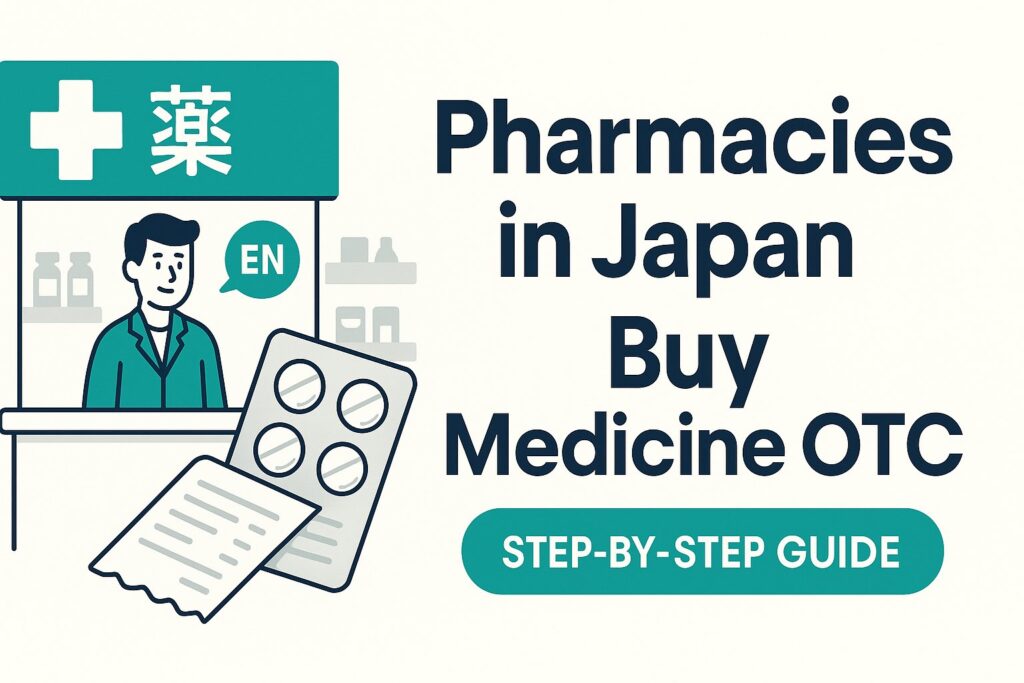
- A consultation counter—look for signage with the kanji 薬 (medicine) and terms like 薬剤師 (pharmacist) or 登録販売者 (registered seller)
If you’d rather see a clinician first, try Telemedicine in Japan or our list of Top 5 English-Speaking Hospitals in Tokyo for in-person care.
OTC medicine and English support: handy resources
- Official MHLW page for OTC categories, sales rules, and the registered salesperson system.
- Japan Health Policy NOW for a plain-English primer on Class 1/2/3 and information-provision duties.
- Kusuri-no-Shiori for patient-friendly drug sheets (many in English).
- JNTO “feeling ill” page for hotlines, search tools, and how to use medical institutions.
- PMDA overview of OTC regulation and self-medication context.
Frequently asked questions
Can I buy strong painkillers like codeine OTC?
Japan limits or closely manages several actives. Some codeine-containing combinations appear only in low doses and under stricter shelf controls; sales are monitored as “abuse-prone” products. Expect careful counseling and possible restrictions. Check at the counter.
Are pseudoephedrine decongestants available?
Availability and limits are regulated; imports are controlled and certain amounts/strengths may require declarations. If you rely on a specific product from abroad, check MHLW’s personal-import rules before travel and consult a pharmacist locally for legal alternatives.
Is the morning-after pill really OTC now?
Yes. After the 2023–2024 pilot, levonorgestrel emergency contraception received non-prescription approval nationwide in October 2025. You’ll purchase it after pharmacist counseling at participating pharmacies.
Can I order OTC medicine online to my hotel?
For many Class 2/3 items, yes—Japan allows online OTC sales subject to strict “specific sales” rules. Some higher-risk products still require face-to-face pharmacist involvement. When time-sensitive, in-store is faster.
Will I get an English leaflet?
Not always, but many stores can provide English summaries or direct you to the official drug sheet online. Use Kusuri-no-Shiori.
A simple buying game plan
- Name your main symptom and any conditions/meds you already take.
- Ask for a non-drowsy or kid-safe option if relevant.
- Show staff your travel meds (photos of labels help) to avoid duplication.
- Confirm the class and who must sell it (pharmacist vs registered salesperson).
- Keep the box or take a photo of the instructions for dosing and warnings.
Table: Label language at a glance
| Label word | Meaning | Why it matters |
|---|---|---|
| 成分 | Active ingredients | Helps you avoid doubling the same drug in combo products. |
| 効能 | Indications | Confirms the symptom(s) a product actually treats. |
| 用法用量 | Dosing instructions | Check adult vs child doses and maximum daily amounts. |
| 相談すること | Consult before use | Flags conditions/meds where you should ask staff or a doctor. |
| 第○類医薬品 | Class 1/2/3 | Tells you if a pharmacist must sell it or if a registered seller may assist. |
When to see a doctor instead
- Fever persisting >3 days or worsening symptoms
- Shortness of breath, chest pain, confusion, severe dehydration
- Blood in stool/vomit, severe abdominal pain
- New rash + fever, eye pain/vision changes
- Suspected pregnancy complications
Start with Telemedicine in Japan for quick triage, or use Emergency Medical Services in Japan if urgent.
Final takeaways
- Japan’s OTC landscape is organized and safe by design: categories, counseling duties, and trained sellers protect you.
- Recent update: emergency contraception is now OTC nationwide with pharmacist counseling.
- Save OTC receipts if you’re a resident; you may reduce your taxes via the self-medication system.
- If you’re traveling with medicines, check MHLW’s import rules and apply for Yunyu Kakunin-sho if needed—before you fly.
Keep exploring on Japan Handbook
- International Patient Services: Getting English Help at Hospitals
- Telemedicine in Japan: Remote Healthcare Options
- Emergency Medical Services in Japan
- Full-Body Health Screenings in Japan: How to Book and What to Expect
- Dental and Vision Care in Japan: A Foreigner’s Guide
- Claiming Health Insurance Reimbursements in Japan
This guide is crafted for clarity and safety so you can buy confidently, ask the right questions at the counter, and know when it’s time to see a doctor.
Disclaimer
This article is for general informational purposes only and does not constitute professional advice. Laws, prices and regulations vary by location and change over time. Consult a qualified professional for guidance on your specific situation.