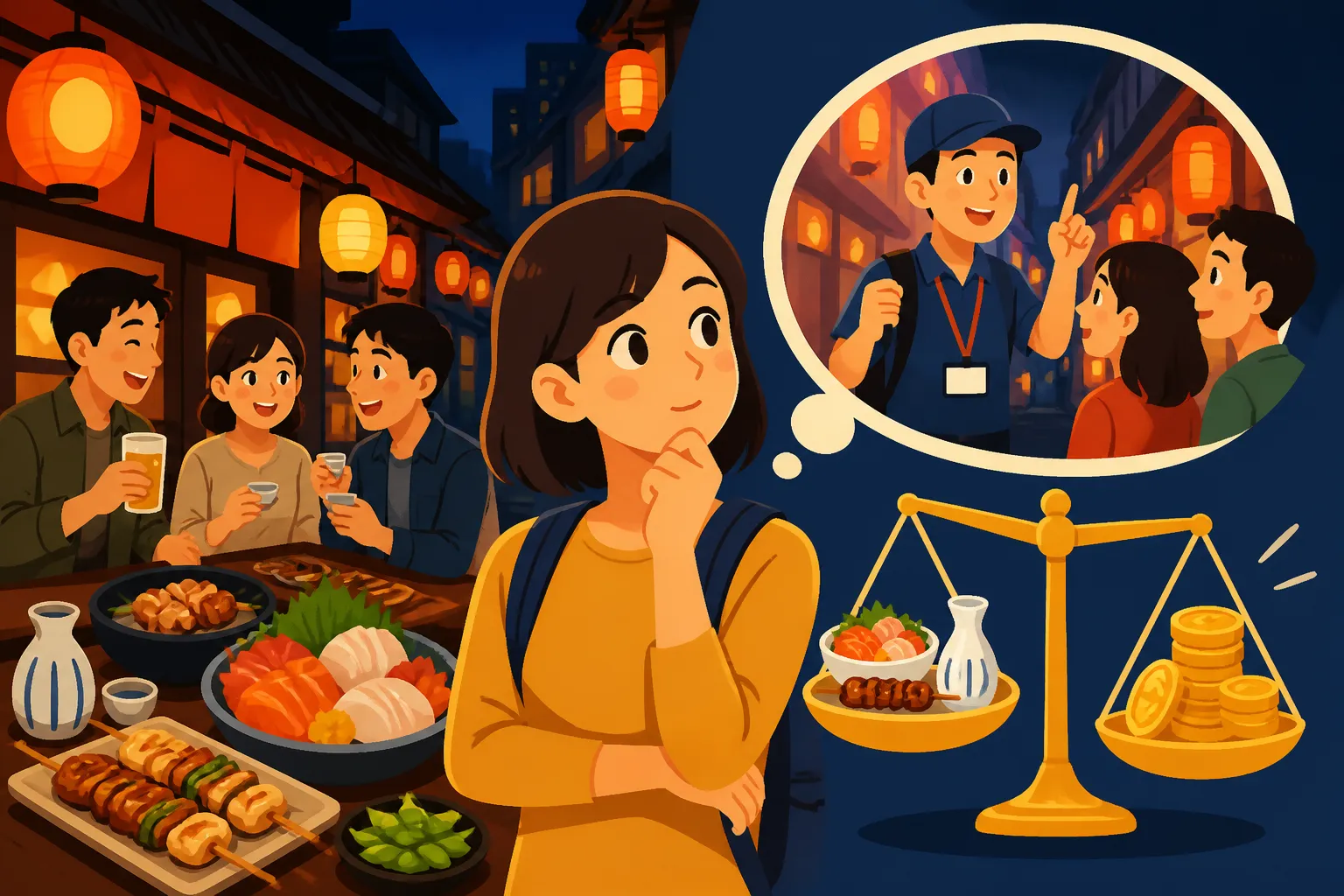
Food and Izakaya Tours in Japan: Are Guided Night Tours Worth the Price?
You’ve landed in Tokyo and walked past a dozen glowing red lanterns. Behind each sliding door, regulars sit elbow to elbow and the menu is handwritten in Japanese. You want to go in, but you hesitate. This guide explains whether a guided food and izakaya night tour is worth paying for, what you actually get, and how to book one that fits your trip.
Disclosure: This post may contain affiliate links. We may earn a commission at no extra cost to you if you make a purchase through these links. Read full disclosure.
What a Guided Izakaya Night Tour Actually Gives You
My first izakaya attempt was in Shinjuku, years ago. I picked a tiny place off Omoide Yokocho because it looked authentic. It was. The master looked up, said something I didn’t understand, and made a small crossed-arms gesture. I later learned it meant the place was full or regulars-only that night. I tried two more doors and got two more polite refusals. I ended up eating a convenience store onigiri on a bench and feeling foolish.
If that sounds familiar, you’re not the problem. Japan’s best drinking and eating culture is built around familiarity, small spaces, and unspoken rules. A guided tour exists to remove those barriers in one evening.
The Hidden Doors Problem
Many of the best izakaya, tachinomi standing bars, and yakitori counters seat very few people. In alleys like Omoide Yokocho, Golden Gai, Nonbei Yokocho in Shibuya, or the lanes under the train tracks at Yurakucho, a group of four foreigners walking in unannounced can fill half the room. Owners aren’t being unfriendly when they turn you away. They are protecting space for regulars and keeping a small business running.
Language is part of it, but not all of it. Some places have no English menu or picture menu at all. Prices may be written in kanji numerals or not shown, and dishes change daily based on what came in from the market. Even confident travelers get stuck looking at a wooden board of brushstrokes, unsure whether “shime saba” is something they’d enjoy. It’s cured mackerel, and it’s excellent.
A good guide has already built relationships with the owners. On a guided tour the group is expected, the seats are held, and the master often greets the guide like an old friend. Being welcomed rather than tolerated changes the whole mood of the night. You get a glimpse of the regular’s experience that would otherwise take months of returning to the same counter.
There is a cultural layer too. Things like the otoshi, the small appetizer that arrives unrequested and appears as a cover charge on the bill, can confuse first-timers. So can the ritual of waiting for everyone’s drink before the kanpai toast, and the habit of ordering in small rounds rather than all at once. A guide explains these in the moment, with a laugh, so you aren’t left wondering whether you’ve been overcharged or done something rude. For the full background before you go, see Izakaya Etiquette: Ordering, Sharing, and Paying the Bill.
What Is Usually Included and What Is Not
Every tour is structured a little differently, so read the listing carefully. Most guided food and izakaya night tours follow a recognizable pattern, and it helps to know the general shape before you compare options.
What is commonly included:
- A local guide who speaks English, and sometimes other languages, for the full route.
- Visits to several venues in one neighborhood, usually walkable from a station meeting point.
- A set selection of dishes at each stop, chosen by the guide to show the range of local food.
- A certain number of drinks, which may be beer, sake, highballs, or soft drinks depending on the listing.
- Commentary on the neighborhood’s history, the food, and drinking customs.
- Help with ordering anything extra and with paying the bill at the end.
What is commonly not included, or included only partly:
- Unlimited drinks. Many tours include a fixed number, and anything beyond that is paid separately on the spot.
- Transport to the meeting point and back to your hotel.
- Food beyond the set menu if you are still hungry and want to order more.
- Guaranteed accommodation of every dietary restriction, which varies widely by tour and venue.
The point here is the shape of the cost. With a guided tour you pay one upfront fee that bundles the guide’s time, the reservations, and a defined amount of food and drink. With a self-guided night you pay each venue separately, including any cover charges, and there is no fixed ceiling. For current prices and exactly what each package covers, check the individual tour page on Klook, because operators update their menus and inclusions regularly.
A Real Night Out: Two Versions of the Same Evening
Picture a couple, Dana and Marcus, on their second night in Tokyo. They want the classic smoky yakitori-and-beer experience they’ve seen in travel videos.
In version one they go alone. They take the train to Shinjuku, find Omoide Yokocho, and spend twenty minutes walking up and down the narrow lane. Two places are full. One has a sign they can’t read. They finally get two stools at a counter where the cook is kind but busy. Unable to read the menu, they point at what the man beside them is eating. It turns out to be chicken heart. Marcus loves it and Dana does not. They pay a bill that includes an otoshi charge they didn’t expect, and they head home before the area really gets lively. It was fine, but they mostly remember the stress.
In version two they book an evening food tour. They meet the guide at a station exit at a fixed time. The guide leads them straight past the crowds into a pre-reserved counter. A spread of skewers arrives, from tsukune meatballs to negima chicken with leek, with an explanation of tare sauce versus shio salt seasoning. At the second stop, a standing bar, they try three styles of sake and learn why one tastes dry and another fruity. At the third stop, a tiny place run by a woman in her seventies, the guide translates as she tells them how the alley looked decades ago. They end the night knowing how to order, what they liked, and which streets to come back to on their own.
The second version costs more than a self-guided night where you eat lightly. What you are paying for is the evening going right on the first try, plus the confidence to repeat it alone afterward. That second benefit is the one many travelers underestimate.
Guided Tour vs Doing It Yourself: The Honest Comparison
I’m a fan of exploring independently. Some of my best food memories in Japan came from stumbling into the wrong door. Still, I’ve watched enough friends and visiting family struggle to know that a guided tour solves specific problems very well. Here is how the two approaches compare on the factors that matter most.
| Factor | Guided Night Tour | Self-Guided Izakaya Crawl |
|---|---|---|
| Ease of planning | Very easy: the guide handles the route, reservations, and venue selection | Demanding: you research areas, map routes, and hope places have seats |
| Getting seated | Seats held in advance at each stop | First come, first served, with refusals possible in small bars |
| Understanding the menu | Guide explains and orders for the group | You rely on picture menus, translation apps, or pointing |
| Cost structure | One upfront fee bundling guide, set food, and a set number of drinks | Pay as you go at each venue, including any cover charges |
| Cost control | Predictable, with extras paid on the spot only if you choose | Flexible, but can climb quickly with no fixed limit |
| Cultural explanation | Built in, with history and etiquette explained as you go | Only what you have read beforehand |
| Flexibility and spontaneity | Fixed route and timing | Total freedom to linger, leave, or switch neighborhoods |
| Social atmosphere | Shared with other travelers in the group | Just your own party, plus any locals you chat with |
| Dietary needs | Can be arranged ahead with some operators | You must communicate restrictions yourself at each stop |
| Confidence afterward | High: you learn how to order and where to return | Grows slowly through trial and error |
When the Tour Is Worth Every Yen
A guided night tour earns its price in these situations.
You’re short on time. If you have only a few nights in Tokyo or Osaka, one evening lost to wandering and refusals is a large share of your trip. A tour turns that evening into a sure thing.
It’s your first trip to Japan. First-timers get the most from a guide because everything is new: the otoshi, the oshibori hot towel, the way to call a server with “sumimasen,” the timing of the kanpai. After one guided evening you’ll walk into izakaya on your own with far less hesitation.
You have dietary restrictions. This one surprises people. Japanese cooking relies on dashi stock, often made with bonito flakes, and fish sauce and meat extracts turn up in places you wouldn’t expect. Vegetarians, people avoiding pork or alcohol, and anyone with a serious allergy face real risk ordering blind. Some tours accept dietary requests in advance and arrange suitable dishes with the venues. Read Vegetarian Travel: Hidden Ingredients and Safe Ordering to understand where hidden animal products appear, and Food Allergies in Japan: Labels and Safe Phrases if allergies are a concern.
You’re traveling solo. Eating alone at a counter is completely normal in Japan, but some solo travelers find the izakaya atmosphere hard to break into. A tour gives you instant company for the night. Many people come away with dinner companions for the rest of their trip.
You want stories as much as food. In areas like Omoide Yokocho, which grew out of the postwar black market, or Shinsekai in Osaka, with its faded early-twentieth-century charm, the history is half the experience. A guide who knows the neighborhood adds depth no menu can.
You’re hosting visitors. If you live in Japan and family or friends arrive, a tour takes the pressure off you as host and translator. You get to enjoy the evening too, rather than spending it reading menus aloud.
When You Should Skip It
To be fair, there are times a tour isn’t the right call.
You already speak functional Japanese and know the etiquette. If you can read a menu, handle “osusume wa nan desu ka” (what do you recommend), and don’t mind the odd refusal, a tour mainly saves you research. Your money might go further on a long self-guided night.
You’re on a very tight budget. A self-guided night where you share a few plates and a couple of drinks at a cheap standing bar can cost less than a tour. Chains like Torikizoku, known for uniform pricing on yakitori, and the many tachinomi near major stations make budget nights very doable.
You hate fixed schedules. Some of the joy of izakaya culture is staying for hours at one counter because you hit it off with the master. Tours move on to the next stop when it’s time, which some travelers find frustrating.
You’re staying for months. Long-term residents and digital nomads can afford to build a relationship with a neighborhood izakaya slowly. Even so, many expats I know took one tour early on to learn the ropes, then went independent.
A middle path that works well: book a tour on your first or second night, then use what you learned to explore on your own for the rest of the trip.
Best Cities and Neighborhoods for Food Night Tours
Not every area is equally suited to a guided food night. Tours work best where drinking alleys are dense, venues are tiny, and the barrier to entry is highest. Here is where they shine.
Tokyo: Alleys, Under-Track Bars, and Old-School Districts
Tokyo has the widest range of evening food tours and the most variety in atmosphere.
Shinjuku is the classic choice. Omoide Yokocho, sometimes called Memory Lane, is a narrow, smoky strip of yakitori stalls beside the station. Nearby, Golden Gai packs a maze of tiny bars into a few small lanes. Many of those bars seat only a handful of people and some charge a seating fee, so a guide who knows which ones welcome visitors is a real help. Note that many Golden Gai bars are drink-focused rather than food-focused, so look for tours that pair the area with a proper dinner stop.
Shibuya has Nonbei Yokocho, known as Drunkard’s Alley, a short lane of compact bars near the tracks. It’s a good contrast to the neon intensity of the scramble crossing.
Yurakucho and Shimbashi feel like the salaryman’s Tokyo. Under the train tracks you’ll find izakaya and yakitori places where office workers unwind after work, with trains rumbling overhead. Tours here show a very local, working-class side of the city.
Ueno and Ameyoko mix market-street energy with standing bars and seafood stalls. The atmosphere is loud, casual, and great for first-timers.
Ebisu and Ebisu Yokocho offer a slightly more polished, younger crowd, with an indoor alley of small eateries that gets lively later in the evening.
If you’re unsure which neighborhood fits your style, see Tokyo Neighborhood Guide: Where to Go for Each Vibe. One practical warning about Tokyo nights: trains stop running around midnight, and missing the last one can mean an expensive taxi. Check Last Train Times: Avoid Missing Your Connection before you head out.
Osaka and Kyoto: Kitchen of Japan Meets Old Capital
Osaka calls itself the “kitchen of Japan,” and its food culture is famously friendly, loud, and generous. The concept of kuidaore, eating yourself into ruin, sums up the spirit.
Dotonbori is the neon-lit headline, packed with takoyaki and okonomiyaki stands, but a good guide will take you past the tourist frontage. Ura-Namba, the back streets behind Namba, is full of small izakaya and standing bars where locals actually drink. Shinsekai, near Tsutenkaku tower, is the home of kushikatsu, deep-fried skewers, along with its famous no-double-dipping rule for the shared sauce. Tenma, around JR Tenma Station, has one of the city’s densest clusters of cheap, cheerful bars. For daytime and street-level background before your night tour, see Osaka Street Food Guide: Dotonbori and Beyond.
Kyoto offers a quieter, more refined evening. Pontocho is a narrow lantern-lit lane along the Kamo River with restaurants ranging from casual to very upscale. Kiyamachi, running alongside a small canal nearby, is more relaxed and youthful. Nishiki Market is mostly a daytime experience, but some evening tours start nearby for snacks before moving on. Kyoto’s food scene has more invisible rules and more establishments wary of unfamiliar guests than most cities, which makes a guide especially useful here. A tour that combines sake tasting with obanzai, Kyoto-style home cooking, gives you a feel for the city that’s hard to get alone. For background on sake styles, Sake 101: Types, Regions, and How to Order is a helpful primer.
Fukuoka, Sapporo, and Hiroshima: Regional Night Food Scenes
Fukuoka is the yatai capital of Japan. Yatai are open-air food stalls that set up each evening, mostly in Nakasu along the river and in Tenjin. Each one seats a small group around the counter, so you end up chatting with strangers. Hakata ramen with its rich tonkotsu pork broth, motsunabe offal hotpot, and mentaiko spicy cod roe are local specialties. Yatai have their own etiquette, such as not lingering too long when others are waiting, and a guide helps you choose a good stall. See Fukuoka Food Weekend: Yatai Stalls, Ramen, and Cafés for planning the rest of your stay.
Sapporo comes alive at night in Susukino, one of the largest entertainment districts north of Tokyo. Look for tours covering Jingisukan, grilled lamb named after Genghis Khan, plus soup curry, seafood, and miso ramen. In winter, a warm izakaya after a cold walk is one of the great pleasures of Hokkaido.
Hiroshima is the place to taste its layered style of okonomiyaki, built with noodles and cooked on a griddle in front of you. Evening tours often pair this with oysters, a local specialty, and a stop at a sake-focused bar, since nearby Saijo is a famous sake brewing town.
In smaller cities, guided food tours are less common, so book ahead if your dates are fixed.
How to Book the Right Tour on Klook Step by Step
Once you’ve decided a guided evening is worth it, the next question is where to book. I usually start with Klook because it lists a wide range of Japanese food and izakaya night tours in one place. You can compare routes, read reviews from other travelers, and see inclusions side by side without opening a dozen operator websites. Booking in your own language, paying with a foreign card, and getting an e-voucher on your phone removes much of the friction international visitors face booking directly with small local operators.
Here is the process I follow.
- Decide on your city and neighborhood first. Choose the area that matches the mood you want, such as smoky and old-school in Shinjuku, loud and friendly in Osaka, or refined in Kyoto. Then search for food or izakaya tours in that city on Klook.
- Filter by date and time. Most night tours start in the early evening. Pick a date that isn’t your arrival day, because jet lag and a big drinking night don’t mix well.
- Read the full inclusions list. Check how many stops there are, how many dishes and drinks are included, whether drinks are alcoholic, and what costs extra. This tells you the true shape of the cost.
- Check the group size. Smaller groups fit better into tiny izakaya and give you more time with the guide. The listing usually states a maximum.
- Read recent reviews carefully. Look for comments on the guide’s knowledge, food portions, and whether the venues felt authentic or touristy. Reviews mentioning the guide by name are a good sign of consistent quality.
- Confirm dietary options before you pay. If you’re vegetarian, halal, gluten-free, or have an allergy, check whether the tour accepts requests and how far in advance you need to submit them.
- Review the cancellation policy. Free cancellation windows differ between tours, so read the terms for the specific listing before you book.
- Save the meeting point details. Note the exact station exit and meeting time. Large stations like Shinjuku have many exits, and arriving at the wrong one is a common way to start the night late.
- Keep your voucher ready offline. Download or screenshot your e-voucher in case your connection drops in a crowded area.
Before committing, I like to see how Klook’s listings compare with other platforms for the same city. Klook vs KKday for Japan: Coverage, Price, and Cancellation Compared goes through that side by side. For saving on your booking, Klook Japan Discount Guide: How to Stack Coupons, App Deals, and Seasonal Promotions 2026 covers app deals and promotions worth watching.
Screening a Tour Listing for Red Flags
Not every tour is equal. After years of booking these for myself and visiting friends, these are the warning signs I watch for:
- Vague inclusions. If the listing just says “food and drinks included” with no detail, you may get much less than you expect.
- Too many stops in too little time. A huge number of venues in a short evening often means rushing in and out rather than enjoying each place.
- Only big chain venues. Chains are fine for a cheap night alone, but a guided tour should show you independent places you couldn’t easily find yourself.
- Very large groups. A big group can’t fit into a tiny yokocho bar, which defeats much of the purpose.
- Reviews that mention only the food, never the guide. The guide is the main thing you’re paying for. If reviewers don’t mention them, the experience may be closer to a set menu than a tour.
Tours that clearly list each stop, the type of venue, the dishes, and the drink allowance tend to deliver what they promise. One advantage of booking through Klook is that reviews come from people who actually took the tour, so you can spot patterns before you pay.
Read the cancellation terms of each tour before booking too. Weather, illness, or a delayed train can disrupt plans, so it helps to know what’s refundable and by when. Cancellation Policies on Japan Tours: What You Get Back and When explains how to read those terms.
Handling Dietary Needs and Allergies on a Food Tour
Japanese food culture is not set up for restrictions by default, so extra preparation matters.
The biggest hidden ingredient is dashi, the stock behind many sauces, soups, and simmered dishes. It is often made with katsuobushi, dried bonito, which means a “vegetable” dish may not be vegetarian. Mirin and some sauces contain alcohol. Pork and pork-based broths are common, and soy sauce contains wheat, which matters for gluten-free diets.
Practical steps:
- Tell the operator in advance. Use the booking notes or contact the operator through the platform to state your restriction clearly.
- Choose a tour that advertises dietary accommodation. Some tours have vegetarian or halal-friendly versions. These are your safest option.
- Carry a written card in Japanese. Even with a guide, having your restriction written clearly in Japanese helps when the master asks questions.
- Remind the guide at the start. Mention it when you meet the guide so they can check each dish with the kitchen.
For phrases to carry, see Japanese Phrases for Ordering Dietary Restrictions. Muslim travelers will find detailed advice in Halal Dining in Japan: Practical Tips and Apps.
Getting the Most from Your Guide on the Night
You’ve booked, you’ve arrived at the right exit, and the guide is waving a small flag. Here’s how to make the evening count.
Ask about what you’re eating. Guides love curious guests. Ask how a dish is made, what region it comes from, and what it’s called so you can order it again later. I keep a note on my phone of every dish I liked, in both romaji and Japanese if the guide writes it down.
Ask for recommendations beyond the tour. Your guide knows the neighborhood. Ask where they’d go on their night off, which yokocho welcomes solo visitors, and which dishes you should try elsewhere in the city. This is often the most valuable information of the night.
Practice a few phrases with the guide’s help. Saying “kanpai” for cheers, “oishii” for delicious, and “gochisousama deshita” as you leave goes a long way. Owners appreciate the effort, and the guide can correct your pronunciation in a friendly setting. For help with menus after the tour, Reading Simple Japanese Menus: Common Words and Symbols is a good next step.
Pace your drinking. Several stops with a drink at each adds up faster than you’d think, especially with sake. Drink water between stops and eat steadily.
Don’t leave a tip. Tipping isn’t part of Japanese culture and can cause confusion even with guides. A sincere thank-you, a good review, or a small souvenir from your home country is a better way to show appreciation. For more on this, see No Tipping in Japan: How to Show Appreciation.
Respect the venues. Ask before taking photos of other diners or the kitchen, keep your voice at the level of the room, and follow the guide’s lead on etiquette. Being good guests is part of why these small places keep welcoming tour groups.
So, are guided night tours worth the price? For first-timers, short trips, solo travelers, anyone with dietary needs, and hosts with visiting family, the answer is usually yes. You trade some flexibility and a predictable upfront fee for a night that goes right the first time, an inside look at places you couldn’t easily enter, and the confidence to explore on your own afterward. If that sounds like what you need, browse the food and izakaya tours for your city on Klook, compare a few listings using the checklist above, and lock in an evening early in your trip so you can use what you learn for the rest of it.
Disclaimer
This article is for general informational purposes only and does not constitute professional advice. Laws, prices and regulations vary by location and change over time. Consult a qualified professional for guidance on your specific situation.