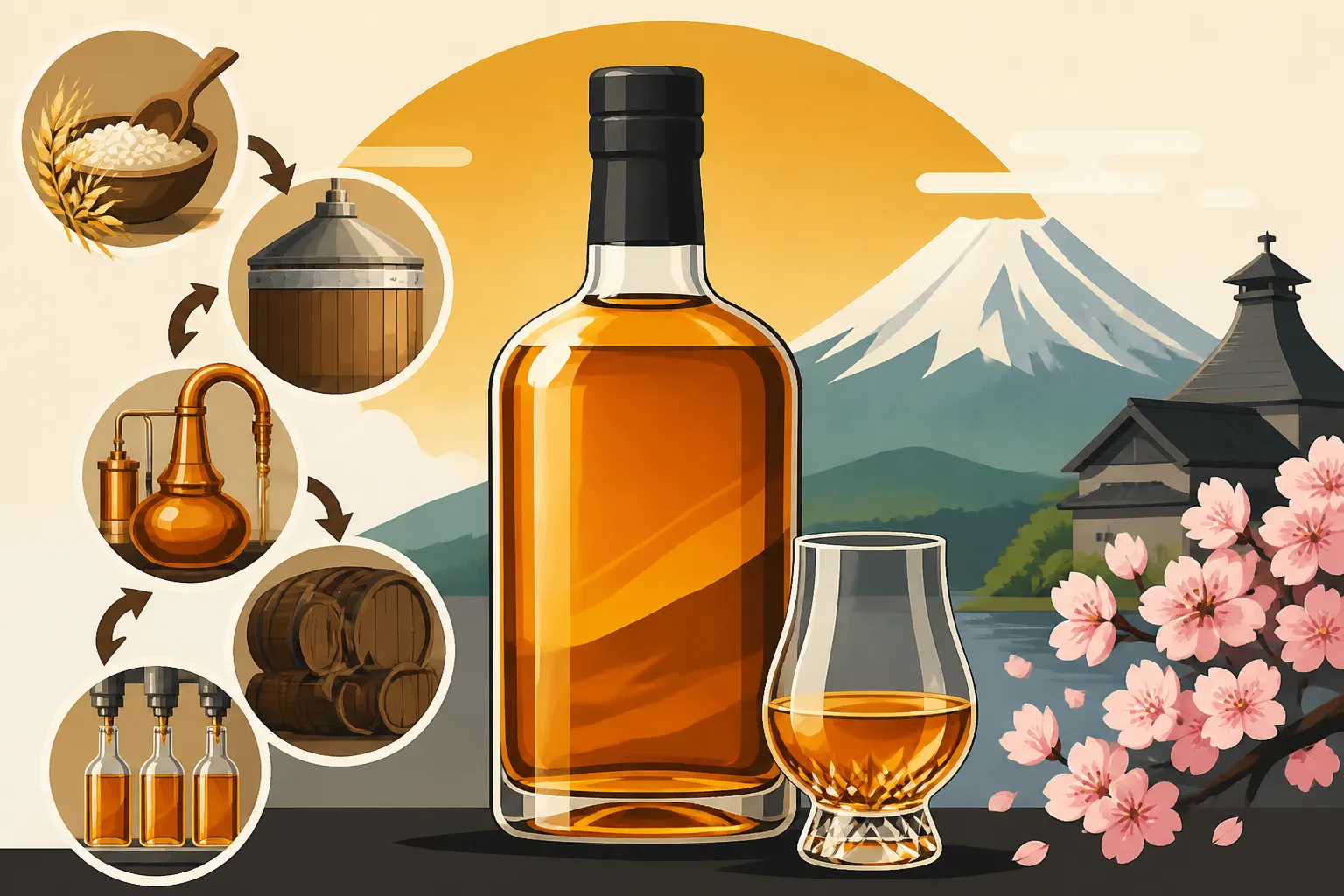
How Japanese Whisky Is Made: From Mash to Bottle
Staring at the whisky wall in a local Bic Camera or a high-end department store in Ginza can feel like a test you didn't study for. I remember my first year in Tokyo, standing in the liquor aisle for twenty minutes, paralyzed by labels I couldn't read and prices that seemed to defy logic. This guide explains exactly how that liquid in the bottle is made so you can navigate the shelf with confidence.
Disclosure: This post may contain affiliate links. We may earn a commission at no extra cost to you if you make a purchase through these links. Read full disclosure.
The Foundation of Flavor: Raw Materials and Water Sources
When you start diving into the production of Japanese whisky, you quickly realize that the "Japanese-ness" of the spirit doesn't always start with the grain. Many newcomers are surprised to learn that a significant portion of the malted barley used in Japan is actually imported from Scotland or England. This is a legacy of Masataka Taketsuru, the father of Japanese whisky, who studied in Glasgow. However, the way Japanese distillers handle these raw materials is where the cultural divergence begins. They don't just follow a recipe; they obsess over the minute variables of the grain's origin and the specific levels of peat smoke used during the malting process.
The water, however, is where the local terroir truly shines. Unlike many Scottish distilleries that deal with hard water or heavy peat runoff, Japanese distilleries are almost universally located near exceptionally soft water sources. I’ve visited several sites where the locals still talk about the water as a "gift from the mountains." In Yamazaki, the confluence of three rivers creates a unique humidity and temperature profile, while in Hakushu, the water is filtered through ancient granite. This soft water leads to a cleaner, more delicate fermentation process, which is the hallmark of the Japanese style. It is this purity that allows the subtle floral and fruit notes to emerge later in the process.
Beyond the water, the choice of yeast is a point of intense pride and experimentation. In many Western distilleries, a single, reliable yeast strain is used for decades to ensure consistency. In Japan, it is common for a single distillery to cultivate dozens of different yeast strains. Some are designed to produce heavy, oily esters, while others are intended for light, floral aromatics. This variety allows a single distillery to create a massive library of "building blocks" for their final blends. This is a crucial concept to grasp if you are just starting out and reading Japanese Whisky for Beginners: Where to Start and What to Try First.
The Art of Fermentation and Wash Backs
Fermentation in Japan is often longer and more controlled than in other parts of the world. The "wash," which is essentially a beer-like liquid created from the malted barley and water, sits in large vats called wash backs. While many modern distilleries worldwide have switched to stainless steel for ease of cleaning, a veteran expat will tell you that the best Japanese distilleries still cling to Douglas Fir or Japanese cedar (Sugi) wash backs. These wooden vessels harbor local microflora that contribute to the complexity of the final spirit.
The temperature during fermentation is managed with surgical precision. In a climate like Japan’s, which swings from humid, tropical summers to bone-chilling winters, keeping the yeast happy is a full-time job. I once spoke with a distiller in Saitama who described his yeast as "more temperamental than a Tokyo commuter during a typhoon." If the fermentation is too fast, you lose the delicate fruit notes. If it is too slow, you risk off-flavors. This balanced approach is what gives Japanese whisky its characteristic "transparency" of flavor.
What makes this stage uniquely Japanese is the obsession with "clarity." Before the wash is sent to the stills, it is often filtered or allowed to settle until it is crystal clear. In many other traditions, a cloudy wash is preferred to add "bready" or "nutty" notes. In Japan, the goal is often a "clear wort," which leads to a more refined, elegant spirit that doesn't feel heavy on the palate. This difference in approach is a major reason for the Japanese Whisky vs Scotch: Key Differences in Taste and Production that enthusiasts often debate.
Diversity in Distillation: The Pot Still Variation
If you walk into a distillery in Scotland, you will usually see rows of identical pot stills. In Japan, a single distillery like Yamazaki or Yoichi will often have stills of completely different shapes, sizes, and neck lengths. Some are fat and squat, producing a heavy, robust spirit; others are tall and slender, producing something light and ethereal. Some are heated by direct coal fires—a grueling, old-school method that produces "toasted" flavors—while others use steam coils.
This diversity is a necessity born of history. In Scotland, distilleries traditionally traded whiskies with each other to create blends. In Japan, the two giants, Suntory and Nikka, historically refused to trade with one another. This meant each company had to be self-sufficient. They had to produce every possible flavor profile under one roof. When you visit the Suntory Yamazaki Distillery: Expressions, History, and Buying Guide, you can see this "rainbow" of stills firsthand. It is an administrative and operational headache, but it results in an incredible palette for the master blender.
The distillation process also accounts for the altitude. Some of Japan’s newer craft distilleries are located high in the mountains. At higher altitudes, the boiling point of alcohol is lower, which changes the chemical reactions inside the still. This often results in a "greener," more vibrant spirit. As a resident, you start to notice these nuances once you move past the famous labels and start looking at the craft movement. Understanding this stage helps you appreciate why a bottle might be priced at fifty dollars versus five hundred.
Maturation and the Japanese Climate
Once the spirit is distilled, it goes into the cask, and this is where the Japanese environment takes over. The four distinct seasons in Japan act like a bellows on the cask. The hot, humid summers cause the wood to expand and the spirit to soak deep into the staves. The cold winters cause the wood to contract, pushing the spirit back out. This "breathing" happens more aggressively in Japan than in the relatively stable, cool climate of Scotland. Consequently, Japanese whisky often reaches a perceived maturity faster than its Scottish cousins.
The choice of wood is the most legendary aspect of this stage. While ex-bourbon and ex-sherry casks are the workhorses of the industry, the use of Mizunara oak is what defines the premium tier. Mizunara is a difficult wood; it is porous, prone to leaking, and the trees must be at least 200 years old before they can be harvested. However, it imparts flavors of sandalwood, temple incense, and coconut that are found nowhere else in the world. You can read more about this specific wood in our guide: What Is Mizunara Oak and Why Does It Matter in Japanese Whisky?
Beyond Mizunara, brewers are increasingly experimenting with local woods like Sakura (cherry blossom) and Cedar. I have tried whiskies finished in Sakura wood that smell like a spring afternoon in Ueno Park. However, as an expat buyer, you must be careful. The high demand for these unique finishes has led to some "fake" Japanese whiskies hitting the shelves—products that are actually imported spirits bottled in Japan. To protect yourself, always refer to The 2024 Japanese Whisky Labeling Standards Explained before making a big purchase.
| Production Stage | Key Japanese Characteristic | Impact on Flavor |
|---|---|---|
| Water Sourcing | Exceptionally soft, volcanic-filtered water | Clean, delicate, floral base notes |
| Fermentation | Use of wooden wash backs and multiple yeast strains | Complex esters and high aromatic diversity |
| Distillation | Multiple still shapes and sizes in one distillery | Ability to produce diverse spirits (heavy to light) |
| Maturation | Mizunara oak and intense seasonal temperature swings | Sandalwood, incense, and accelerated wood interaction |
| Blending | Focus on "Harmony" and balance | Polished, elegant, and "transparent" profiles |
The Master Blender: The Architect of Harmony
In Japan, the Master Blender is treated with the same reverence as a Michelin-starred chef or a master swordsmith. The goal of a Japanese blend is rarely to be "bold" or "aggressive." Instead, the cultural ideal is "Wa" or harmony. The blender’s job is to take the hundreds of different spirits produced by the various stills and casks and weave them into a seamless whole. This is why Japanese whiskies are often described as "polished" or "silky."
The blending process involves tasting thousands of samples. The blenders aren't just looking for good whisky; they are looking for how different whiskies interact. It’s a bit like a marriage—two great individuals might not make a great couple. As a consumer in Japan, you have access to some incredible blending sets and "distillery only" releases that allow you to see these individual components. If you're looking for something to take home, check out our list of the Best Japanese Whisky to Bring Home from Japan.
The blending philosophy also extends to how the whisky is consumed. Much of the production process is geared toward how the spirit holds up when diluted with water and ice. The "Mizuwari" (whisky and water) and the "Highball" are the primary ways locals enjoy the spirit. A blender ensures that even when the whisky is stretched thin in a tall glass of soda, the structure and aroma remain intact. You can learn to replicate this at home with our tutorial on How to Make the Perfect Japanese Highball at Home.
Navigating the Market: Labels and Authenticity
Understanding the production process is only half the battle; the other half is knowing how to buy. Because of the global boom, many bottles labeled "Japanese Whisky" are actually blends of Scotch and Canadian spirits that have never seen a Japanese still. This has been a source of massive frustration for those of us living here who want the real deal. Fortunately, as of 2024, the Japan Spirits & Liqueurs Makers Association has enforced stricter rules.
When you are out shopping, look for the term "Single Malt" or "Single Grain," and ensure the label specifies that the mashing, fermentation, and distillation all took place in Japan. If a deal looks too good to be true at a discount shop, it probably is. I usually recommend that friends look for reputable retailers or use specialized services. If you are abroad and trying to source a specific bottle, you might find success through How to Buy Japanese Whisky Online and Get It Shipped Worldwide or by browsing the selections at Dekanta or The Whisky Exchange, both of which are very transparent about the origins of their stock.
Finally, the best way to understand production is to taste the results in a controlled environment. Tokyo has an incredible array of bars that specialize in rare and discontinued bottles. Sitting at a quiet counter in a place like Bar BenFiddich or Campbelltoun Loch will teach you more about the "mash to bottle" journey than any textbook ever could. For my personal recommendations on where to go, see Best Whisky Bars in Tokyo for Rare Japanese Bottles. If you are confused by a label in a shop, use your phone to check How to Tell Real Japanese Whisky from World Blends on the Label.
Important Medical and Legal Disclaimer
The information provided in this article is for educational and informational purposes only and does not constitute medical or legal advice. Alcohol consumption carries inherent health risks and can lead to addiction. In Japan, the legal drinking age is 20. Always drink responsibly and never drink and drive. Laws regarding the labeling and production of spirits are subject to change; please consult official government or industry association resources for the most current regulations.





