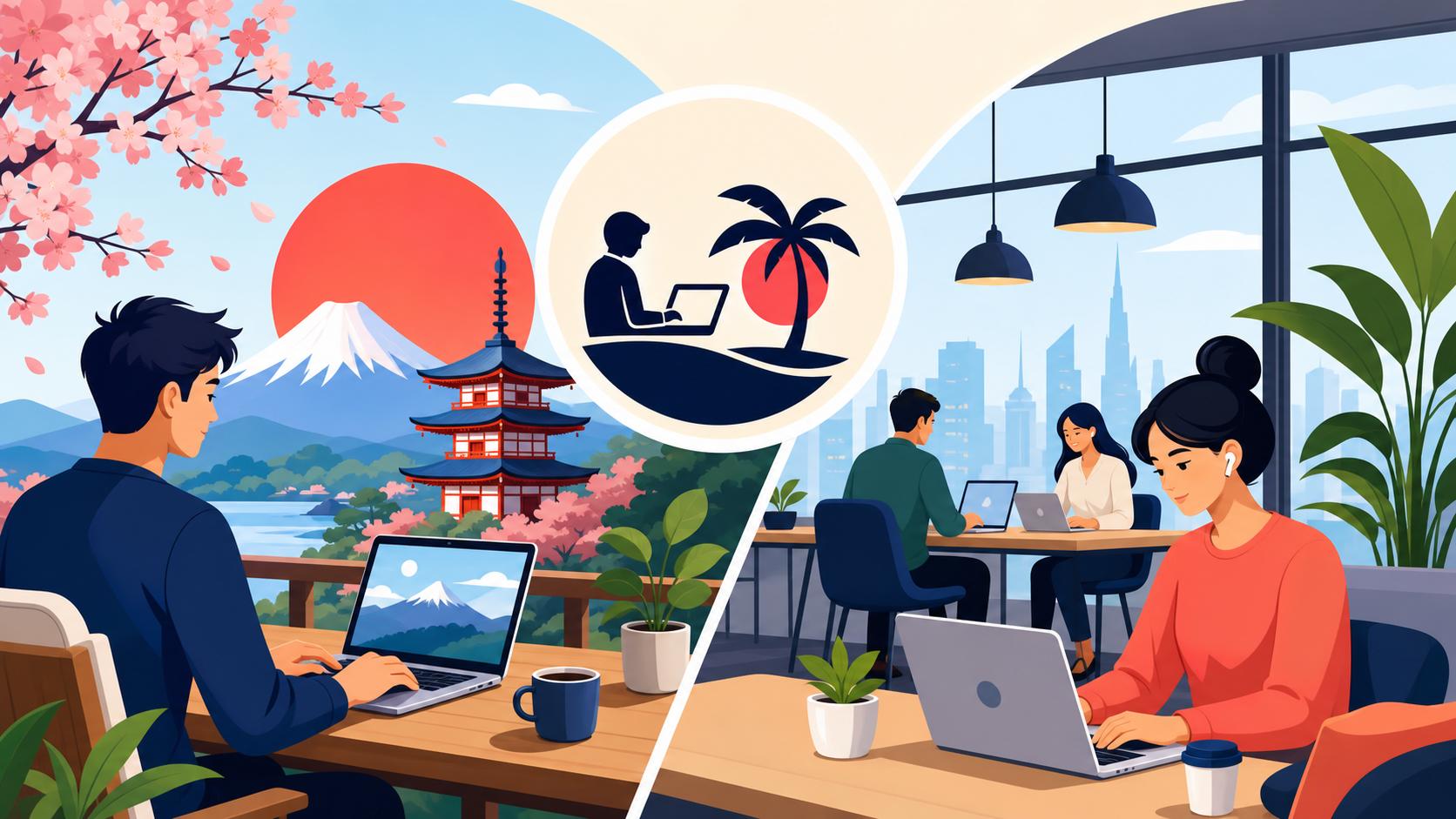
Remote Work & Co-Working in Japan: The Ultimate Digital Nomad Hub Guide
Disclosure: This article contains affiliate links. If you buy through them, we may earn a commission at no extra cost to you. Read our full disclosure.
Finding a stable internet connection in Japan while avoiding the silent judgment of a busy cafe manager is a rite of passage for every remote professional here. I spent my first three months in Tokyo frantically hopping between Starbucks locations only to realize that "free Wi-Fi" often comes with a ninety-minute time limit and a very uncomfortable wooden stool. This guide solves the logistical nightmare of setting up a remote office in Japan, from securing the right visa to finding the best co-working communities.
The Legal Landscape: Visas for Remote Workers in Japan
For years, the dream of working remotely from a traditional machiya in Kyoto or a high-rise in Tokyo was hampered by a rigid visa system that didn't recognize "digital nomads." If you weren't employed by a Japanese company, you were essentially stuck on a 90-day tourist waiver, which felt like living on borrowed time. I remember the constant anxiety of "visa runs" to Korea just to reset the clock, which is why the recent legislative changes feel like such a massive victory for our community.
The landscape has shifted significantly with the introduction of specialized pathways. Understanding the Japan Digital Nomad Visa 2027 – Can You Remote Work in Japan? is the first step for anyone looking to stay longer than a standard vacation allows. This visa specifically targets high-income earners who can prove an annual income of at least 10 million yen. While that sounds like a steep mountain to climb, it finally provides a legal framework for those of us who carry our offices in our backpacks.
However, the visa isn't without its quirks. It currently limits your stay to six months and does not allow for immediate renewal from within the country. This means you need to be strategic about your timing. Many of my peers use this six-month window to test the waters before deciding if they want to pursue a more permanent Business Manager Visa or investigate 2026 Update: Key Changes in Japanese Visa Policies to see if other categories like the "Highly Skilled Professional" visa might fit their long-term goals.
Understanding the Specific Income Requirements
The JPY 10 million requirement is non-negotiable and must be proven through tax returns, contracts, or bank statements. When I first looked into this, I was confused by the exchange rate fluctuations, but the Japanese immigration bureau typically looks at the value at the time of application. If you are a freelancer with multiple clients, you will need to provide a meticulously organized portfolio of contracts to show that your income is stable and not just a one-time windfall.
Documentation is king in Japan. You cannot simply show a screenshot of your bank balance and expect a "thumbs up." You will likely need apostilled documents and official translations. Many talented developers get rejected simply because they provided "informal" proof of income. If you are coming from a country without a tax treaty with Japan, you should also look into Digital Nomad Nomad Taxes in Japan: Residency Status and Tax Treaty Exemptions to ensure you aren't being taxed twice on the same dollar.
The 6-Month Limitation and Tax Realities
One of the biggest "I wish I knew this" points is that the six-month nomad visa is strictly for "staying," not for "settling." Because it is shorter than a year, you are generally considered a "non-resident" for tax purposes. This is a double-edged sword. On one hand, you might avoid the local residence tax, but on the other, you lack the "My Number" card which is essential for things like opening a local bank account or getting a long-term phone contract.
If your plan is to stay exactly six months and then head to Bali or Lisbon, this visa is perfect. But if you fall in love with the country—as most of us do—you’ll find yourself hitting a wall at the 180-day mark. You’ll need to leave the country for at least six months before you can apply for the nomad visa again. This is why many people use the time to build a network and eventually switch to a different status, such as an Intra-Company Transferee Visa if their employer decides to open a small branch here.
Finding Your Base: Best Cities for Remote Work in Japan
Choosing where to park your laptop is about more than just aesthetics; it's about the "vibe" of the local infrastructure. Tokyo is the obvious choice, but the cost of living can eat your budget alive if you aren't careful. When I first moved here, I chose Shinjuku for the convenience, but I quickly realized that the noise and the crowds made focusing nearly impossible. Eventually, I migrated to the western suburbs, which offered a much better balance of peace and connectivity.
If you are looking for a community that actually understands what a digital nomad is, you might want to look beyond the capital. Cities like Fukuoka have branded themselves as "Startup Cities" and offer incredible support for foreign entrepreneurs. Meanwhile, Osaka provides a much more laid-back atmosphere where the "work hard, play hard" culture is replaced by "work efficiently, eat incredibly well." Your choice of city will dictate your access to Best Co-Working Spaces in Tokyo and Osaka for Transient Digital Nomads.
Tokyo: The Fast-Paced Hub of Innovation
Tokyo is a beast. If you thrive on the energy of millions of people and want to be at the center of the tech scene, neighborhoods like Shibuya, Minato, and Setagaya are your best bets. Shibuya is home to "Bit Valley," the heart of the Japanese tech world. Here, you are never more than five minutes away from a high-speed co-working space or a networking event. The downside? You will pay a premium for every square inch of space.
For a more "writerly" or creative vibe, it is worth considering Shimokitazawa or Koenji. These neighborhoods have a slower pace, plenty of vintage cafes that are laptop-friendly, and a community of freelancers that feels less like a corporate grind. If you are living in a tiny "mansion" apartment, you will definitely need to master Ergonomics and Posture Health for Long-Term Remote Workers in Tiny Japanese Homes, as most Tokyo rentals don't leave much room for a proper standing desk.
Osaka and Fukuoka: Balancing Cost and Lifestyle
Osaka is often described as the "soul" of Japan. For a remote worker, this translates to cheaper rent and a more approachable social scene. The Umeda and Namba districts have world-class co-working facilities, but the real magic happens in the smaller neighborhoods like Horie. Living here allows you to save significantly on overhead, which can be redirected into traveling during your weekends.
Fukuoka, on the southern island of Kyushu, is the rising star. It has a dedicated "Startup Cafe" where you can get free consultations on starting a business in Japan. The city is compact, the beaches are close, and the internet speeds are some of the fastest in the country. Many nomads find that their quality of life jumps significantly in Fukuoka because they spend less time commuting and more time integrating into the local culture. It's a great place to start Learning Japanese: Top 10 Apps and Resources for Expats because the locals are generally more talkative than their Tokyo counterparts.
| City | Average Monthly Rent (1K) | Best For | Nomad Friendliness |
|---|---|---|---|
| Tokyo (Shinjuku) | ¥100,000 – ¥130,000 | Tech Networking | High (but expensive) |
| Osaka (Chuo-ku) | ¥70,000 – ¥90,000 | Food & Social Life | Very High |
| Fukuoka (Hakata) | ¥55,000 – ¥75,000 | Startups & Nature | Elite |
| Kyoto (Nakagyo) | ¥65,000 – ¥85,000 | Traditional Culture | Moderate (crowded) |
| Sapporo (Chuo-ku) | ¥50,000 – ¥70,000 | Summer Cooling | High (seasonal) |
Co-Working Spaces: Where to Productively Get Things Done
The "laptop at a cafe" lifestyle in Japan is romanticized, but the reality is often a struggle with low battery and unstable Wi-Fi. This is why co-working spaces are essential. Unlike in some Western countries where co-working is just about a desk, in Japan, it’s about "the environment of focus." Many spaces have strict "no-talking" zones and "phone-booth only" areas for Zoom calls. This cultural emphasis on silence can be a shock if you're used to the buzzing social atmosphere of a WeWork in New York.
When looking for a space, you have to decide between the big international chains and the "local" hubs. Chains like WeWork or Regus offer consistency and English-speaking staff, but they can feel a bit sterile. Local spots, often found in renovated warehouses or older office buildings, offer a more authentic connection to the local creative scene. I’ve found that some of the best networking happens in these smaller hubs where the owner actually knows everyone's name.
Membership Models and Drop-in Rates
Most Japanese co-working spaces offer three tiers: drop-in (hourly or daily), monthly hot-desk, and dedicated desk. Drop-in rates usually hover around ¥500 per hour or ¥2,000–¥3,000 per day. If you are only in a city for a week, this is perfect. However, be aware that many spaces require an initial registration fee, which can be as high as ¥5,000. It pays to check their website beforehand to see if they have a "nomad-friendly" plan that waives this.
For long-term stays, a monthly membership is almost always better. It typically includes perks like a mailing address (very important for some official paperwork) and access to meeting rooms. Some high-end spaces even offer "nap rooms" and shower facilities, which are lifesavers if you're working across different time zones. If you’ve managed to get your How to Use Your Tokutei Zairyu Card to Set Up Utilities and Fiber Internet sorted, you might only need the co-working space for social interaction rather than just the Wi-Fi.
Amenities That Actually Matter: Booths, Monitors, and Coffee
The "killer app" of any Japanese co-working space is the "Tel-booth." Because Japanese office culture values quiet, taking a video call at an open desk is often considered a major "manner violation." Always check how many soundproof booths a space has before signing up.
Other amenities to look for include 4K monitors for rent and high-quality "all-you-can-drink" coffee stations. Some spaces, like "G's Academy" or "FabCafe," even offer 3D printers and laser cutters if you’re in the hardware or maker space. If you're struggling with the language barrier while trying to understand the membership contract, using a platform like Preply to find a tutor who can help you translate specific business terms is a smart move before you sign any long-term agreements.
The Remote Work From Cafe Culture in Japan
Let’s be honest: sometimes you just want the smell of roasted beans and the gentle hum of a cafe. While Japan has thousands of amazing cafes, not all of them want you there with your MacBook Pro. The "Cafe Nomad" culture here is governed by a set of unwritten rules that, if broken, will result in a very polite but very firm request to leave. I learned the hard way that "one coffee for four hours of work" is the quickest way to become a "persona non grata" at your local neighborhood spot.
The trick is to look for signs. If you see a "No Laptops" sticker on the door, believe it. If you see power outlets at the counter, it’s an invitation. Many chains have leaned into the remote work trend by creating "Station Booths" or dedicated work sections. However, the soul of the nomad experience is finding those "hidden gems" where the owner doesn't mind you lingering, provided you follow the "one order per hour" rule.
Navigating the Unwritten Rules of Cafe Camping
The most important rule is the "90-minute limit." Many popular cafes in busy districts like Harajuku or Ginza will place a small laminated card on your table when you arrive, noting your "expiry time." Don't try to argue; it's just the way it is. If you want to stay longer, the polite thing to do is to stand up, go back to the counter, and order another drink or a meal. This shows the staff that you respect their business and aren't just "squatting."
Another major point is noise. Using your laptop’s speakers or taking a call at a table is an absolute no-go. Even if you think you’re whispering, you’re likely disturbing the "wa" (harmony) of the space. I always keep a pair of noise-canceling headphones on, even if I’m not listening to anything, just to signal that I am in "work mode" and won't be a disturbance. If you're feeling lonely while working in these quiet spaces, checking out Networking in Japan: How Expats Can Build Professional Connections can help you find groups that actually meet up for louder social brainstorming.
Best Chains and Hidden Gems for Laptoppers
If you need a reliable "emergency" office, chains like Starbucks, Tully’s Coffee, and Renoir are your best friends. Renoir, in particular, is an "old-school" chain that specifically caters to business people. The chairs are plush, they give you hot towels (oshibori), and they often have dedicated smoking and non-smoking work areas. It’s a bit more expensive than Starbucks, but the "productivity per yen" is much higher.
For hidden gems, look for "Comic Cafes" or "Internet Cafes" like Kaitsu. These are not your typical Western internet cafes; they are private booths with high-end PCs, flat-lie chairs, and unlimited soft drinks. While they can feel a bit "gritty" to some, they are incredibly cheap and provide total privacy for those days when you have back-to-back calls. If you're spending a lot of time in these dim spaces during the colder months, be mindful of Managing Seasonal Affective Disorder in Japan’s Winter Months, as the lack of natural light can affect your mood over time.
Setting Up Your Digital Infrastructure
A digital nomad is only as good as their connection. Japan is famous for its fiber-optic speeds, but getting that speed into your rented apartment is a bureaucratic obstacle course. When I first signed my lease, I assumed the internet would be "plug and play." Instead, I spent three weeks using a sluggish mobile hotspot because I didn't realize I needed to book a "construction" appointment to have the fiber line activated.
The options have improved. We now have 5G home routers (like "Home 5G" from Docomo) which offer decent speeds without the need for drilling holes in your walls. However, if you are a heavy user—someone doing video editing or large-scale deployments—you will still want a dedicated landline. Navigating the contracts for these services is much easier if you’ve been using JapanesePod101 to pick up technical vocabulary related to "kaisen" (lines) and "setsuzoku" (connection).
Pocket Wi-Fi vs. eSIM: What’s Best for Mobility?
For the first few weeks, I highly recommend a high-end pocket Wi-Fi rental. It allows you to connect multiple devices (laptop, phone, tablet) to a single secure network without draining your phone's battery. Companies like Sakura Mobile or Mobal specialize in "foreigner-friendly" rentals that don't require a Japanese bank account. The "Unlimited" plans are usually capped at around 3GB to 10GB per day before they throttle your speed, so read the fine print carefully.
If you have a newer phone, an eSIM is the modern standard. It’s incredibly convenient because you can activate it the moment you land at Narita or Kansai Airport. However, eSIMs are usually data-only for short-term visitors. If you need a local phone number—which you will if you want to use food delivery apps or register for some co-working spaces—you’ll need a physical SIM or a long-term contract. For those staying on the nomad visa, proving your identity to get a number can be tricky, so refer to Setting Up High-Speed Fiber Internet for Heavy Remote Work (Nomad Infrastructure) for the latest workarounds.
Language Barriers in Tech Support and Utilities
What happens when the internet goes out at 2:00 AM and you have a deadline? Most major ISPs have English support, but it’s often limited to business hours. This is where having a basic grasp of the language—or a very good translation app—becomes vital. I’ve found that the "live chat" features on Japanese websites are often more helpful than calling, as you can use browser-based translation tools to navigate the conversation.
If you're finding the technical jargon overwhelming, don't forget that platforms like iTalki allow you to book lessons with tutors who can specifically help you role-play these scenarios. Even a 30-minute lesson spent practicing how to explain to a technician that a router’s "ONT" light is flashing red can be worthwhile. It may sound silly, but it can save hours of frustration. Being proactive about your tech setup is the difference between a successful nomad stint and a stressful one.
Balancing Productivity with Cultural Integration
The biggest trap of being a digital nomad in Japan is the "bubble." It is very easy to spend all day in a co-working space surrounded by other English speakers, eat at a nearby Lawson, and never actually interact with the country you’re living in. I fell into this trap in my first year, and it led to a strange sense of "homesickness in paradise." Integration isn't just about being polite; it’s about making the effort to understand the rhythm of Japanese life.
Remote work gives you the freedom to explore, but you have to be intentional about it. This means working from different cities, joining local meetups that aren't specifically for "tech," and saying "yes" to that local festival even if you have a mountain of emails. The more you integrate, the more you’ll find that Japan opens up to you in ways that a tourist never sees.
Using Language Apps to Bridge the Gap
You don't need to be fluent to work here, but knowing "survival Japanese" changes everything. When you can walk into a local neighborhood "kissaten" (traditional coffee shop) and order in Japanese, you stop being a "tourist" and start being a "neighbor." I used JapanesePod101 during my morning commutes to learn specific phrases for cafes and offices. It wasn't about passing the JLPT; it was about making my daily life smoother.
Beyond the basics, I recommend using Preply to find a language partner who lives in the same city as you. They can give you the "inside scoop" on which cafes are actually laptop-friendly and which ones are "strictly for talking." This kind of hyper-local knowledge is something you won't find in any guidebook. It also helps you avoid "cultural friction"—knowing when to bow, how to handle your business card (meishi), and how to read the "air" (kuuki wo yomu) in a professional setting.
Networking and Building a Community
Networking in Japan is often done through "Nomikai" (drinking parties) or specialized "Meetup" groups. Even as a remote worker, you should look for professional organizations related to your field. For example, Tokyo has a vibrant "Hacker News" community and several "Founders in Japan" groups. These aren't just for finding jobs; they are for finding people who understand the unique struggle of filing taxes as a foreigner or finding a good English-speaking doctor.
Don't ignore the "analog" world either. Some of my best professional connections were made at bouldering gyms or local running clubs. Japanese people often separate their "work self" from their "private self," so meeting them in a hobby-based setting can lead to more genuine friendships. If you’re ever unsure about how to navigate these social waters, take a look at Networking in Japan: How Expats Can Build Professional Connections for a deeper dive into the etiquette of building a local circle.
Final Practical Tips for Success
As you prepare for your nomad journey, remember that Japan is a land of contradictions—it is high-tech but still uses fax machines; it is incredibly safe but requires constant vigilance regarding natural disasters. Your success as a remote worker here depends on your ability to be flexible and prepared.
Always have a backup for your backup. This means having two ways to access your money, a secondary mobile hotspot, and a clear understanding of where your nearest evacuation point is. Most importantly, don't forget to look up from your screen. The temples, the mountains, and the neon-lit streets are why you came here in the first place. Make sure you're living in Japan, not just working from it.
Disclaimer
The information provided in this guide is for informational purposes only and does not constitute legal, financial, or professional advice. Visa regulations, tax laws, and local policies in Japan are subject to frequent change. Always consult with official government sources or qualified professionals before making significant life or financial decisions. Use of the mentioned brands is at the reader's discretion.