Living in Kyoto as an Expat: Pros, Cons & Neighborhoods
Kyoto offers a unique blend of ancient tradition and modern living, making it a dream destination for many expats. From the bike-friendly streets and stunning nature to the challenges of summer heat and tourist crowds, this guide breaks down everything you need to know about building a life in Japan’s cultural capital.
Disclosure: This post may contain affiliate links. We may earn a commission at no extra cost to you if you make a purchase through these links. Read full disclosure.
Why You Will Fall in Love with Life Here
There is a reason why Kyoto consistently ranks as one of the best cities in the world. The quality of life here can be exceptionally high if you appreciate culture and nature.
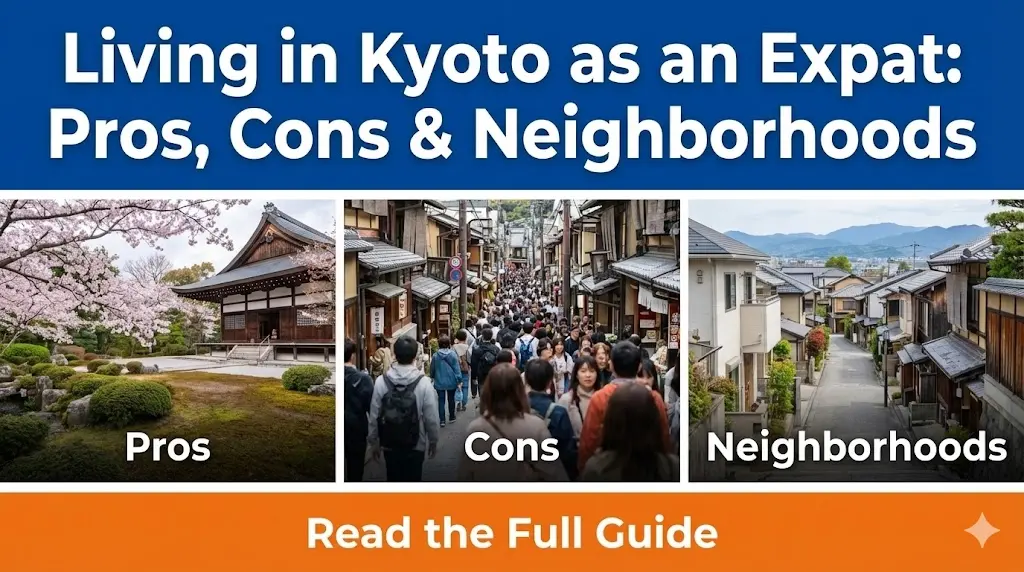
Immersion in History and Culture
In Kyoto, history is not something you visit in a museum; it is something you live alongside. With over 1,600 temples and 400 shrines, you are constantly surrounded by heritage. You might find yourself attending a fire festival on your way home from work or buying vegetables from a shop that has been open for 300 years. This proximity to the “Old Japan” provides a deep sense of connection to the culture.
The City of Bicycles
Unlike the sprawling metropolis of Tokyo where trains are essential, Kyoto is compact and flat. This makes it the ultimate cycling city. You can get almost anywhere on a bicycle in 30 minutes. Riding along the Kamo River (Kamogawa) on a sunny morning is one of the pure joys of living here. It saves you money on transport and keeps you active.
Access to Nature
Kyoto is surrounded on three sides by mountains. This geographical feature, known as a basin (bonchi), means that hiking trails are never far away. You can be in the bustling downtown area of Shijo-Kawaramachi one moment, and 20 minutes later, you can be hiking up Mount Daimonji for a sunset view over the city. The connection to the seasons—cherry blossoms in spring, lush green in summer, red maples in autumn, and snow in winter—is profound here.
A Relaxed Pace of Life
Compared to Osaka and Tokyo, people in Kyoto walk a little slower. The rush hour is less intense. There is a strong culture of cafés and bakeries (Kyoto residents consume more bread and coffee than almost anywhere else in Japan). It is a city that values leisure, aesthetics, and quiet moments.
Challenges You Might Face as a Resident
No place is perfect, and Kyoto has some well-known drawbacks that every potential expat should be aware of before signing a lease.
The Basin Climate
The geography that makes Kyoto beautiful also makes its weather extreme.
- The Oven Summers: Because the city sits in a bowl surrounded by mountains, the heat and humidity get trapped in the summer. It creates a sauna-like effect that can be physically draining from July to September.
- The Bone-Chilling Winters: Conversely, the cold air gets trapped in the winter. While it doesn’t snow heavily, the damp cold (“soko-bie”) penetrates right through your coat.
Check out Staying Fit in Japan: Gyms and Outdoor Activities
The Overtourism Factor
Kyoto is one of the most popular tourist destinations on the planet. In peak seasons (Spring and Autumn), public transport can become overwhelmed. Buses that you rely on to get to work might be too full to board because of tourists with large suitcases. Downtown areas like Gion and Higashiyama can feel like theme parks rather than neighborhoods. As a resident, you quickly learn which areas to avoid and when.
The Social Wall
There is a stereotype in Japan that Kyoto people are polite but distant. You might hear the phrase Ichigensan Okotowari (first-time customers refused), which historically applied to high-end teahouses but metaphorically describes the social circle. It can take longer to build deep friendships with locals here compared to the outgoing nature of Osakans. However, once you are “in,” the bonds are incredibly loyal and strong.
Finding the Perfect Corner for Your Lifestyle
Kyoto is divided into “wards” (Ku), each with a distinct personality. Choosing the right neighborhood is the most important decision you will make.
Sakyo-ku: The Bohemian Student Hub
If you are an artist, a student, or someone who loves alternative culture, Sakyo Ward is the place to be.
- Vibe: Located in the northeast, this area is home to Kyoto University. It is filled with used bookstores, funky cafes, vegan restaurants, and small music venues.
- Key Areas: Demachiyanagi, Ichijoji (famous for Ramen street), and Yoshida.
- Pros: Cheaper rent, younger crowd, very bike-friendly.
Kamigyo-ku: The Historic Center
This is the heart of old Kyoto, located just north of the city center.
- Vibe: Quiet, residential, and prestigious. It houses the Imperial Palace (Gosho). It is sophisticated and peaceful.
- Key Areas: Nishijin (the textile district).
- Pros: Central but quiet, beautiful traditional architecture, safe.
- Cons: Few supermarkets, can be expensive.
Shimogyo-ku: The Modern Gateway
This is the area around Kyoto Station and down to Shijo street.
- Vibe: Urban, convenient, and commercial. If you need to commute to Osaka for work, living near Kyoto Station is a lifesaver.
- Key Areas: Kyoto Station, Gojo.
- Pros: Incredible transport links, endless shopping and dining options.
- Cons: Noisy, less greenery, lacks the “traditional” charm of other districts.
Higashiyama-ku: The Tourist Dream
This is the area with Kiyomizu-dera and Gion.
- Vibe: Stunningly beautiful with preserved historical streets.
- Pros: You live in a postcard.
- Cons: Overwhelmed with tourists. Grocery shopping is difficult as there are few supermarkets. Rents are high.
Read more about Housing Types in Japan: Mansion vs Apartment
Arashiyama & Ukyo-ku: The Nature Retreat
Located in the far west of the city.
- Vibe: famous for the Bamboo Grove. It feels like a separate village.
- Pros: Surrounded by nature, beautiful river views.
- Cons: Far from the city center (20-30 mins by train), crowded on weekends.
Cost of Living Comparison
Is Kyoto expensive? Generally, it is cheaper than Tokyo but slightly more expensive than Osaka for rent.
Here is a rough monthly estimation for a single expat living in a 1K or 1DK apartment.
| Expense Category | Monthly Cost (JPY) | Notes |
| Rent | 60,000 – 90,000 | Depends heavily on age of building. |
| Utilities | 10,000 – 15,000 | Higher in Summer/Winter due to AC. |
| Internet/Phone | 5,000 – 8,000 | Standard SIM and fiber optic costs. |
| Food/Groceries | 40,000 – 60,000 | Eating out is relatively affordable. |
| Transport | 5,000 | Low if you bike; higher if you commute. |
| Total | ~120,000 – 180,000 | A comfortable baseline budget. |
Rent Tip: If you want to save money, look for older apartments or “cultural properties.” Sometimes you can rent a renovated room in an old house for a very reasonable price, though insulation might be an issue.
Check out Cost of Living in Japan: Budgeting Tips
The Job Market for Foreigners
Kyoto is not an economic powerhouse like Tokyo or Osaka. The job market is specific and somewhat limited.
Tourism and Hospitality This is the biggest sector. Hotels, tour companies, and restaurants are always looking for multilingual staff. If you speak English and some Japanese, you can find work here easily.
Education and Research Kyoto is known as a “University City.” There are many universities, which means there are opportunities for researchers, professors, and administrative staff in academia. Additionally, English teaching (Eikaiwa and ALTs) is a steady source of employment.
Tech and Gaming Surprisingly, Kyoto is home to some massive global companies like Nintendo and Kyocera. While competitive, there are engineering and localization roles available for highly skilled professionals.
Remote Work Many expats living in Kyoto actually work remotely for companies based in Tokyo or overseas. Kyoto is an ideal base for digital nomads because the cost of living is lower than Tokyo, but the lifestyle quality is unique.
Navigating the Housing Market
When hunting for an apartment in Kyoto, you will encounter two main styles.
The Modern Mansion These are concrete condo-style buildings. They are safe, insulated, and convenient. They look just like apartments in Tokyo or Osaka. They are low-maintenance and practical.
The Machiya (Traditional Townhouse) This is the Kyoto dream. A Machiya is a traditional wooden wooden house, often narrow and deep. Living in one is romantic—you have tatami mats, sliding paper doors (shoji), and maybe a tiny inner garden (tsubo-niwa).
- Warning: They are incredibly cold in winter. They are drafty, and sound travels easily. Maintenance can be tricky. However, for many, the aesthetic is worth the discomfort.
Food Culture: Obanzai and Bakeries
You cannot talk about living in Kyoto without talking about food. While Kaiseki (haute cuisine) is famous, expats rarely eat it daily.
Obanzai This is the traditional home-style cooking of Kyoto. It consists of small vegetable dishes using local seasonal ingredients. It is healthy, delicious, and sustainable. Many small restaurants serve “Obanzai buffets” for lunch which are a great value.
The Bread Capital You might expect rice, but Kyoto residents consume a massive amount of bread. The city is dotted with high-quality artisan bakeries. On weekends, it is a local tradition to walk to a favorite bakery, buy a baguette or curry bread, and sit by the Kamogawa river to eat it.
Coffee Culture Kyoto has a serious coffee scene, ranging from old-school Kissaten (smoky, retro coffee shops) to modern, minimalist specialty roasters. It is a great city for cafe hopping and working on your laptop.
Transportation: The Bus vs. Train Dilemma
Kyoto’s subway system is limited. It basically has two lines: one going North-South (Karasuma Line) and one going East-West (Tozai Line).
The Bus Network The bus system covers every corner of the city. However, it is slow and subject to traffic jams. As a resident, you will likely learn to hate the bus during tourist season.
The Bicycle Solution This brings us back to the bike. It is simply the best way to live.
- Rules: You cannot park your bike just anywhere. You must use designated parking lots, or it will be impounded. Police are strict about this in downtown areas.
- Etiquette: Don’t ring your bell aggressively. Cycle on the left.
Read more about Driving in Japan: License and Rules
Conclusion
Living in Kyoto is a privilege. It is a city that demands you slow down and pay attention to the details—the changing color of the leaves, the specific seasonal sweet at the wagashi shop, the texture of the tatami under your feet.
It is not a city for those who crave the high-energy, 24/7 rush of Tokyo. It is a city for those who want to be inspired by beauty and are willing to tolerate the humid summers and the slow buses in exchange for living in a living museum.
If you are ready to trade skyscrapers for shrines and subways for bicycles, Kyoto might just be the perfect place for your Japanese adventure.
Disclaimer
This article is for general informational purposes only and does not constitute professional advice. Laws, prices and regulations vary by location and change over time. Consult a qualified professional for guidance on your specific situation.