Cash vs Cashless in Japan: Navigating a Society in Transition
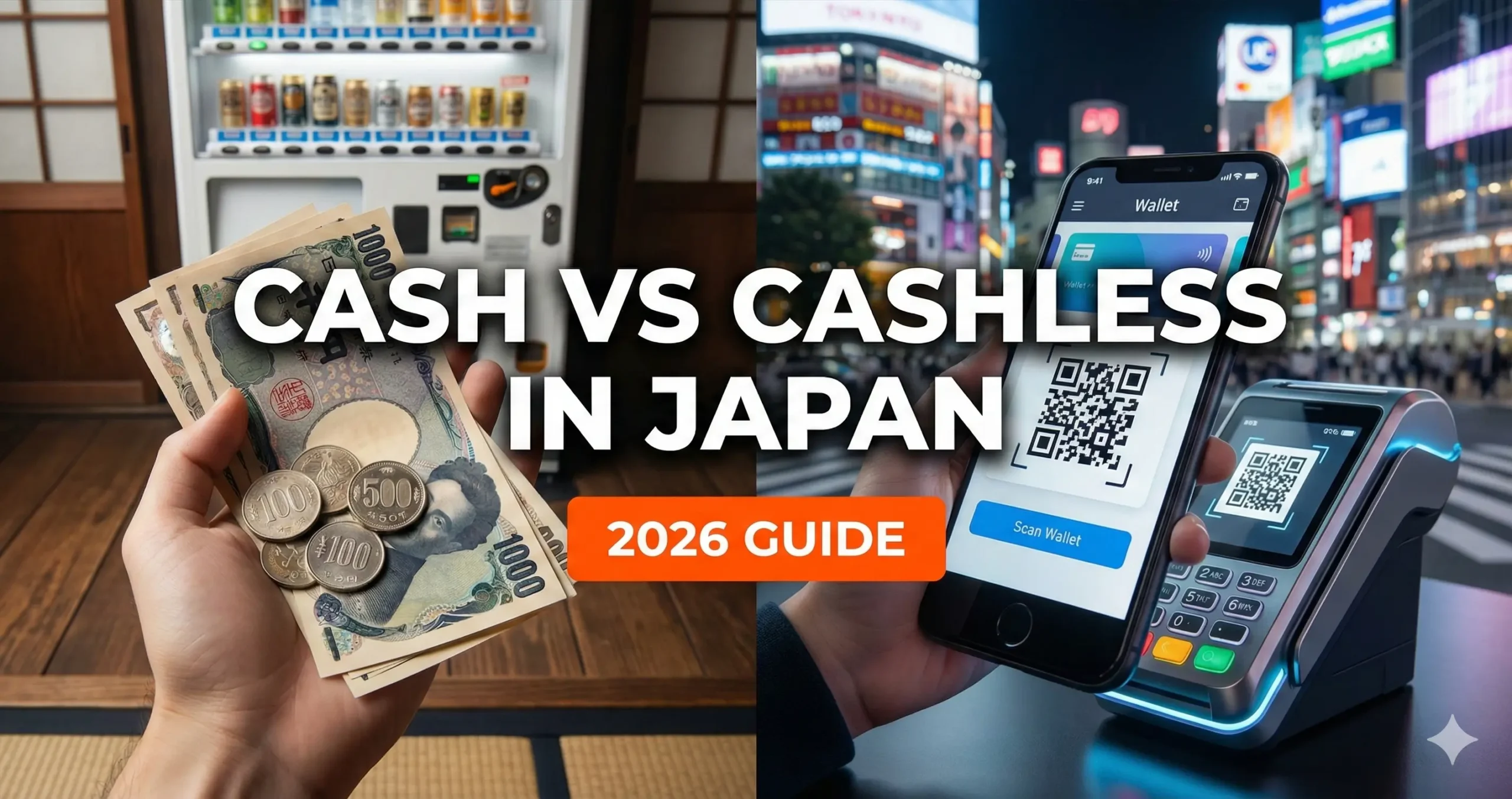
Japan is famous for loving cash, yet QR codes, IC cards, and smartphone wallets are now everywhere. This guide explains how Japan is changing, where you still need cash, and how expats can mix cash and cashless without stress.
Disclosure: This post may contain affiliate links. We may earn a commission at no extra cost to you if you make a purchase through these links. Read full disclosure.
Japan Is Moving From Cash First To Cash Plus Cashless
For years, people called Japan a “cash society.” That is still partly true – but the numbers show a clear shift.
The Ministry of Economy, Trade and Industry (METI) reports that cashless payments reached 42.8% of consumer payments in 2024, up from just 13.2% in 2010, and Japan reached its 40% cashless target for 2025 one year early. The long-term goal is around 80% cashless.
At the same time, surveys show that many residents still see cash as their main payment method, and Japan keeps a very high level of cash in circulation compared to other rich countries.
So for expats, the real picture is simple:
Japan is not “cash or cashless” – it is cash and cashless at the same time.
Understanding this mix will make everyday life, travel, and budgeting much smoother. For a wider cost overview, you can also read Cost of living in Japan for foreigners.
How Cashless Payments Work in Japan Today
When people say “cashless in Japan,” they usually mean four main things:
- Credit and debit cards – VISA, Mastercard, JCB, etc.
- IC cards – Suica, PASMO, ICOCA and similar rechargeable cards.
- QR code payment apps – mainly PayPay, Rakuten Pay, d-Barai, LINE Pay and others.
- Mobile wallets – Apple Pay, Google Pay, Mobile Suica/PASMO.
You will see contactless readers at:
- Convenience stores
- Train stations and buses
- Supermarkets and drugstores
- Chain cafés and restaurants
- Many taxis and vending machines
But outside big cities, small family shops, some clinics, temples, and older restaurants can still be cash only, even in 2025.
Why Cash Still Matters in Japan
Even with strong government support for cashless payments, Japan remains unusually cash-heavy.
Several reasons often appear in research and travel reports:
- High trust in cash – People feel notes and coins are safe and “real.”
- Low crime rates – Carrying cash does not feel very risky compared to many countries.
- Disaster mindset – Earthquakes and typhoons make people value payment methods that work even when power or networks are down.
- Older population – Many seniors are more comfortable with cash than apps.
- Small merchants’ costs – Some small shops dislike card or QR fees and prefer simple cash.
A survey in 2021 found that over 90% of respondents still named cash as their most used payment method, even though many also used cards or digital payments.
So while the value of cashless payments is rising fast, cash is still used very often in everyday life – especially for small local purchases.
Cashless Growth in Numbers
Government and industry data make the trend very clear:
| Year | Approximate cashless payment ratio | What changed |
|---|---|---|
| 2010 | 13.2% | Cash dominates, cards and IC cards growing slowly. |
| 2015 | Around mid-teens | IC cards spread beyond transport into shops and vending machines. |
| 2018–2019 | Low 20s | QR apps like PayPay and LINE Pay launch big campaigns. |
| 2022 | 36.0% | Government pushes hard for cashless ahead of future events. |
| 2023 | 39.3% | QR transactions jump; PayPay leads QR market. |
| 2024 | 42.8% | 40% goal reached early; new target 80% in long term. |
At the same time, the card payments market in Japan is forecast to keep growing strongly, and rules for card security (like 3-D Secure for online card payments) are getting stricter.
For expats, the message is:
- Cashless is now very normal in big cities.
- But cash is far from dead, and many people still prefer it for certain situations.
When You Still Need Cash in Japan
Even in 2025, you should always keep some cash in your wallet. Situations where cash is often needed include:
- Small local restaurants (especially ramen shops, mom-and-pop diners)
- Old shopping streets (shotengai) and markets
- Local clinics, dentists, and some pharmacies
- Temple and shrine donations, fortune slips, and entrance to some gardens
- Coin lockers in some older stations
- Rural buses and small train lines without IC readers
- Some small bars, karaoke boxes, and beauty salons, especially outside major cities
Even so, blogs from long-term residents show that tourists are often surprised how often cash is still the only option.
Where Cashless Shines in Daily Life
On the other hand, cashless is now extremely convenient in many parts of Japanese life:
- Trains, subways, and buses with IC cards like Suica or PASMO.
- Convenience stores (konbini) – all big chains accept cards, IC cards, and QR apps.
- Supermarkets and drugstores in cities.
- Vending machines that accept IC cards or mobile Suica.
- Taxis in bigger cities, especially when you see IC or QR stickers on the door.
- Online shopping on sites like Rakuten, Amazon Japan, and Yahoo! Shopping.
- Chain cafés and fast-food shops.
Guides to Japan’s “cashless society” now present IC cards and QR apps as standard tools for tourists, students, workers, and entrepreneurs.
If you want more structure for your day-to-day spending, see Best budgeting apps for expats in Japan to manage yen expenses.
Main Cashless Payment Methods for Expats
IC Cards for Transport and Small Purchases
IC cards like Suica, PASMO, ICOCA and others are prepaid smartcards. You tap them on a reader to pay for:
- Train and bus fares
- Convenience store shopping
- Drinks and snacks from vending machines
- Some taxis, shops and coin lockers
You can buy them at train stations, charge them with cash or card, and even load them into your Apple Pay or Google Pay on compatible phones. Some special versions like Welcome Suica and PASMO Passport are designed just for visitors.
Credit and Debit Cards
Card usage is growing steadily: research shows Japan’s card payment market is expected to keep expanding, pushed by online shopping and government efforts.
However:
- Some small shops and clinics still do not accept cards.
- Foreign-issued cards may be rejected by a few machines or websites.
- Japan also has proprietary brands like JCB, which are not always available overseas.
Once you have a local bank, getting a Japanese credit card can make life easier for things like online subscriptions, rent guarantees, or phone plans. See Opening a bank account and getting a card in Japan for step-by-step help.
QR Code Payment Apps
QR apps are the fastest-growing area of Japanese cashless.
The government and industry data show:
- QR code payments exceeded 11.5 billion transactions in one recent year, and
- PayPay holds around two-thirds of the QR market, making it the dominant app.
A 2024 overview lists the main QR and mobile payment apps as:
- PayPay – the most widely used QR app, strong in small shops, restaurants and taxis, with frequent point and cashback campaigns.
- Rakuten Pay – linked to Rakuten’s online shopping and Rakuten Card, popular at major chains and convenience stores.
- d-Barai (d Payment) – run by NTT Docomo, tied to d-Point; strong among Docomo users.
- LINE Pay – integrated into the LINE messaging app, popular for sending money between friends.
Most of these apps connect to:
- A Japanese bank account, and/or
- A Japanese credit card, and
- Reward you with points for each payment.
For a practical setup guide, see Using PayPal and other cashless apps in Japan.
Online Payments and Auto-Charge
Many people in Japan also:
- Use online banking and credit cards for utilities, phone bills, and subscriptions.
- Set up auto-charge from their bank to IC cards or QR apps.
This lets you keep a low cash reserve for emergencies, but handle most daily spending with a tap or scan.
If you move money across borders, you may also want tools like Wise or PayPal. We cover these in Using PayPal, Wise, or international payment services in Japan.
Comparing Cash and Cashless Options for Expats
Here is a simplified comparison to help you choose what to use when:
| Method | Best for | Main pros | Main cons |
|---|---|---|---|
| Cash | Local shops, clinics, small restaurants, rural travel | Always accepted, great for emergencies, easy for budgeting | Bulky, no automatic record, ATMs may have fees or limited hours |
| IC cards (Suica etc.) | Transport, convenience stores, vending machines | Very fast, works offline, good for small daily spending | Need to top up, refunds for tourists may require going to station |
| Credit/debit cards | Larger shops, online shopping, hotels | Good for bigger purchases, travel rewards, purchase records | Some places still cash only, foreign cards sometimes refused |
| QR apps (PayPay etc.) | Chain stores, many small shops, taxis | Points/cashback, easy on smartphone, detailed history | Usually need Japanese bank or card, setup in Japanese |
| Online transfers and auto-charge | Bills, rent, topping up cards | Very convenient, no cash handling | More complex to set up, some language barrier on websites |
If you prefer to see everything in one place, you can pair these tools with Best budgeting apps for expats in Japan to manage yen expenses so your cashless transactions and cash withdrawals are all tracked together.
Setting Up Cashless Payments as an Expat
A simple step-by-step path looks like this:
Step 1 Get a Japanese Bank Account
- Open a local bank account once you receive your residence card and address.
- Many online banks or “new banks” are easier for foreigners, but major banks are also fine.
See Opening a bank account in Japan as a foreign resident for documents and tips.
Step 2 Get an IC Card on Day One
- At the airport or main station, buy a Suica, PASMO, ICOCA or the tourist versions like Welcome Suica.
- Charge it with cash first. Later you can connect it to your phone or auto-charge.
This alone solves most transport and convenience store payments from your first day.
Step 3 Add One Main Cashless App
- Once your bank account and phone are ready, install one QR app, for example PayPay or Rakuten Pay.
- Connect it to your bank or card and test a few small payments at konbini or chain stores.
You do not need every app. One good IC card + one good QR app is enough for most people.
Step 4 Decide How You Will Use Cash
- Keep a small cash cushion in your wallet (for example, ¥10,000–20,000).
- Use it for cash-only places and emergencies.
- Withdraw from an ATM maybe once every 1–2 weeks, depending on your lifestyle.
To keep your cash usage under control, you can also read Saving money on everyday expenses in Japan.
Balancing Cash and Cashless Safely
Security Tips
- Carry some cash, but do not carry your full monthly budget.
- Keep cards, IC card and phone separate when possible so you do not lose everything at once.
- Set up PINs, fingerprint, or face ID for payment apps and mobile wallets.
- For online shopping, enable 3-D Secure or similar security features on your cards, as Japanese guidelines now strongly recommend this for safer online payments.
Budgeting Tips
- Use your bank or QR app history to review spending every week.
- Treat IC card top-ups as a fixed part of your monthly budget (“transport + small snacks”).
- Consider apps like Zaim, Moneytree, or Money Forward ME to track everything automatically.
Sample Daily Money Strategy for Expats
Here is one simple way to mix cash and cashless in your everyday life in Japan:
- Wallet cash: Keep around ¥10,000–15,000 in notes and coins for:
- Local ramen shop
- Clinic visit
- Temple donations
- IC card: Charge ¥5,000–10,000 at the start of each week for:
- Train, subway, bus
- Convenience store buys
- Vending machines
- QR app: Use for:
- Supermarket and drugstore shopping
- Chain cafés and restaurants
- Taxis that show PayPay or other QR stickers
- Credit card: Reserve mainly for:
- Rent (if allowed) and utilities
- Online shopping
- Bigger purchases like electronics or travel
At the end of the week, check your app histories and adjust for the next one. Over time you will find your own balance.
Final Thoughts
Japan today is not stuck in the past, and it is not fully cashless either. It is a country where:
- Cash still plays a big role in daily life and culture.
- Cashless payments have grown to over 40% of consumer payments and continue to rise.
- IC cards, QR apps, and cards make life much easier once you learn how to use them.
As an expat, you do not need to choose one side. With a little preparation – one bank account, one IC card, one QR app, and a small amount of cash – you can enjoy the best of both worlds while Japan’s payment culture continues its slow, steady transition.
Disclaimer
This article is for general informational purposes only and does not constitute professional advice. Laws, prices and regulations vary by location and change over time. Consult a qualified professional for guidance on your specific situation.