Workplace Culture in Japan: Etiquette for Foreign Employees
Understanding workplace culture in Japan will help you avoid awkward mistakes, build trust with Japanese colleagues, and enjoy your job more. This guide explains key values, common etiquette rules, and simple habits foreign employees can use to adapt smoothly at work.
Disclosure: This post may contain affiliate links. We may earn a commission at no extra cost to you if you make a purchase through these links. Read full disclosure.
Why Japanese Workplace Culture Matters
When you start working in Japan, your skills get you hired, but your behavior decides how well you fit in. Many foreign workers say that understanding workplace culture was more important than understanding their actual job tasks.
Good etiquette at work will help you to:
- Build strong relationships with your team
- Communicate smoothly with your manager
- Avoid unspoken mistakes that nobody explains
- Feel less stressed and more confident
If you are still planning your move, you might also want to read How to Find a Job in Japan as a Foreigner or Study and Work in Japan – Complete Starter Guide.
Core Values of Workplace Culture in Japan
Before learning detailed rules, it helps to understand why Japanese workplaces act the way they do. Several cultural values are especially important.
Group harmony
In Japanese, wa means “harmony.” In the office this means:
- The group’s needs are usually more important than one person’s opinion.
- People try to avoid direct conflict, loud arguments, or public criticism.
- It is better to suggest ideas gently than to push your own way strongly.
Your goal is not to be invisible, but to cooperate and show you care about the team.
Hierarchy and respect
Japanese companies often have a clear hierarchy based on rank, age, and years in the company.
You will feel this in:
- How people talk (polite language to seniors, casual to close juniors)
- Where people sit in meetings
- Who makes final decisions
As a foreign employee, people will usually be kind if you make small mistakes, but they will appreciate it when you show respect to seniors and managers.
To understand your formal rights as a worker, you can read Labor Laws in Japan: 10 Rights Foreign Workers Should Know.
Dedication and endurance
Japan is famous for hard work. Many people value effort, patience, and staying calm under pressure.
Today, some companies are changing to better work–life balance, but you will still see:
- People arriving early and leaving late
- Careful attention to details and quality
- A strong sense of responsibility to customers and coworkers
You do not have to become a work robot, but showing that you take your job seriously is important.
First Impressions: Greetings and Self-Introductions
Your first week sets the tone for your whole time in the company.
Daily greetings
In many offices, people greet each other every day with simple phrases:
- Morning: “Ohayō gozaimasu.”
- During the day: “Otsukaresama desu.” (literally “You must be tired,” but it means “Thanks for your hard work.”)
Use these when:
- You enter the office in the morning
- You pass coworkers in the hallway
- You send a work chat to someone who is already busy
Even if your Japanese is weak, using a few key phrases will make a good impression. To build basic language, see Beginner’s Guide to JLPT for Workers in Japan.
Bowing and handshakes
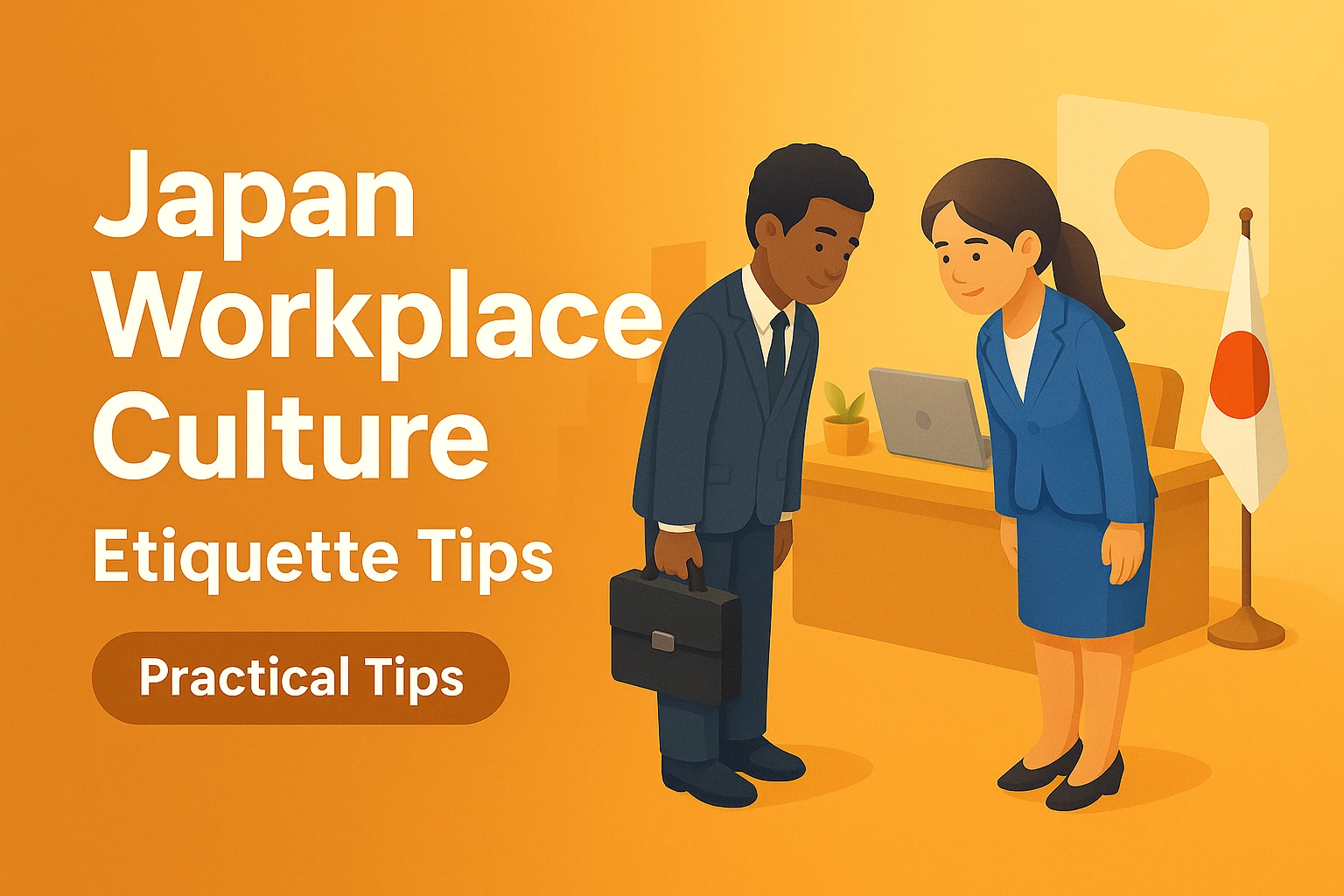
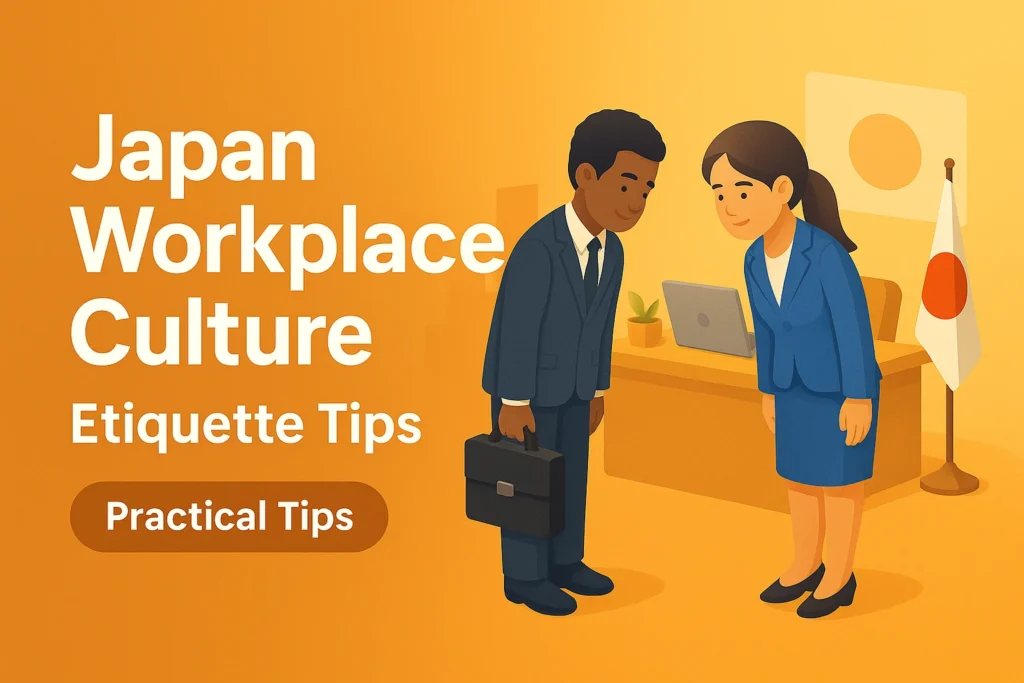
Bowing is still the standard greeting in Japanese business. Some companies also use handshakes, especially with foreigners, but bowing is always safe.
Simple rule:
- Stand straight, hands at your side, bow slightly from the waist.
- For managers or clients, bow a little deeper and hold for a second longer.
If someone offers you a handshake, you can do a light handshake with a small bow at the same time.
Self-introduction
On your first day, you will usually give a short self-introduction (自己紹介 / jikoshōkai). Keep it simple:
“Hajimemashite. I’m Alex Kim from Korea. I joined the marketing team today.
I’m happy to work with you and I’ll do my best. Yoroshiku onegaishimasu.”
“Yoroshiku onegaishimasu” is a very important phrase. It roughly means “Please take care of me / let’s work well together.”
Business Card Etiquette in Japan
If your job involves clients or partners, you will use business cards (meishi). In Japan, exchanging cards is a small ceremony that shows respect.
Basic rules:
- Carry clean cards in a proper card holder, not loose in your pocket.
- When giving your card:
- Stand up, face the person, and bow lightly.
- Hold your card with both hands, text facing the other person.
- When receiving their card:
- Take it with both hands.
- Look at the name and title for a moment, and say something like “Arigatō gozaimasu.”
- Do not write on it, fold it, or put it in your back pocket.
During a meeting, keep important cards on the table in front of you so you can remember names and positions.
If you work with many clients, you might like Japanese Business Card Etiquette for Foreigners.
Punctuality and Time Etiquette
Japan is famous for extreme punctuality. Trains, meetings, and schedules are all expected to be on time.
General rules
- Arrive 10–15 minutes early for important meetings.
- For normal work start time, aim to be at your desk a few minutes before.
- If you will be late (even by 5–10 minutes), send a message or call as soon as you know.
If you are late because of a train delay, people will usually understand, but it is still polite to apologize briefly when you arrive.
Time and deadlines
Japanese coworkers may avoid saying “no” directly, but missed deadlines can cause serious stress for the team. When you get a task:
- Confirm the due date and time.
- If you realize you cannot finish in time, tell your manager as early as possible.
- Suggest a realistic new time and propose what you can finish first.
This shows respect for other people’s schedules and helps keep trust.
Communication Style in Japanese Workplaces
Even in global companies, many Japanese coworkers use a more indirect communication style than in Western countries.
Indirect and polite language
People often avoid strong words like “no,” “impossible,” or “you are wrong.” Instead they might say:
- “It might be difficult.”
- “Maybe we need to think more.”
- “That could be challenging for the client.”
These phrases can actually mean “no” or “we really should not do this.” As you gain experience, you will learn to “read the air” (空気を読む / kūki o yomu) – to understand the meaning behind soft words and silence.
Email and chat etiquette
In email and chat tools (Slack, Teams, etc.):
- Start with a greeting like “Otsukaresama desu. This is Alex from marketing.”
- Be clear and polite, but not too casual with seniors or clients.
- Use short paragraphs and bullet points for easy reading.
- End with “Yoroshiku onegaishimasu” or “Thank you in advance.”
If you work mainly in English, people may be more relaxed, but keeping a polite, calm tone is still important.
Giving opinions and feedback
In many Japanese teams, the meeting is not the real place where decisions are made. Often, people talk informally before the meeting to build consensus (this is called nemawashi).
Tips:
- Share your ideas with your manager or close coworkers privately before a big meeting.
- In meetings, give your opinion clearly but calmly, and show that you listened to others.
- If you disagree, focus on the idea, not the person:
- “I see your point. Maybe we can also consider…”
Meetings and Seating Etiquette
Meetings in Japan can feel formal, even for simple topics. Understanding basic rules will help you relax.
Seating order
In many meeting rooms:
- The seat farthest from the door is for the most senior person.
- Seats closer to the door are for junior staff.
If you are not sure where to sit, wait for your manager to show you, or choose a modest seat closer to the door.
During the meeting
- Come prepared with documents and notes.
- Avoid interrupting others. Wait for a natural pause.
- Keep your phone silent and off the table during serious meetings.
- Take notes, even if you will get slides later; it shows interest.
When the meeting ends, people often say “Otsukaresama deshita” (“Thank you for your hard work”) to everyone before leaving the room.
Dress Code and Professional Appearance
Dress expectations depend on the type of company, but in general, Japanese workplaces prefer a clean, modest, and conservative style.
Traditional corporate offices
For many banks, manufacturers, and traditional firms:
- Dark suit (black, navy, or dark gray)
- White or light-colored shirt
- Simple tie for men
- Minimal jewelry and perfume
- Neat hair and clean shoes
More casual or global companies
Tech companies and creative industries may allow:
- Smart casual (chinos, simple shirts, clean sneakers)
- No tie, sometimes no jacket
Even in casual offices, avoid:
- Very bright or flashy clothes
- Deep necklines or very short skirts/shorts
- Slippers or beach-style sandals
If you are unsure, dress slightly more formal during your first week. Then adjust after you see what coworkers wear.
Quick Comparison: Japanese vs Western Workplace Norms
Here is a simple table to see some typical differences. These are general trends, not strict rules.
| Topic | Many Japanese workplaces | Many Western workplaces |
|---|---|---|
| Main value | Group harmony and consensus | Individual initiative and results |
| Punctuality | Very strict; arrive early | Important, but small delays sometimes tolerated |
| Communication | Indirect, polite, “read the air” | More direct and explicit |
| Hierarchy | Strong; seniority and age matter | Flatter; performance matters more than age |
| Overtime | Often common, though slowly improving | Depends on company; work–life balance often stressed |
| Meetings | Formal, structured, consensus-focused | More open debate and fast decisions |
| Criticism | Usually private and gentle | More direct feedback is common |
Understanding these patterns will help you adapt without feeling that something is “wrong” with you or your colleagues.
Overtime, Drinking Parties and Social Events
Overtime culture
Historically, Japanese companies had a strong overtime culture, and staying late was a sign of commitment. Today, many firms are trying to reduce long hours, but you may still see coworkers working late.
Tips for foreign employees:
- Do not run out of the office exactly at closing time every day from your first week.
- Watch your team: what is the normal pattern?
- If you must leave earlier than others, explain briefly to your manager and say “Otsukaresama desu” on the way out.
Remember: you still have legal rights around working hours and overtime pay. For details, see Labor Laws in Japan: 10 Rights Foreign Workers Should Know.
Nomikai (drinking parties)
After-work drinking parties, called nomikai, are used to relax and build relationships. They are less formal than meetings, but some etiquette still applies:
- Try to join sometimes, especially early in your employment.
- Do not pour your own drink first; pour for others near you, then they will pour for you.
- It is okay not to drink alcohol. You can order soft drinks and still join.
- Private topics usually stay private; people may speak more openly than in the office.
If you feel tired, you can leave the second party (二次会 / nijikai) and say something like, “Thank you very much. I had a great time, but I need to go home now.”
For mental balance and health, you may also like Mental Health Tips for Expats in Japan.
Working With Your Manager and Colleagues
Senpai–kohai relationships
Japanese offices often use senpai (senior) and kohai (junior) relationships. A senpai is not only older; it can also be anyone who joined the company earlier than you.
Your senpai might:
- Teach you daily tasks
- Introduce you to other teams
- Give informal advice on unspoken rules
Showing respect to your senpai is important, but they are also expected to support you.
Talking to your manager
Many managers prefer that you:
- Share problems early, not at the last minute
- Bring not only problems, but also possible solutions
- Keep them updated on progress without being asked every time
In Japan, your manager is often evaluated partly based on their team’s stability. If you communicate well, you make their job easier, and they will usually support you more.
For workers under special programs, such as trainees, understanding both etiquette and rights is important. If that is your case, see Technical Intern Training (TITP) Program Guide: How Vietnamese & Filipino Workers Can Work in Japan.
Remote Work and Hybrid Offices in Japan
Since the pandemic, more companies in Japan use remote or hybrid work, especially in IT and global firms. But Japanese culture still influences online behavior.
Tips for online etiquette:
- Join online meetings a few minutes early.
- Turn your camera on if others do, unless there is a clear reason not to.
- Mute yourself when not speaking, but nod or react so people know you are listening.
- Use polite language in chat tools and avoid heavy sarcasm, which can be misunderstood.
Even when you work from home, showing that you are reliable, reachable, and respectful keeps trust high.
Useful Japanese Phrases for Workplace Etiquette
You do not need perfect Japanese to be polite. A few phrases go a long way:
- Ohayō gozaimasu – Good morning (in the office)
- Otsukaresama desu / deshita – Thank you for your hard work
- Shitsurei shimasu – Excuse me (when entering/leaving a room)
- Itadakimasu – Said before eating
- Gochisōsama deshita – Said after eating
- Arigatō gozaimasu – Thank you
- Sumimasen – Excuse me / I am sorry / Thank you (polite catch-all)
- Mō ichido onegaishimasu – One more time, please
- Yoroshiku onegaishimasu – Please treat me kindly / I look forward to working with you
If you work in English but show effort in Japanese, most coworkers will appreciate it. For more language help, see Survival Japanese for Working in Japan.
Handling Culture Shock and Problems at Work
Even if you prepare well, you may feel culture shock: confusion, frustration, or loneliness. This is normal.
Healthy ways to manage it:
- Talk with other foreign coworkers; they probably had similar experiences.
- Ask polite questions when you do not understand a rule.
- Keep hobbies outside work (sports, clubs, language exchange).
- Take care of your sleep, food, and exercise.
If you experience serious problems such as harassment, unsafe work, or unpaid overtime, remember that etiquette does not mean you must accept illegal or abusive behavior. In that case, read Labor Laws in Japan: 10 Rights Foreign Workers Should Know.
Final Thoughts: Finding Your Own Balance
Workplace culture in Japan can feel strict at first, but it is built on simple ideas: respect, harmony, and responsibility. When you:
- Greet people warmly
- Arrive on time
- Show respect for hierarchy
- Communicate politely and clearly
- Make an effort to understand local customs
…you will already be doing better than many new foreigners.
Remember, nobody expects you to be perfect. Most Japanese coworkers know that their culture is complex. They will forgive mistakes if they see your sincere effort. Over time, you will find a comfortable balance between being yourself and adapting to Japanese work style.
Disclaimer
This article is for general informational purposes only and does not constitute professional advice. Laws, prices and regulations vary by location and change over time. Consult a qualified professional for guidance on your specific situation.