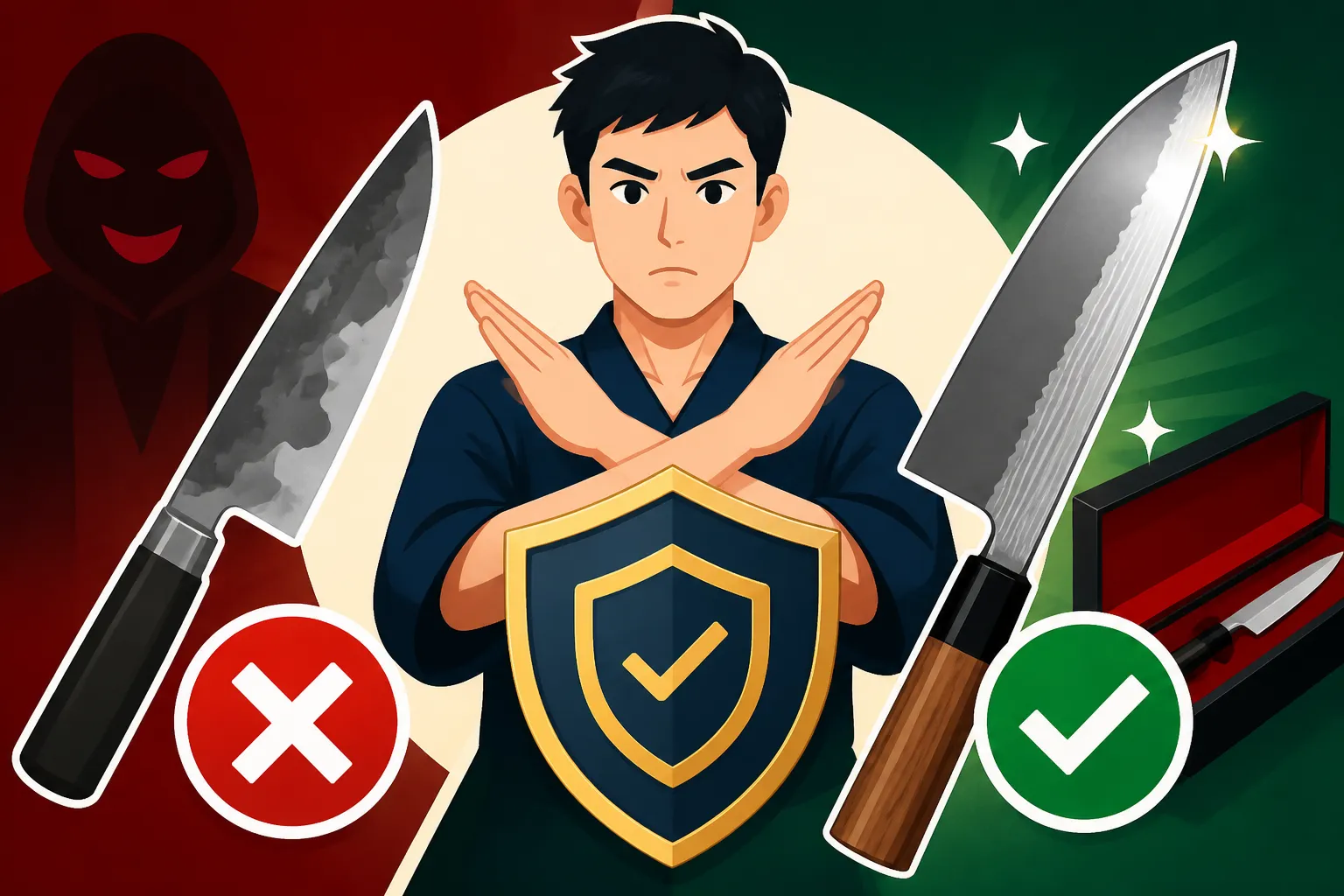
How to Avoid Fake Japanese Knives Online
Disclosure: This article contains affiliate links. If you buy through them, we may earn a commission at no extra cost to you. Read our full disclosure.
Nothing stings quite like spending hard-earned yen on what you think is a master-crafted Sakai blade, only to realize you have been shipped a mass-produced piece of scrap metal from a generic factory overseas. This guide is here to end the confusion by exposing the deceptive marketing tactics used by online scammers and showing you exactly how to identify an authentic Japanese knife before you hit the checkout button.
The Rise of the Japanese-Style Marketing Trap
When you first move to Japan or start diving into the world of Japanese culinary tools, you are quickly inundated with advertisements for "Damascus steel" and "Samurai-sharp" blades. The reality of the modern market is that there is a massive industry built around "Japanese-style" knives that have absolutely no connection to Japan. These are often dropshipped products, manufactured in large quantities with low-grade steel, and then laser-etched with patterns to mimic the look of traditional craftsmanship.
The frustration for many foreigners is that these companies use beautiful photography and emotional storytelling about "ancient traditions" to justify a high price point. Some enthusiasts pay 30,000 yen for a set that actually costs less than 2,000 yen on wholesale sites. To avoid this, you must understand that "Japanese-style" is a design term, not a geographical or quality guarantee. An authentic blade is defined by its steel source, the blacksmith's lineage, and the specific region of production, such as Seki or Sakai.
If you are just starting your collection, you might find it helpful to read about Japanese vs Western Knives: Which Is Right for Your Kitchen? to understand what features you should actually be looking for. Authentic knives focus on performance and edge retention, while fakes focus almost entirely on the visual pattern of the blade to catch your eye on social media.
The Misuse of the Damascus Label
The most common bait used by online scammers is the word "Damascus." In the authentic Japanese knife world, Damascus refers to the layering of different steels to create a beautiful, swirling pattern. However, on fake knives, this "pattern" is often just a surface-level laser etching or an acid-wash that will rub off over time. Authentic Damascus is part of the structural integrity of the knife, not just a tattoo on the side of the blade.
When you look at a high-quality knife from a reputable seller like Hocho-Knife, the Damascus pattern will be subtle and have a physical texture that matches the layers of the steel. If the pattern looks too perfect, too dark, or repeated identically across several knives in a set, it is almost certainly a fake. For a deeper dive into why this matters, you can explore whether Are Damascus Knives Just for Looks? to help you decide if you really need the aesthetic or if you should focus on a simpler, higher-performance steel.
Deceptive Geographical Claims
Another major red flag is the phrase "Japanese Steel." Companies will often claim their knives are made with "Japanese 7CR17MOV steel." Here is the catch: 7CR17MOV is a Chinese steel grade. While it can be a decent budget steel, calling it "Japanese" is a blatant lie designed to trick people who recognize that Japan produces some of the world's best metallurgy. Authentic Japanese knives will almost always specify the exact type of steel used, such as VG-10, SG2, or the traditional Shirogami and Aogami series.
It is advisable to look for the specific city of origin. If a website says "Made in Japan" but cannot tell you if it came from Sakai, Seki, Sanjo, or Echizen, you should be very suspicious. Each of these regions has a distinct history and set of standards. For instance, understanding Sakai Knives: The Heritage of Japan's Knife City can give you a baseline of what a truly premium, handcrafted blade looks like compared to a generic factory imitation.
Red Flags in Online Listings and Social Media Ads
Scammers love social media because they can target people who have expressed a passing interest in cooking or Japanese culture. Their ads usually follow a specific template: a dramatic video of a knife cutting through a tomato or a piece of paper, followed by a "limited time" discount of 50% or 70% off. Real Japanese knives rarely go on such deep discounts because the margins for handcrafted work are quite slim.
Another red flag is the brand name itself. If the brand sounds like a generic Japanese word that doesn't correspond to a known blacksmith or a historical company, do your research. Many of these "brands" are created overnight. They might use a name that sounds vaguely like a Japanese surname but has no physical address in Japan. In contrast, brands like FN Sharp or those carried by Hocho-Knife have transparent histories and clear manufacturing processes.
The Problem with Knife Sets
In the authentic Japanese knife world, it is quite rare to buy a massive 7-piece or 10-piece set in a wooden block. Traditional Japanese chefs and collectors usually buy their knives one by one, choosing the specific blade for the specific task. Scammers love sets because they can offer a "massive value" that seems too good to pass up.
If you see a full set of "Damascus" knives for $150, you are looking at a fake. A single, authentic handcrafted Gyuto can easily cost that much on its own. For those looking for their first real piece, I suggest looking at the Best First Japanese Knife for Beginners instead of wasting money on a set of seven mediocre blades that will lose their edge in a week.
Analyzing the Marketing Language
Pay close attention to the adjectives used. If the copy is full of words like "Indestructible," "Military Grade," or "Ancient Samurai Secret," you are likely dealing with a marketing firm, not a knife maker. Real Japanese blacksmiths talk about HRC (Rockwell Hardness), bevel angles, and the specific characteristics of the heat treatment.
The focus of companies like FN Sharp is on the actual utility and the sharpening service they provide, which is a hallmark of a brand that stands behind its product. They won't tell you the knife was forged in the fires of a volcano; they will tell you it uses premium VG-10 steel and has a specific edge geometry designed for precision.
Technical Indicators of Authenticity
If you have the knife in your hand or can see high-resolution photos, there are technical details that fakes almost always get wrong. The most prominent is the "cladding line." Most Japanese knives are made with a hard core steel sandwiched between layers of softer stainless steel. Where these layers meet, there is a visible, wavy line called the "kiriha." On a fake knife, this line is either missing or is perfectly straight because the knife is made from a single sheet of cheap metal.
Another indicator is the handle construction. Authentic "Wa-handles" (traditional D-shaped or octagonal wooden handles) are usually made of ho wood, cherry, or ebony with a horn or plastic ferrule. They are light and balanced toward the blade. Fake knives often use heavy, cheap plastic that mimics the look of wood but feels "off" in the hand. If the balance is heavily toward the handle, it’s a sign that the blade is thin and low-quality.
| Feature | Authentic Japanese Knife | Fake / Imitation Knife |
|---|---|---|
| Steel Type | Specific (VG-10, Blue #2, SG2, etc.) | Vague (Japanese Steel, 7CR17) |
| Damascus Pattern | Part of the steel layers, subtle | Laser-etched, dark, repetitive |
| Cladding Line | Visible, wavy line near the edge | Non-existent or perfectly straight |
| Weight | Balanced, often surprisingly light | Heavy or feels like "pot metal" |
| Price | ~12,000 JPY to 100,000+ JPY | Often 2,000 JPY to 8,000 JPY |
| Marketing | Technical, focused on maker | Emotional, focused on "Samurai" |
Understanding Steel Specs
When you shop at a place like Hocho-Knife, the product descriptions are a masterclass in transparency. You will see the specific carbon content and the hardness rating. Authentic Japanese knives are usually quite hard, ranging from 60 to 64 on the Rockwell scale. This allows them to hold a very thin, sharp edge. Fakes are much softer (usually 54-56 HRC), which means they will go dull almost immediately after use.
If you are confused by the technical jargon, I highly recommend reading White Steel (Shirogami) vs Blue Steel (Aogami) Explained. Knowing the difference between these steels is your best defense against scammers. If a seller can't tell you if their carbon steel is White or Blue, they don't know what they are selling, or they are lying.
The Grind and the Bevel
Traditional Japanese knives often have a single bevel or a very specific 70/30 or 50/50 double bevel. The grind should be consistent and smooth. On fake knives, the factory grind is often uneven, and the "out of the box" sharpness is achieved through a rough, jagged edge that looks okay under a magnifying glass but tears through food rather than slicing it.
The level of finish on the spine and the "choil" (the part of the blade where it meets the handle) is another giveaway. Authentic makers take the time to smooth and polish these areas so they are comfortable for the user. Fake knives often have sharp, unfinished edges in these spots because smoothing them requires manual labor that doesn't fit the mass-production model.
Trusted Sources and Buying Strategies
The best way to avoid a fake is to buy from established retailers who have a direct relationship with Japanese blacksmiths. Hocho-Knife is one of the most trusted names for expats and international buyers because they offer an incredible range of verified makers. They provide the provenance for every blade, so you know exactly which workshop in Seki or Sakai produced your knife.
Another great option is FN Sharp, which focuses on providing high-quality, authentic Japanese steel with a modernized approach to maintenance. They bridge the gap between traditional quality and the needs of a modern home cook who might be intimidated by the upkeep of a high-carbon blade.
Vetting a New Website
If you find a new website and aren't sure if it’s legit, look for a physical address. If the "About Us" page is full of stock photos and doesn't mention a specific location in Japan, walk away. Check for reviews on independent platforms, not just the ones hosted on their own site. Scammers frequently delete negative reviews that point out the "Damascus" pattern is just paint.
You should also look at the variety of products. A legitimate knife shop will carry accessories like whetstones and specialized tools. If they only sell "miracle knives" and nothing else, it's a red flag. Real enthusiasts know that How to Sharpen and Care for Japanese Knives: The Complete Guide is just as important as the knife itself, and a real shop will support that journey.
Regional Vetting
If a knife claims to be a "Seki" knife, look for the official mark of the Seki Cutlery Association. This region is famous for its history of sword making and now produces some of the world's most consistent cutlery. Learning about Seki City Knives: History and Top Makers will help you recognize the names of legitimate factories like Misono or Honsho that actually operate in that area.
If you are looking for something truly unique, you might want to explore Best Handmade Japanese Knives from Independent Blacksmiths. These are knives made by individual artisans, often with a waitlist. These are almost never faked because the cost of replicating the specific hammer marks and "Kurouchi" finishes of a master blacksmith is too high for scammers.
Long-Term Maintenance and Value
An authentic Japanese knife is an investment that can last a lifetime if cared for properly. This is the biggest difference between a real blade and a fake one. A fake knife will eventually lose its "etched" pattern, its handle will wobble, and it will never take a truly sharp edge again once the initial factory burr is gone.
An authentic knife, however, actually gets better with age. As you sharpen it on a whetstone, you learn the geometry of the blade. The steel responds to your touch. If you decide to go with a high-end option, it's worth checking the Best Japanese Knife Brands for Each Budget Tier to ensure you are getting the best value for your specific price point.
Why Authenticity Matters for Safety
It isn't just about the money; it is also about safety. Authentic Japanese knives are designed with specific balance and ergonomics in mind. A fake knife with poor balance can lead to hand fatigue and slips, which are dangerous when the blade is sharp. Furthermore, the materials used in fake handles may not be food-safe or may harbor bacteria if the fit and finish are poor.
When you buy a knife from a reputable brand like Hocho-Knife, you are paying for the peace of mind that the materials are high-grade and the construction is solid. If you are planning to give a knife as a gift, knowing How to Choose a Japanese Knife as a Gift will help you find a piece that is not only beautiful but also a functional tool that the recipient can rely on for years.
Avoiding the "Influencer" Brand
In recent years, many "influencer" brands have popped up where a famous chef or personality puts their name on a knife. In many cases, these are just rebranded generic knives with a 300% markup. Unless the influencer can specify the Japanese blacksmith or factory they are partnering with, treat it with the same skepticism as a random Instagram ad. Stick to the brands that have stood the test of time and the retailers that have physical roots in Japan's knife-making districts. If you ever find yourself in the capital, Buying Japanese Knives in Tokyo: Best Shops is a great starting point for seeing and feeling the difference in person.
Legal and Medical Disclaimer
The information provided in this guide is for educational and informational purposes only. Knives are sharp tools and should be handled with extreme caution. The author and publisher are not responsible for any injuries or damages resulting from the use or misuse of cutlery described herein. Prices and availability of products from third-party retailers are subject to change. Always verify the authenticity of a product directly with the manufacturer or a certified distributor before purchasing. All product names, logos, and brands are property of their respective owners. Use of these names, logos, and brands does not imply endorsement. Information regarding steel composition and hardness is based on general industry standards and may vary by individual maker. Always follow local laws regarding the purchase and carry of knives.